QUESTION IMAGE
Question
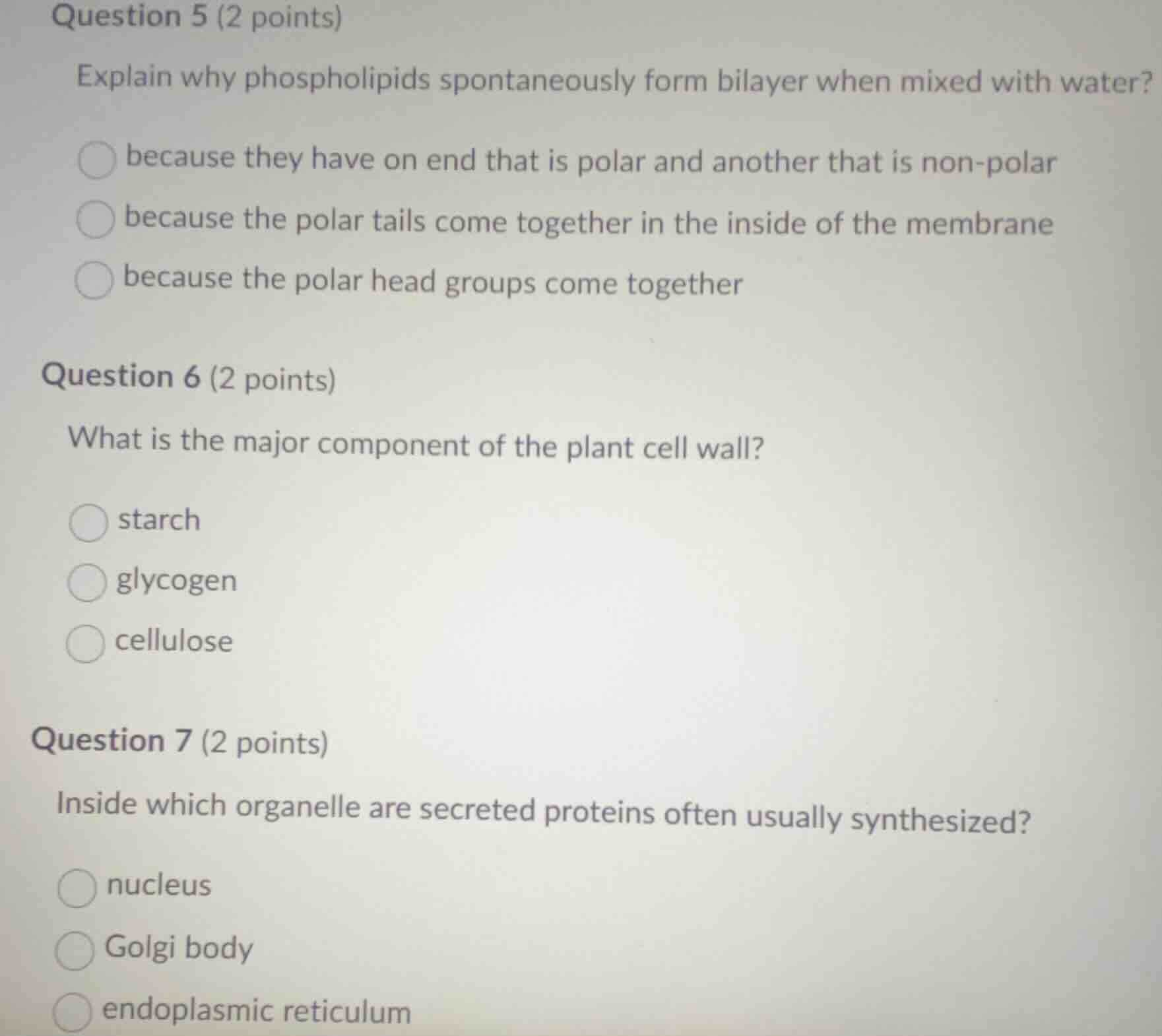
question 5 (2 points)
explain why phospholipids spontaneously form bilayer when mixed with water?
because they have on end that is polar and another that is non - polar
because the polar tails come together in the inside of the membrane
because the polar head groups come together
question 6 (2 points)
what is the major component of the plant cell wall?
starch
glycogen
cellulose
question 7 (2 points)
inside which organelle are secreted proteins often usually synthesized?
nucleus
golgi body
endoplasmic reticulum
Question 5
Phospholipids have a polar (hydrophilic) head and a non - polar (hydrophobic) tail. In water, the polar heads interact with water (hydrophilic interaction) and the non - polar tails avoid water (hydrophobic interaction), leading to the formation of a bilayer. The second option is wrong because phospholipid tails are non - polar. The third option is wrong as the polar head groups interact with water, not come together to form the bilayer.
Starch is a storage polysaccharide in plants. Glycogen is a storage polysaccharide in animals. Cellulose is the major structural component of the plant cell wall, providing rigidity and support.
The nucleus is the control center of the cell, not the site of protein synthesis. The Golgi body is involved in modifying, sorting, and packaging proteins. Secreted proteins are synthesized on ribosomes attached to the endoplasmic reticulum (specifically the rough endoplasmic reticulum).

Snap & solve any problem in the app
Get step-by-step solutions on Sovi AI
Photo-based solutions with guided steps
Explore more problems and detailed explanations
A. because they have one end that is polar and another that is non - polar