QUESTION IMAGE
Question
question 5
1 pts
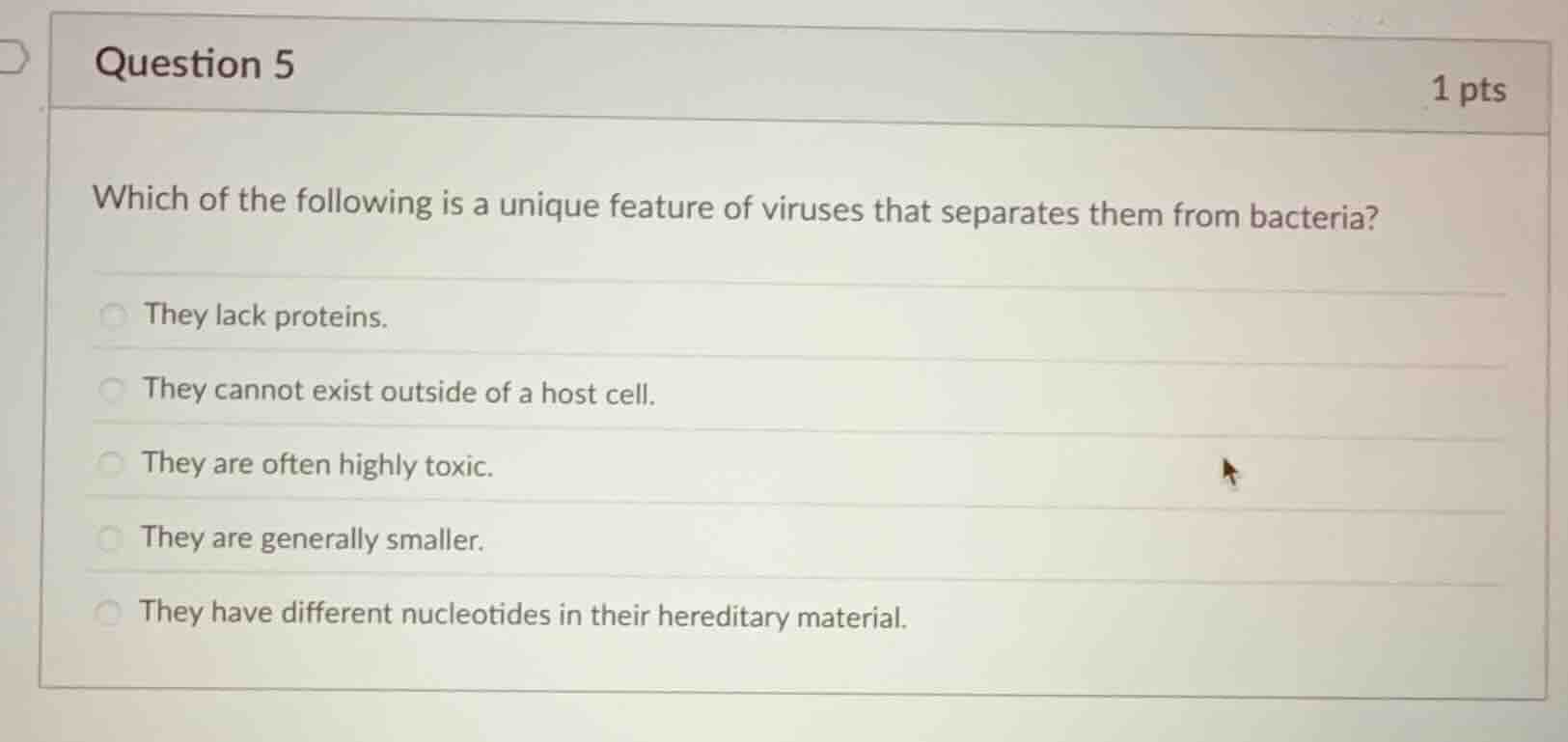
which of the following is a unique feature of viruses that separates them from bacteria?
they lack proteins.
they cannot exist outside of a host cell.
they are often highly toxic.
they are generally smaller.
they have different nucleotides in their hereditary material.
Brief Explanations
- Analyze each option:
- "They lack proteins": Viruses have protein coats (capsids), so this is incorrect.
- "They cannot exist outside of a host cell": Viruses are obligate intracellular parasites, meaning they can't reproduce or carry out metabolic processes outside a host cell. Bacteria can exist and function independently outside a host. This is a key distinguishing feature.
- "They are often highly toxic": Both viruses and bacteria can be toxic, so this isn't unique to viruses.
- "They are generally smaller": While viruses are usually smaller, this is not the most defining or unique feature separating them from bacteria.
- "They have different nucleotides in their hereditary material": Viruses and bacteria can have DNA or RNA (viruses more varied, but bacteria have DNA as main hereditary material, and the nucleotide types (A, T/U, C, G) are similar in terms of the set used, just the nucleic acid type (DNA/RNA) differs, not the nucleotides themselves in a way that's a unique separation).

Snap & solve any problem in the app
Get step-by-step solutions on Sovi AI
Photo-based solutions with guided steps
Explore more problems and detailed explanations
B. They cannot exist outside of a host cell.