QUESTION IMAGE
Question
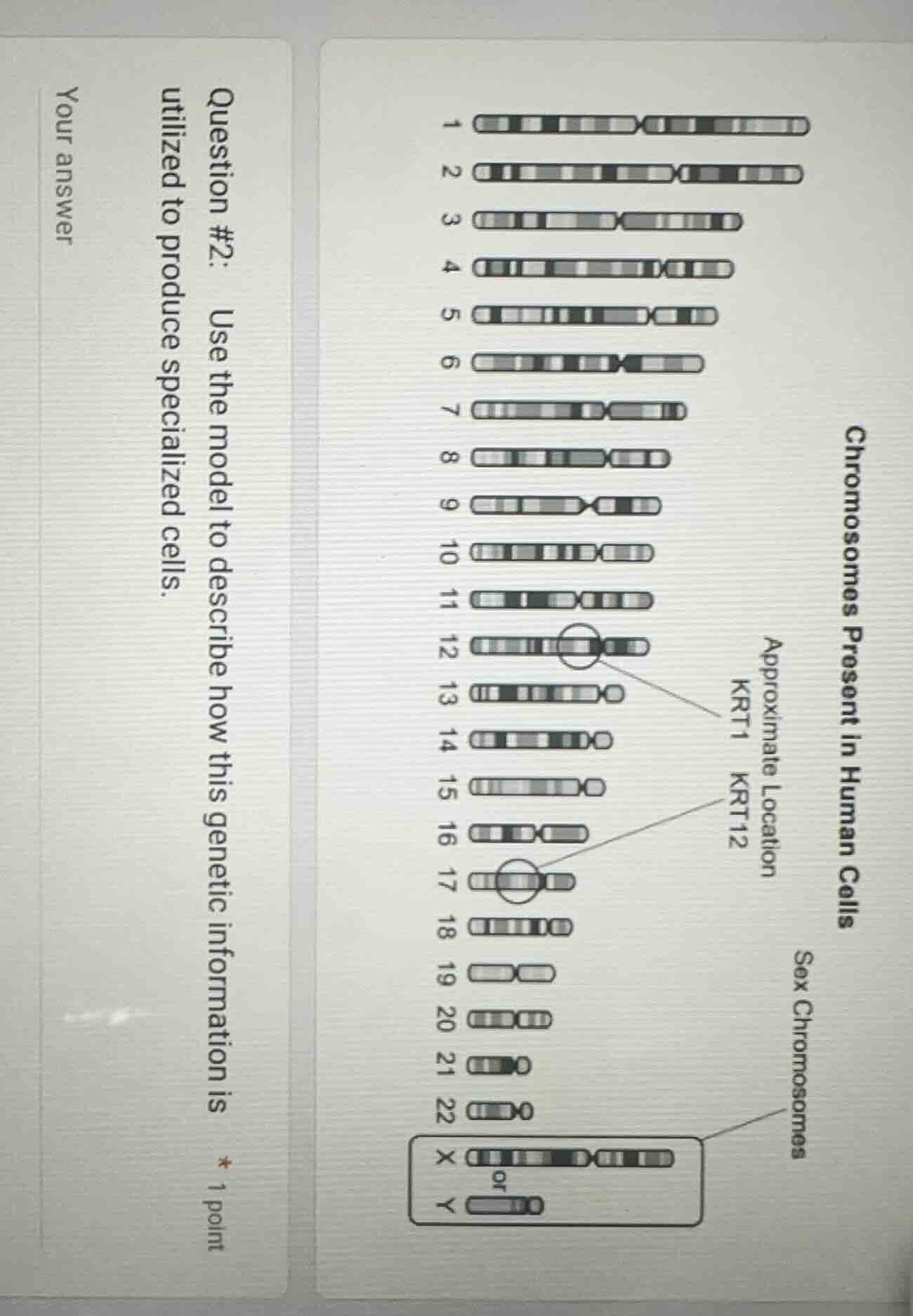
question #2: use the model to describe how this genetic information is utilized to produce specialized cells.
your answer
Brief Explanations
- Transcription: The DNA (containing genes like KRT1, KRT12 on chromosomes) in the nucleus is transcribed into mRNA. Enzymes like RNA polymerase bind to the gene's promoter region, unwind DNA, and synthesize a complementary mRNA strand using one DNA strand as a template. For example, the KRT1 gene on chromosome 12 and KRT12 on chromosome 17 are transcribed into their respective mRNAs.
- RNA Processing (if applicable): The pre - mRNA undergoes modifications like capping (adding a 5' cap), poly - adenylation (adding a 3' poly - A tail), and splicing (removing introns and joining exons) to form mature mRNA.
- Translation: The mature mRNA exits the nucleus and enters the cytoplasm, where it binds to ribosomes. tRNA molecules, carrying specific amino acids, recognize the codons (three - nucleotide sequences) on the mRNA through their anticodons. The ribosome catalyzes the formation of peptide bonds between adjacent amino acids, leading to the synthesis of a polypeptide chain (the protein encoded by the gene). This polypeptide then folds into its functional three - dimensional structure, which is crucial for the cell to become specialized (e.g., if the protein is a keratin, it contributes to the structure and function of epithelial cells).
- Cell Specialization: Different genes are expressed (transcribed and translated) in different cells. The combination of expressed genes (like KRT1 and KRT12 in epithelial - like cells) leads to the production of specific proteins. These proteins interact with the cell's components and environment, driving the cell to differentiate into a specialized cell type with a unique structure and function (e.g., a skin cell with keratin - based structures for protection).

Snap & solve any problem in the app
Get step-by-step solutions on Sovi AI
Photo-based solutions with guided steps
Explore more problems and detailed explanations
- Transcription: DNA (with genes like KRT1, KRT12) in the nucleus is transcribed into mRNA by RNA polymerase, using DNA as a template.
- RNA Processing: Pre - mRNA is modified (capping, poly - A tail, splicing) to form mature mRNA.
- Translation: Mature mRNA in the cytoplasm binds to ribosomes; tRNA brings amino acids, and a polypeptide (protein) is synthesized based on mRNA codons.
- Cell Specialization: Differential gene expression (of genes like KRT1, KRT12) produces specific proteins, leading to specialized cell structures/functions.