QUESTION IMAGE
Question
questions:
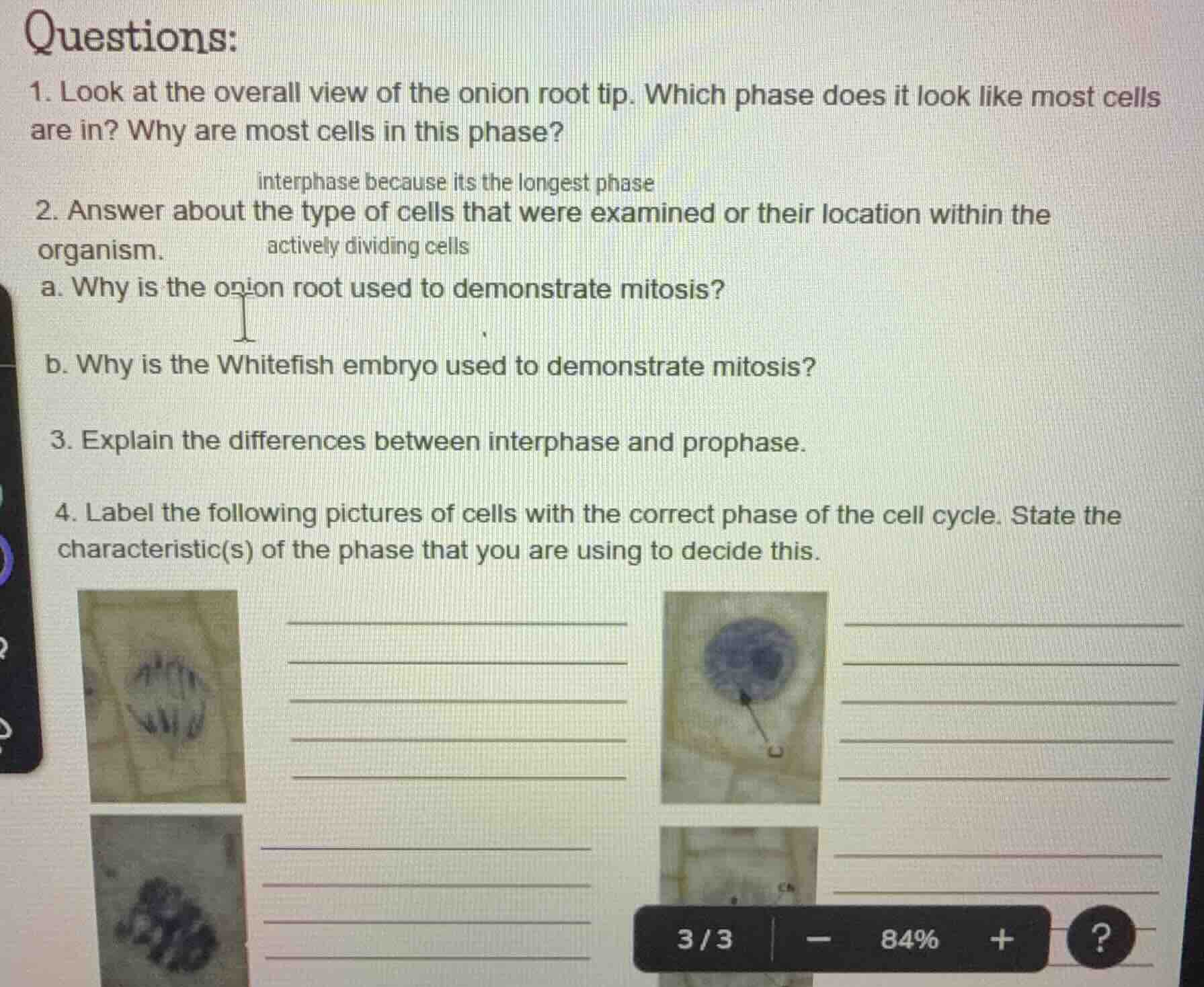
- look at the overall view of the onion root tip. which phase does it look like most cells are in? why are most cells in this phase?
interphase because its the longest phase
- answer about the type of cells that were examined or their location within the organism. actively dividing cells
a. why is the onion root used to demonstrate mitosis?
b. why is the whitefish embryo used to demonstrate mitosis?
- explain the differences between interphase and prophase.
- label the following pictures of cells with the correct phase of the cell cycle. state the characteristic(s) of the phase that you are using to decide this.
Question 1
Most cells in the onion root tip are in interphase. The cell cycle has interphase (G₁, S, G₂) and mitotic phase (M). Interphase is the longest phase as the cell grows, replicates DNA, and prepares for division. So statistically, more cells are caught in interphase when observing a snapshot of the root tip (where cells are actively dividing, but interphase duration > mitotic phases).
Onion root tips have a meristematic region (apical meristem) with cells that are actively dividing (undergoing mitosis frequently). The root tip is easy to obtain, prepare for microscopy, and the cells are large/clear for observing chromosome movements during mitosis. Also, plant cells have a rigid cell wall, making the stages of mitosis (like metaphase plate alignment) more distinct visually.
Whitefish embryos are used because they are in a stage of rapid development (embryonic growth), so their cells are actively undergoing mitosis (many cells in mitotic phases). Animal cells (like whitefish embryo cells) also show mitosis clearly, and the blastula (embryonic stage) has a single layer of cells, making it easy to view individual cells. The chromosomes in whitefish cells are large and distinct, aiding in observing mitotic stages (e.g., spindle fibers, chromosome separation).

Snap & solve any problem in the app
Get step-by-step solutions on Sovi AI
Photo-based solutions with guided steps
Explore more problems and detailed explanations
Most cells are in interphase. Because interphase is the longest phase of the cell cycle (cells spend more time growing, replicating DNA, and preparing for division than in the shorter mitotic phases), so in a random view of the root tip, most cells appear to be in interphase.