QUESTION IMAGE
Question
4.8 quiz: photosynthesis - an overview
submissions enabled
questions 1-8 of 8 | page 1 of 1
question 1 (1 point)
vernon is using the diagram shown below to develop a model of
photosynthesis. the letters a, b, and c each represent a reactant or
product of the process.
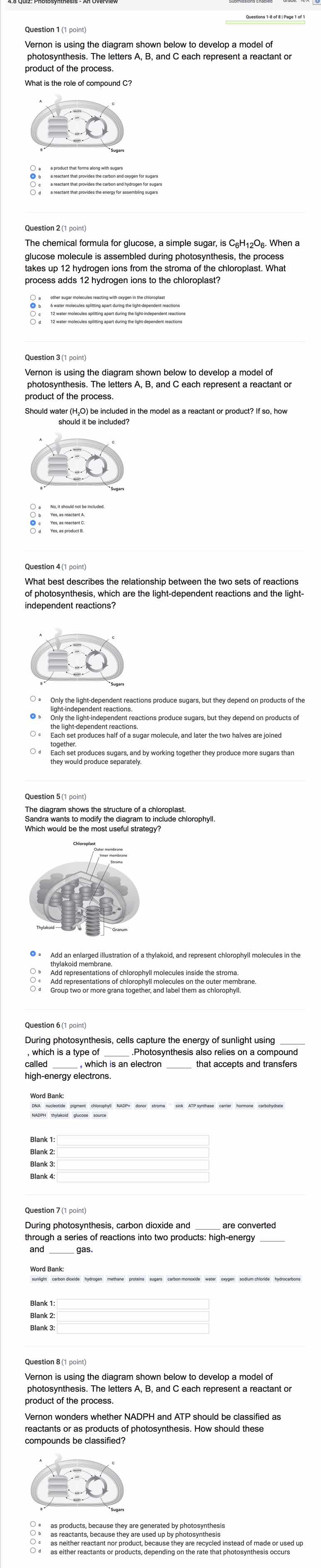
what is the role of compound c?
(image of chloroplast diagram with a, b, c labels and sugars)
options:
a a product that forms along with sugars
b a reactant that is used up by photosynthesis
c a reactant that provides the carbon and oxygen for sugars
d a reactant that provides the energy for assembling sugars
question 2 (1 point)
the chemical formula for glucose, a simple sugar, is c₆h₁₂o₆. when a
glucose molecule is assembled during photosynthesis, the process
takes up 12 hydrogen ions from the stroma of the chloroplast. what
process adds 12 hydrogen ions to the chloroplast?
options:
a other sugar molecules reacting with oxygen in the chloroplast
b 6 water molecules splitting apart during the light - dependent reactions
c 12 water molecules splitting apart during the light - independent reactions
d 12 water molecules splitting apart during the light - dependent reactions
question 3 (1 point)
vernon is using the diagram shown below to develop a model of
photosynthesis. the letters a, b, and c each represent a reactant or
product of the process.
should water (h₂o) be included in the model as a reactant or product? if so, how
should it be included?
(image of chloroplast diagram with a, b, c labels and sugars)
options:
a no, it should not be included.
b yes, as reactant a.
c yes, as reactant c.
d yes, as product b.
question 4 (1 point)
what best describes the relationship between the two sets of reactions
of photosynthesis, which are the light - dependent reactions and the light -
independent reactions?
(image of chloroplast diagram with a, b, c labels and sugars)
options:
a only the light - dependent reactions produce sugars, but they depend on products of the
light - independent reactions.
b only the light - independent reactions produce sugars, but they depend on products of
the light - dependent reactions.
c each set produces half of a sugar molecule, and later the two halves are joined
together.
d each set produces sugars, and by working together they produce more sugars than
they would produce separately.
question 5 (1 point)
the diagram shows the structure of a chloroplast.
sandra wants to modify the diagram to include chlorophyll.
which would be the most useful strategy?
(image of chloroplast structure with outer membrane, inner membrane, stroma, thylakoid, granum labels)
options:
a add an enlarged illustration of a thylakoid, and represent chlorophyll molecules in the
thylakoid membrane.
b add representations of chlorophyll molecules inside the stroma.
c add representations of chlorophyll molecules on the outer membrane.
d group two or more grana together, and label them as chlorophyll.
question 6 (1 point)
during photosynthesis, cells capture the energy of sunlight using ______
, which is a type of ______. photosynthesis also relies on a compound
called ____, which is an electron ____ that accepts and transfers
high - energy electrons.
word bank:
dna, nucleotide, pigment, chlorophyll, nadp⁺, donor, stroma, sink, atp synthase, carrier, hormone, carbohydrate,
nadph, thylakoid, glucose, source
blank 1:
blank 2:
blank 3:
blank 4:
question 7 (1 point)
during photosynthesis, carbon dioxide and ______ are converted
through a series of reactions into two products: high - energy ______
and ______ gas.
word bank:
sunlight, carbon dioxide, hydrogen, methane, proteins, sugars, carbon monoxide, water, oxygen, sodium chloride, hydrocarbons
blank 1:
blank 2:
blank 3:
question 8 (1 point)
vernon is using the diagram shown below to develop a model of
photosynthesis. the letters a, b, and c each represent a reactant or
product of the process.
vernon wonders whether nadph and atp should be classified as
reactants or as products of photosynthesis. how should these
compounds be classified?
(image of chloroplast diagram with a, b, c labels and sugars)
options:
a as products, because they are generated by photosynthesis
b as reactants, because they are used up by photosynthesis
c as neither reactant nor product because they are recycled instead of made or used up
d as either reactants or products, depending on the rate that photosynthesis occurs
Question 1:
Compound C is carbon dioxide ($\text{CO}_2$), which provides the carbon for sugar molecules (glucose, $\text{C}_6\text{H}_{12}\text{O}_6$) and the oxygen in the sugar's carbon-oxygen bonds.
Question 2:
Water splitting (photolysis) in light-dependent reactions releases hydrogen ions, electrons, and oxygen. 12 water molecules split to release 12 hydrogen ions needed for glucose assembly.
Question 3:
Water is a reactant in photosynthesis, used in the light-dependent reactions (represented as A in the diagram, entering the chloroplast to be split).
Question 4:
Light-independent reactions (Calvin cycle) produce sugars, but they require ATP and NADPH, energy carriers made in the light-dependent reactions.
Question 5:
Chlorophyll is embedded in the thylakoid membranes of the grana, so adding it to an enlarged thylakoid membrane illustration is correct.
Question 6:
Chlorophyll (a pigment) captures sunlight energy. NADP$^+$ acts as an electron carrier to accept and transfer high-energy electrons.
Question 7:
The photosynthesis equation is $6\text{CO}_2 + 6\text{H}_2\text{O} \xrightarrow{\text{sunlight}} \text{C}_6\text{H}_{12}\text{O}_6 + 6\text{O}_2$. Water is a reactant, sunlight drives the reactions, and sugars are high-energy products.
Question 8:
NADPH and ATP are produced in light-dependent reactions and consumed in light-independent reactions, so they are intermediate compounds, not final products or core reactants.

Snap & solve any problem in the app
Get step-by-step solutions on Sovi AI
Photo-based solutions with guided steps
Explore more problems and detailed explanations
- b. a reactant that provides the carbon and oxygen for sugars
- c. 12 water molecules splitting apart during the light-dependent reactions
- b. Yes, as reactant A.
- b. Only the light-independent reactions produce sugars, but they depend on products of the light-dependent reactions.
- a. Add an enlarged illustration of a thylakoid, and represent chlorophyll molecules in the thylakoid membrane.
- Blank 1: chlorophyll; Blank 2: pigment; Blank 4: carrier
- Blank 1: water; Blank 2: sunlight; Blank 3: sugars
- c. as neither reactant nor product, because they are recycled instead of made or used up