QUESTION IMAGE
Question
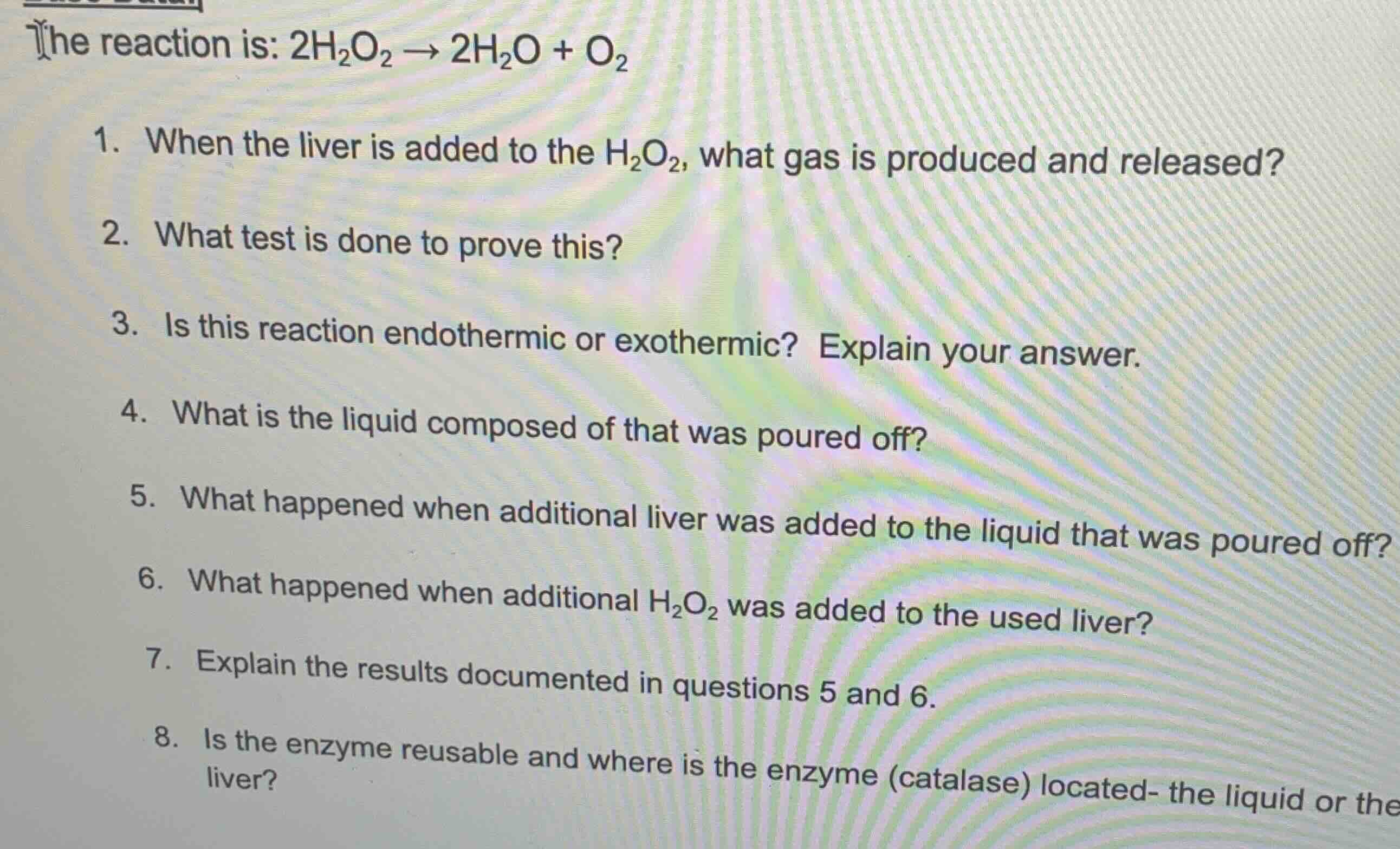
the reaction is: $2\ce{h_{2}o_{2}} \
ightarrow 2\ce{h_{2}o} + \ce{o_{2}}$
- when the liver is added to the $\ce{h_{2}o_{2}}$, what gas is produced and released?
- what test is done to prove this?
- is this reaction endothermic or exothermic? explain your answer.
- what is the liquid composed of that was poured off?
- what happened when additional liver was added to the liquid that was poured off?
- what happened when additional $\ce{h_{2}o_{2}}$ was added to the used liver?
- explain the results documented in questions 5 and 6.
- is the enzyme reusable and where is the enzyme (catalase) located- the liquid or the liver?
Question 1
The reaction given is \(2\text{H}_2\text{O}_2
ightarrow 2\text{H}_2\text{O} + \text{O}_2\). Liver contains the enzyme catalase which speeds up the decomposition of hydrogen peroxide (\(\text{H}_2\text{O}_2\)). From the balanced chemical equation, the gas produced is oxygen (\(\text{O}_2\)).
To test for the presence of oxygen gas, a glowing splint test is used. A glowing splint will relight when inserted into a gas that is oxygen because oxygen supports combustion.
The decomposition of hydrogen peroxide with liver (catalase) releases energy in the form of heat (you can feel the reaction mixture getting warmer). Exothermic reactions release energy (usually heat) into the surroundings, while endothermic reactions absorb energy. Since this reaction releases heat, it is exothermic.

Snap & solve any problem in the app
Get step-by-step solutions on Sovi AI
Photo-based solutions with guided steps
Explore more problems and detailed explanations
Oxygen (\(\text{O}_2\))