QUESTION IMAGE
Question
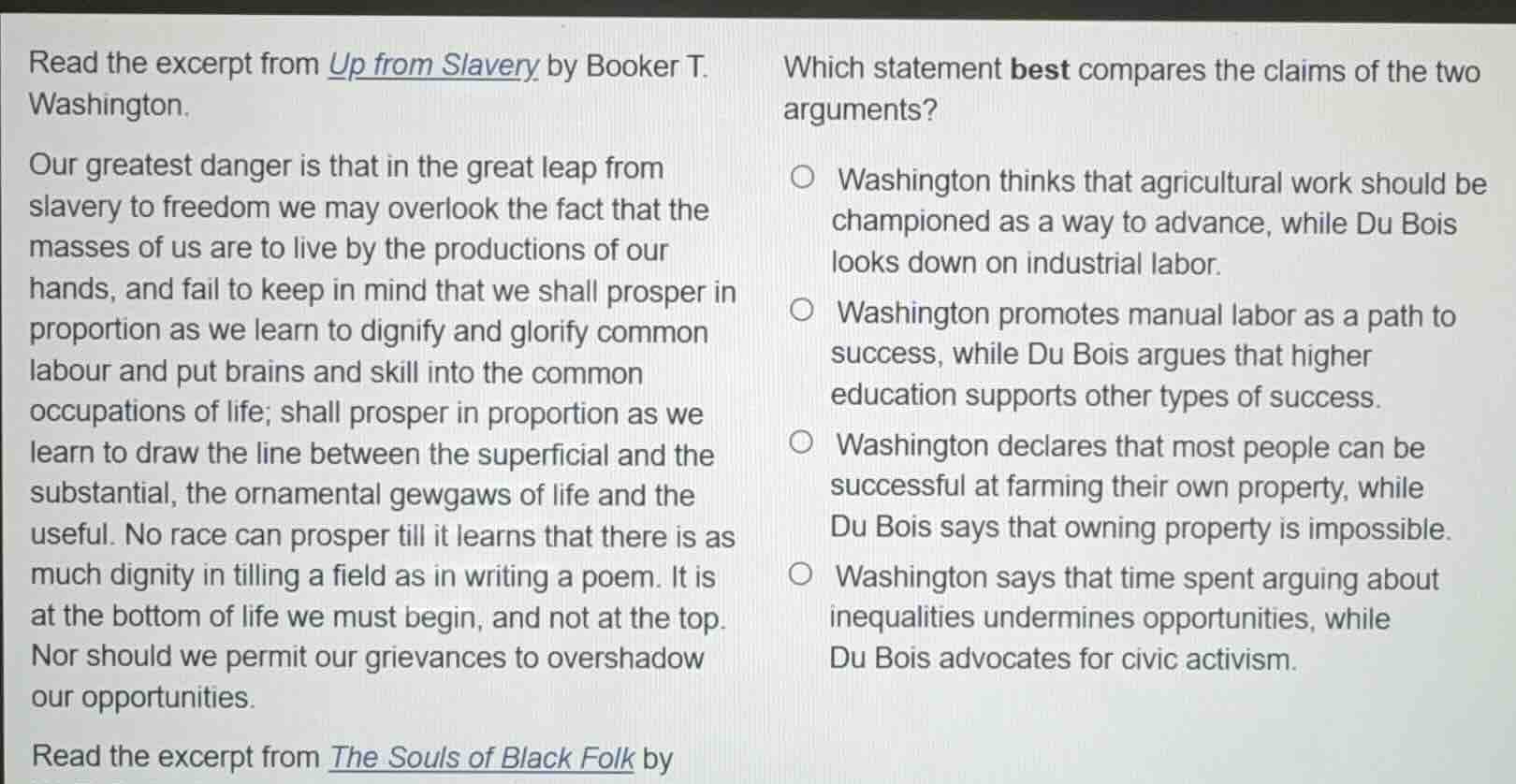
read the excerpt from up from slavery by booker t. washington.
our greatest danger is that in the great leap from slavery to freedom we may overlook the fact that the masses of us are to live by the productions of our hands, and fail to keep in mind that we shall prosper in proportion as we learn to dignify and glorify common labour and put brains and skill into the common occupations of life; shall prosper in proportion as we learn to draw the line between the superficial and the substantial, the ornamental gewgaws of life and the useful. no race can prosper till it learns that there is as much dignity in tilling a field as in writing a poem. it is at the bottom of life we must begin, and not at the top. nor should we permit our grievances to overshadow our opportunities.
read the excerpt from the souls of black folk by
which statement best compares the claims of the two arguments?
○ washington thinks that agricultural work should be championed as a way to advance, while du bois looks down on industrial labor.
○ washington promotes manual labor as a path to success, while du bois argues that higher education supports other types of success.
○ washington declares that most people can be successful at farming their own property, while du bois says that owning property is impossible.
○ washington says that time spent arguing about inequalities undermines opportunities, while du bois advocates for civic activism.
Washington's excerpt emphasizes dignity in common/manual labor as the foundation for Black advancement, starting "at the bottom of life" and prioritizing skill in everyday work. Du Bois, in The Souls of Black Folk, argued that Black progress required access to higher education (the "talented tenth") to develop leadership and professional skills, framing this as a critical path to success alongside (not instead of) labor, but contrasting Washington's focus on manual work. The correct option matches these core claims: Washington promotes manual labor for success, Du Bois argues higher education enables other forms of success. Other options are incorrect: Du Bois did not look down on industrial labor, he did not say property ownership was impossible, and Washington's excerpt does not focus on stopping inequality arguments (it mentions not letting grievances overshadow opportunities, but this is not his core claim compared to labor).

Snap & solve any problem in the app
Get step-by-step solutions on Sovi AI
Photo-based solutions with guided steps
Explore more problems and detailed explanations
Washington promotes manual labor as a path to success, while Du Bois argues that higher education supports other types of success.