QUESTION IMAGE
Question
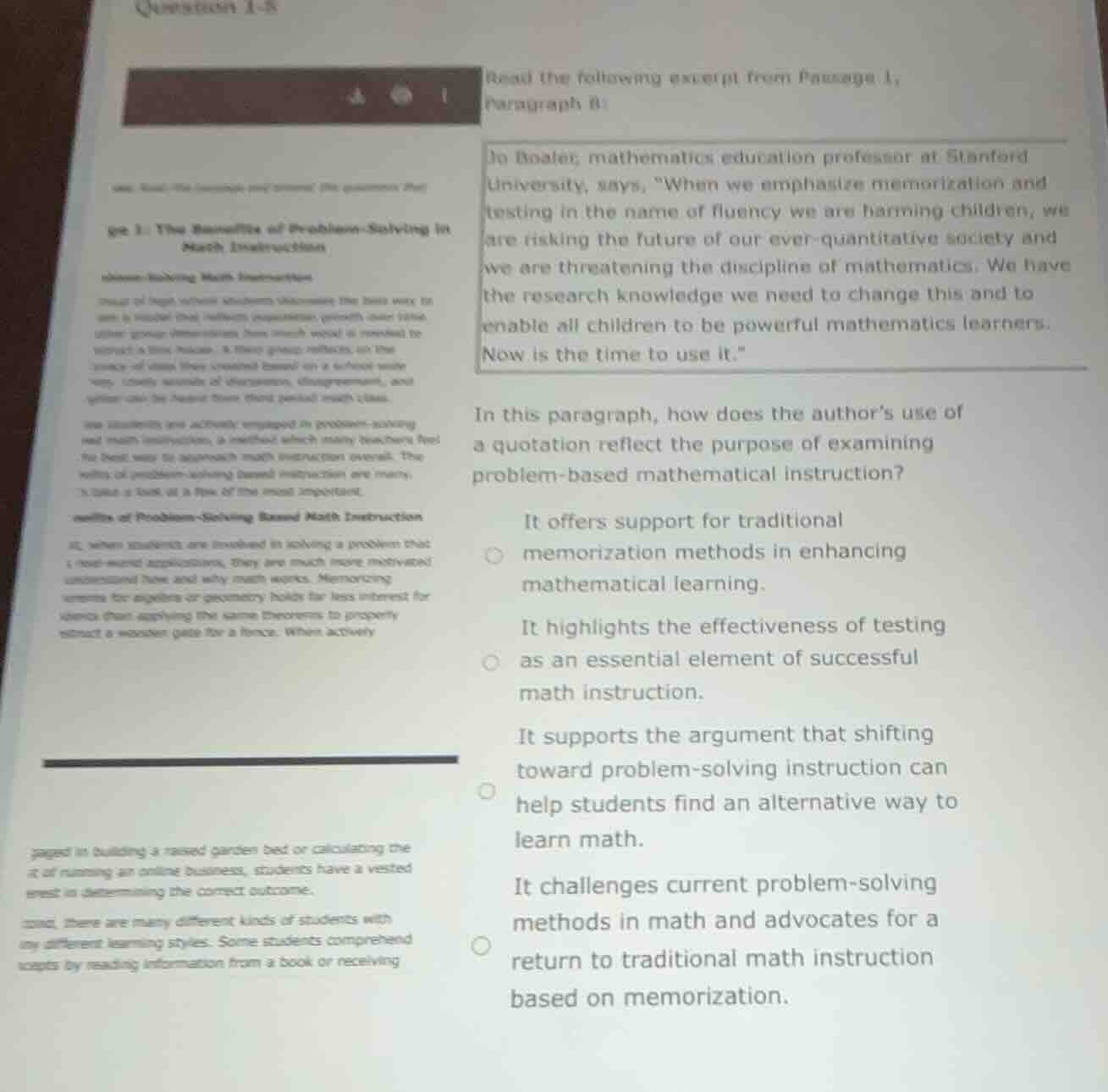
read the following excerpt from passage 1, paragraph 8:
jo boaler, mathematics education professor at stanford university, says, \when we emphasize memorization and testing in the name of fluency we are harming children, we are risking the future of our ever - quantitative society and we are threatening the discipline of mathematics. we have the research knowledge we need to change this and to enable all children to be powerful mathematics learners. now is the time to use it.\
in this paragraph, how does the author’s use of a quotation reflect the purpose of examining problem - based mathematical instruction?
- it offers support for traditional memorization methods in enhancing mathematical learning.
- it highlights the effectiveness of testing as an essential element of successful math instruction.
- it supports the argument that shifting toward problem - solving instruction can help students find an alternative way to learn math.
- it challenges current problem - solving methods in math and advocates for a return to traditional math instruction based on memorization.
- Analyze the quotation: Jo Boaler says emphasizing memorization and testing (traditional methods) is harmful. She argues for using research to shift to problem - based learning to help children be powerful math learners.
- Evaluate each option:
- Option 1: The quotation is against traditional memorization methods, so this is wrong.
- Option 2: The quotation is critical of testing as done in the name of fluency, so this is wrong.
- Option 3: The quotation supports moving from traditional (memorization - based) to problem - solving instruction, which matches the purpose of examining problem - based math instruction.
- Option 4: The quotation is against traditional methods and for problem - solving, so this is wrong.

Snap & solve any problem in the app
Get step-by-step solutions on Sovi AI
Photo-based solutions with guided steps
Explore more problems and detailed explanations
It supports the argument that shifting toward problem - solving instruction can help students find an alternative way to learn math.