QUESTION IMAGE
Question
read this passage about two inherited traits in stick insects.
a stick insect may have solid coloring or stripes on its body. each type of coloring can help an insect blend in with a certain type of leaf. this helps the insect avoid predators, such as birds and lizards.
stick insects with solid green coloring blend in well with wide leaves. on stick insects that have green bodies with white stripes, the stripes make the insects bodies look like thin green ribbons. so these insects blend in well with thin, needle-like leaves.
a stick insect with stripes
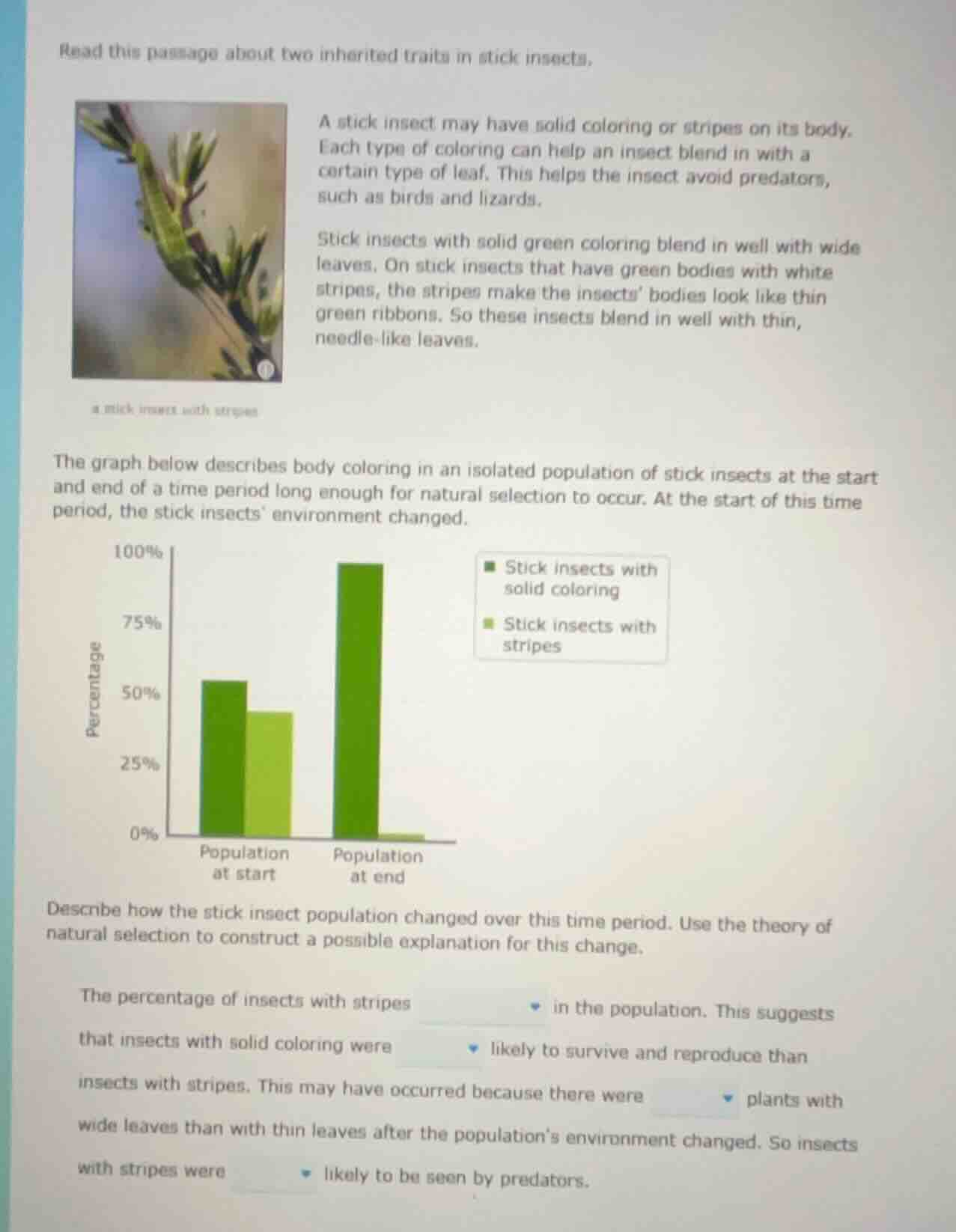
the graph below describes body coloring in an isolated population of stick insects at the start and end of a time period long enough for natural selection to occur. at the start of this time period, the stick insects environment changed.
describe how the stick insect population changed over this time period. use the theory of natural selection to construct a possible explanation for this change.
the percentage of insects with stripes ________ in the population. this suggests
that insects with solid coloring were ________ likely to survive and reproduce than
insects with stripes. this may have occurred because there were ________ plants with
wide leaves than with thin leaves after the populations environment changed. so insects
with stripes were ________ likely to be seen by predators.
- Analyzing the bar graph: at the start, striped insects make up ~45% of the population; at the end, this percentage drops to near 0%, so their proportion decreased.
- Natural selection means traits aiding survival/reproduction become more common. Since solid-colored insects became nearly 100% of the population, they were more likely to survive and reproduce than striped ones.
- The passage states solid-colored insects blend with wide leaves. For solid-colored insects to be favored, the environment must have had more wide leaves than thin, needle-like leaves after the change.
- Striped insects blend with thin leaves. If there were fewer thin leaves, these insects could not camouflage well, making them more likely to be seen and caught by predators.

Snap & solve any problem in the app
Get step-by-step solutions on Sovi AI
Photo-based solutions with guided steps
Explore more problems and detailed explanations
The percentage of insects with stripes decreased sharply in the population. This suggests that insects with solid coloring were more likely to survive and reproduce than insects with stripes. This may have occurred because there were more plants with wide leaves than with thin leaves after the population's environment changed. So insects with stripes were more likely to be seen by predators.