QUESTION IMAGE
Question
read this passage about a variable inherited trait in field mustard plants.
field mustard is a plant species that includes turnips, napa cabbage, and bok choy. like many plants, field mustard reproduces by making flowers that then make seeds.
flowering time, the amount of time between when the plant begins to grow and when it starts to make flowers, can vary among field mustard plants.
in good weather with sufficient rain, plants with longer flowering times can gather more resources and produce more seeds. in harsh, dry weather such as droughts, plants with shorter flowering times are less likely to run out of resources or die before they can produce seeds.
a field mustard plant with flowers
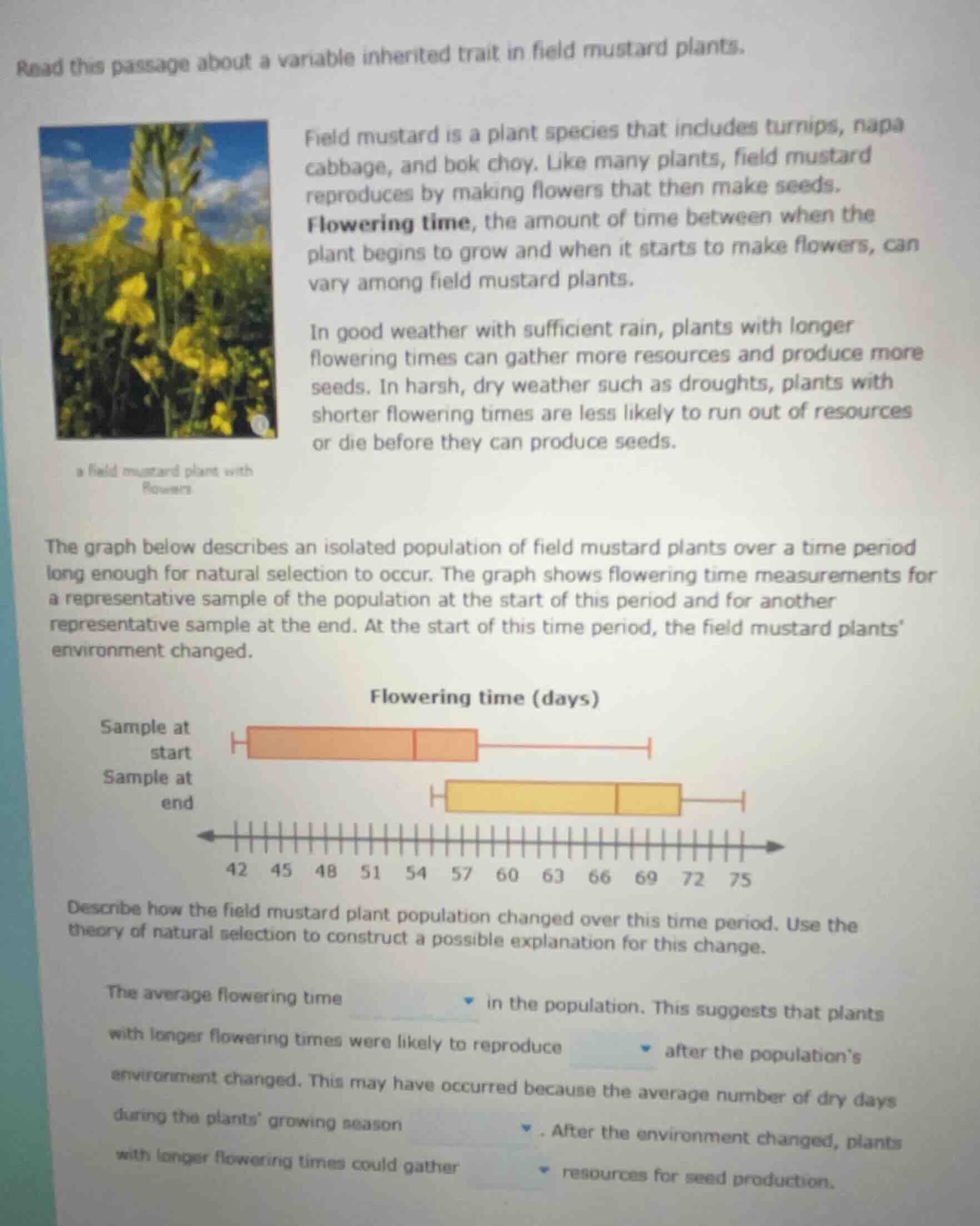
the graph below describes an isolated population of field mustard plants over a time period long enough for natural selection to occur. the graph shows flowering time measurements for a representative sample of the population at the start of this period and for another representative sample at the end. at the start of this time period, the field mustard plants environment changed.
flowering time (days)
sample at start
sample at end
42 45 48 51 54 57 60 63 66 69 72 75
describe how the field mustard plant population changed over this time period. use the theory of natural selection to construct a possible explanation for this change.
the average flowering time in the population. this suggests that plants with longer flowering times were likely to reproduce after the populations environment changed. this may have occurred because the average number of dry days during the plants growing season. after the environment changed, plants with longer flowering times could gather resources for seed production.
- From the box plot, the sample at the start has a lower average flowering time (centered around 54 days) while the sample at the end has a higher average (centered around 69 days), so average flowering time increased.
- Since plants with longer flowering time became more common, they must have reproduced more successfully.
- The passage states shorter flowering time is favorable in dry conditions; the shift to longer flowering time means the environment became less dry, so the number of dry days decreased.
- With fewer dry days (better, wetter conditions), longer-flowering plants could gather more resources as noted in the passage.

Snap & solve any problem in the app
Get step-by-step solutions on Sovi AI
Photo-based solutions with guided steps
Explore more problems and detailed explanations
The average flowering time increased in the population. This suggests that plants with longer flowering times were likely to reproduce more successfully after the population's environment changed. This may have occurred because the average number of dry days during the plants' growing season decreased. After the environment changed, plants with longer flowering times could gather more resources for seed production.