QUESTION IMAGE
Question
read the passage. then answer the question below.
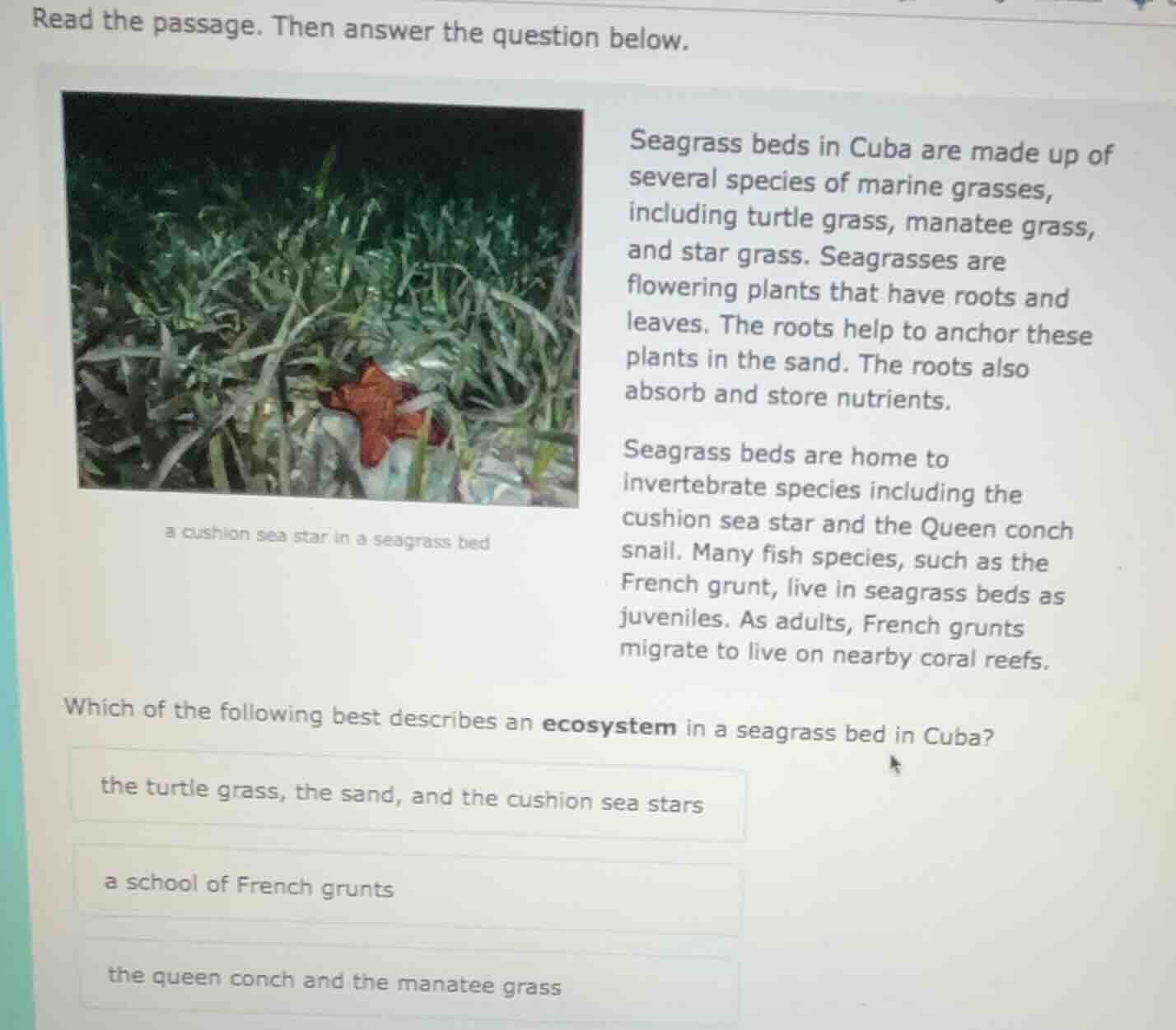
seagrass beds in cuba are made up of several species of marine grasses, including turtle grass, manatee grass, and star grass. seagrasses are flowering plants that have roots and leaves. the roots help to anchor these plants in the sand. the roots also absorb and store nutrients.
seagrass beds are home to invertebrate species including the cushion sea star and the queen conch snail. many fish species, such as the french grunt, live in seagrass beds as juveniles. as adults, french grunts migrate to live on nearby coral reefs.
which of the following best describes an ecosystem in a seagrass bed in cuba?
the turtle grass, the sand, and the cushion sea stars
a school of french grunts
the queen conch and the manatee grass
An ecosystem includes all living (biotic) and non - living (abiotic) components in a particular area. The first option has turtle grass (biotic, plant), sand (abiotic), and cushion sea stars (biotic, animal), which together represent biotic and abiotic parts of the seagrass bed ecosystem. A school of French grunts is only a group of one species (biotic, part of a population, not the whole ecosystem). The queen conch and manatee grass are two biotic components but lack abiotic factors like sand.

Snap & solve any problem in the app
Get step-by-step solutions on Sovi AI
Photo-based solutions with guided steps
Explore more problems and detailed explanations
the turtle grass, the sand, and the cushion sea stars