QUESTION IMAGE
Question
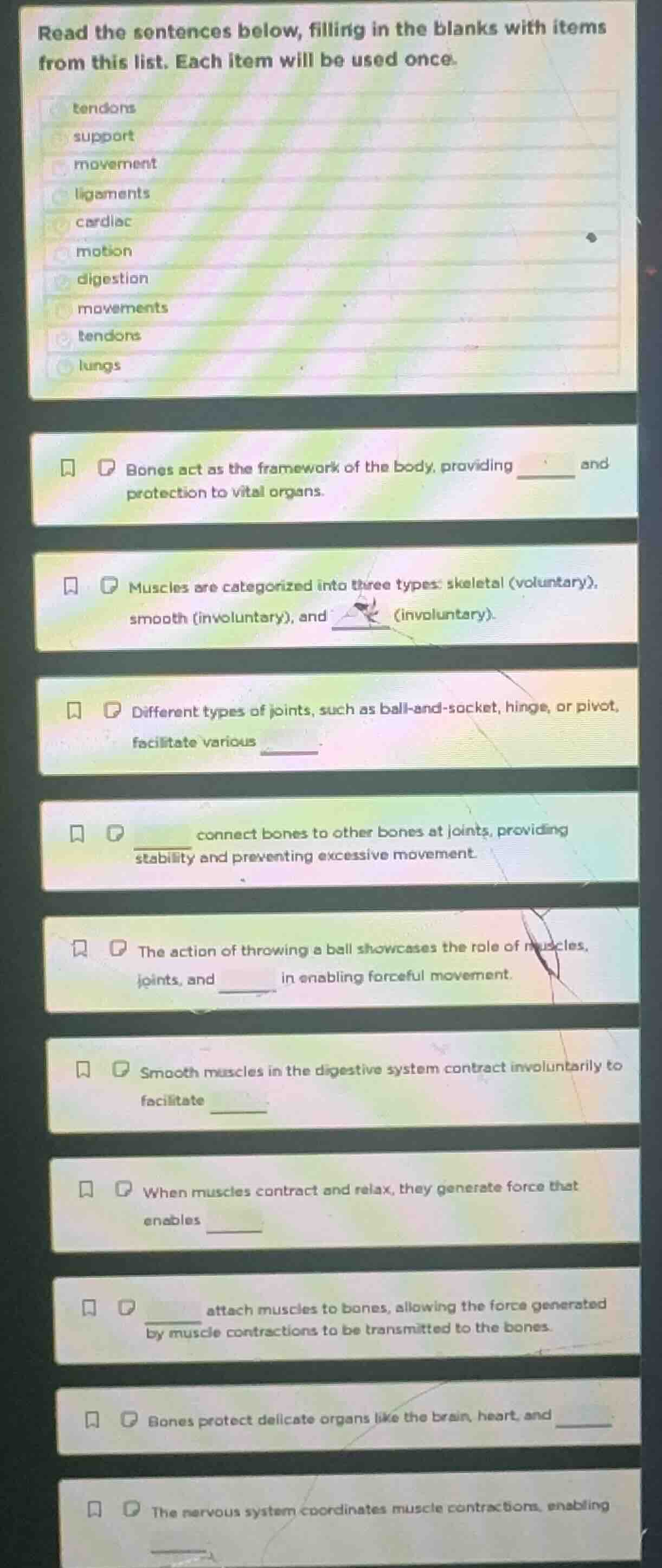
read the sentences below, filling in the blanks with items from this list. each item will be used once.
tendons
support
movement
ligaments
cardiac
motion
digestion
movements
tendons
lungs
bones act as the framework of the body, providing ______ and protection to vital organs.
muscles are categorized into three types: skeletal (voluntary), smooth (involuntary), and ______ (involuntary).
different types of joints, such as ball - and - socket, hinge, or pivot, facilitate various ______.
______ connect bones to other bones at joints, providing stability and preventing excessive movement.
the action of throwing a ball showcases the role of muscles, joints, and ______ in enabling forceful movement.
smooth muscles in the digestive system contract involuntarily to facilitate ______.
when muscles contract and relax, they generate force that enables ______.
______ attach muscles to bones, allowing the force generated by muscle contractions to be transmitted to the bones.
bones protect delicate organs like the brain, heart, and ______.
the nervous system coordinates muscle contractions, enabling ______
Each blank is filled using the provided list items, matching the anatomical/physiological function described in each sentence, with each item used once.
- Bones provide structural framework and protection, so "support" fits.
- The three muscle types are skeletal, smooth, and cardiac.
- Joints allow different kinds of body movements.
- Ligaments are the connective tissue linking bones at joints.
- Throwing a ball relies on muscles, joints, and tendons for forceful motion.
- Smooth muscles in the digestive system aid the process of digestion.
- Muscle contraction/relaxation generates force for movement.
- Tendons are the tissue that attach muscles to bones.
- Bones protect organs including the brain, heart, and lungs.
- The nervous system coordinates contractions to enable motion.

Snap & solve any problem in the app
Get step-by-step solutions on Sovi AI
Photo-based solutions with guided steps
Explore more problems and detailed explanations
- Bones act as the framework of the body, providing support and protection to vital organs.
- Muscles are categorized into three types: skeletal (voluntary), smooth (involuntary), and cardiac (involuntary).
- Different types of joints, such as ball-and-socket, hinge, or pivot, facilitate various movements.
- Ligaments connect bones to other bones at joints, providing stability and preventing excessive movement.
- The action of throwing a ball showcases the role of muscles, joints, and tendons in enabling forceful movement.
- Smooth muscles in the digestive system contract involuntarily to facilitate digestion.
- When muscles contract and relax, they generate force that enables movement.
- Tendons attach muscles to bones, allowing the force generated by muscle contractions to be transmitted to the bones.
- Bones protect delicate organs like the brain, heart, and lungs.
- The nervous system coordinates muscle contractions, enabling motion.