QUESTION IMAGE
Question
read this!
a well - written research question states the independent and dependent variables in the experiment.
for example, a student investigated the effect of soil ph on the number of strawberries produced by a strawberry plant. her research question was \how does the ph of soil affect the number of strawberries produced by a strawberry plant?\
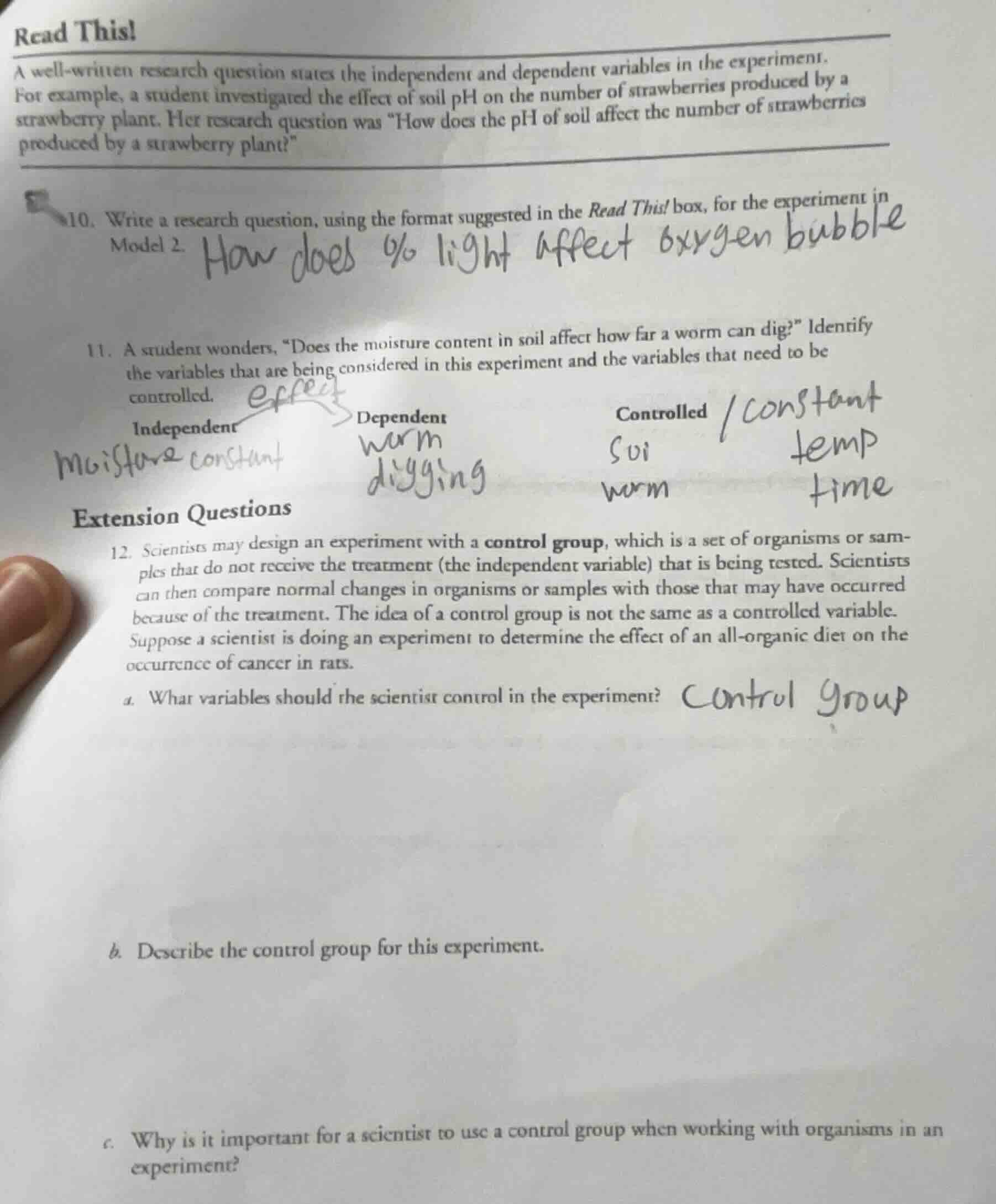
- write a research question, using the format suggested in the read this! box, for the experiment in model 2. (handwritten: how does % light affect oxygen bubble)
- a student wonders, \does the moisture content in soil affect how far a worm can dig?\ identify the variables that are being considered in this experiment and the variables that need to be controlled.
independent (handwritten: moisture constant) dependent (handwritten: worm digging) controlled (handwritten: soil, temp, worm, time)
extension questions
- scientists may design an experiment with a control group, which is a set of organisms or samples that do not receive the treatment (the independent variable) that is being tested. scientists can then compare normal changes in organisms or samples with those that may have occurred because of the treatment. the idea of a control group is not the same as a controlled variable.
suppose a scientist is doing an experiment to determine the effect of an all - organic diet on the occurrence of cancer in rats.
a. what variables should the scientist control in the experiment? (handwritten: control group)
b. describe the control group for this experiment.
c. why is it important for a scientist to use a control group when working with organisms in an experiment?
For Question 11:
- Independent variable: The variable changed to test effects.
- Dependent variable: The variable measured for changes.
- Controlled variables: Held constant to isolate effects.
For Question 12a:
Controlled variables are factors kept identical across all groups to ensure only the independent variable affects the outcome.
For Question 12b:
Control group does not receive the experimental treatment (all-organic diet) to provide a baseline.
For Question 12c:
Control groups rule out confounding variables, ensuring observed changes link to the treatment.

Snap & solve any problem in the app
Get step-by-step solutions on Sovi AI
Photo-based solutions with guided steps
Explore more problems and detailed explanations
11.
- Independent Variable: Soil moisture content
- Dependent Variable: Distance a worm can dig
- Controlled Variables: Type of soil, species/age of worm, temperature, time allowed for digging
12a. Variables to control: Species/age/health of rats, living conditions (temperature, cage size, light cycle), access to water, duration of the experiment.
12b. The control group is a group of rats that are fed a standard (non-organic) diet, with all other conditions identical to the group receiving the all-organic diet.
12c. A control group provides a baseline to compare against the experimental group, allowing the scientist to confirm that any observed changes in cancer occurrence are caused by the all-organic diet (the independent variable) rather than other confounding factors.