QUESTION IMAGE
Question
reading data tables - the solar system
data table to answer the questions that follow. planets are listed in order of
distance from the sun.
celestial
object mean distance
from sun period of
revolution period of
rotation at equator eccentricity
of orbit equatorial
diameter
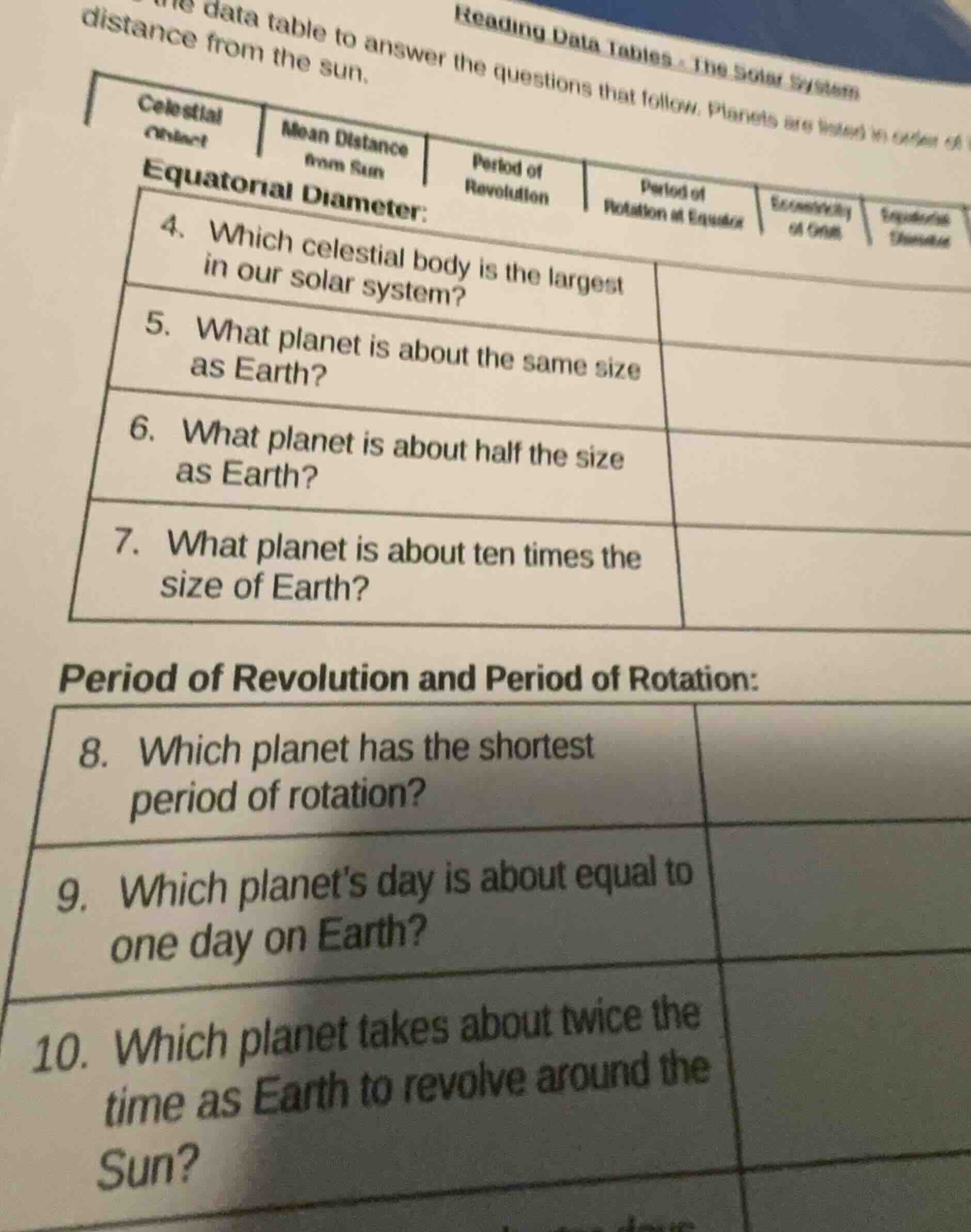
equatorial diameter:
- which celestial body is the largest
in our solar system?
- what planet is about the same size
as earth?
- what planet is about half the size
as earth?
- what planet is about ten times the
size of earth?
period of revolution and period of rotation:
- which planet has the shortest
period of rotation?
- which planet’s day is about equal to
one day on earth?
- which planet takes about twice the
time as earth to revolve around the
sun?
To answer these questions, we typically refer to standard data about the solar system (though the original data table isn't fully visible here, we use known solar system facts):
Question 4:
In the solar system, Jupiter is the largest celestial body (planet) by equatorial diameter and mass, though the Sun is the largest overall (but among planets, Jupiter; if including the Sun, the Sun is the largest celestial body in the solar system). Assuming the table includes the Sun or focuses on planets, the largest (planet) is Jupiter; if including the Sun, the Sun.
Venus has an equatorial diameter very close to Earth’s (Venus: ~12,104 km; Earth: ~12,742 km), making it about the same size as Earth.
Mars has an equatorial diameter of ~6,779 km, which is about half of Earth’s (~12,742 km).

Snap & solve any problem in the app
Get step-by-step solutions on Sovi AI
Photo-based solutions with guided steps
Explore more problems and detailed explanations
The Sun (or Jupiter, depending on the table’s scope; typically, the Sun is the largest celestial body in the solar system).