QUESTION IMAGE
Question
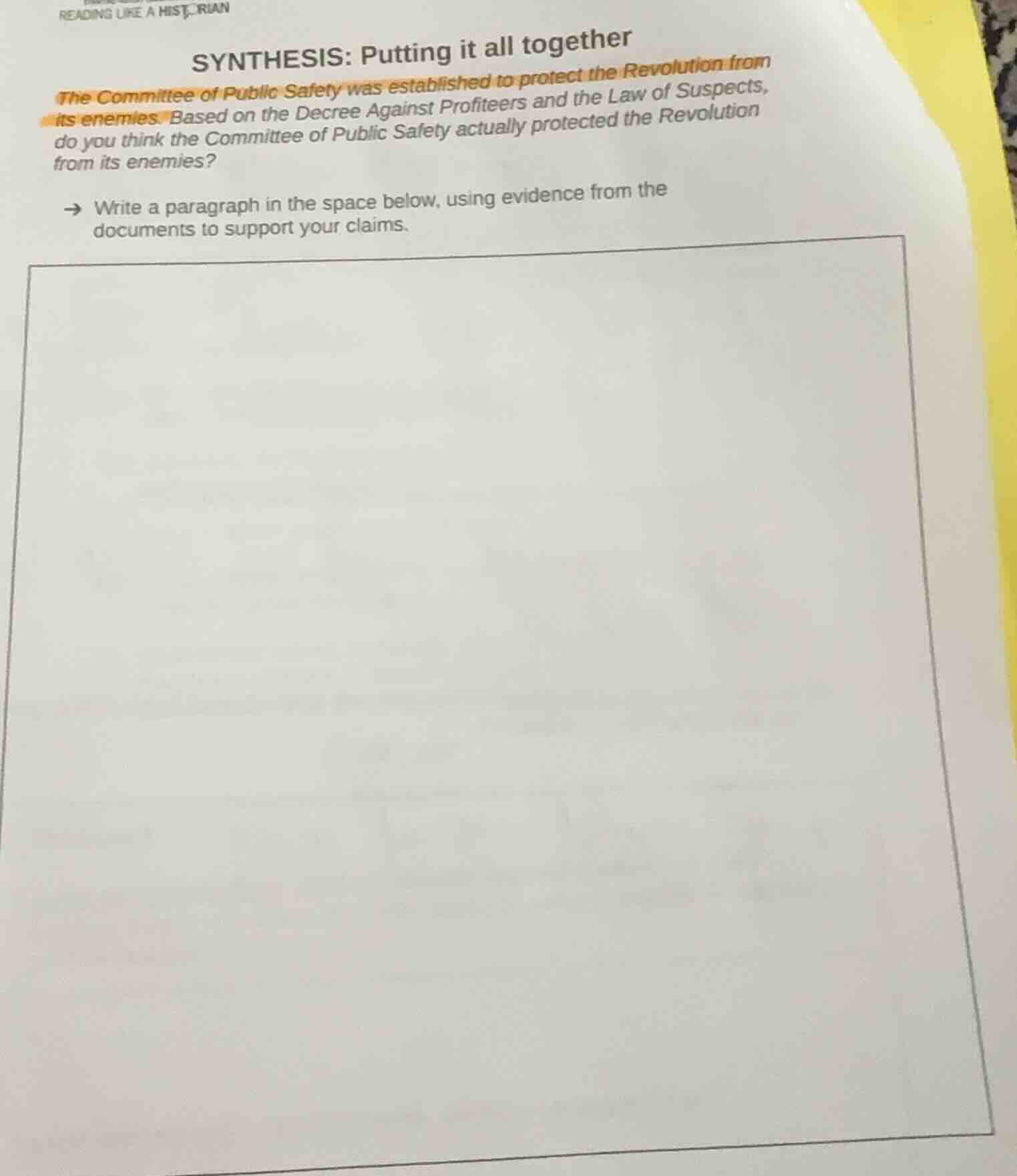
reading like a historian synthesis: putting it all together the committee of public safety was established to protect the revolution from its enemies. based on the decree against profiteers and the law of suspects, do you think the committee of public safety actually protected the revolution from its enemies? write a paragraph in the space below, using evidence from the documents to support your claims.
While the specific text of the Decree Against Profiteers and Law of Suspects is not provided, a supported argument can be framed using their known purposes: The Committee of Public Safety did protect the Revolution from immediate internal enemies through these measures, though at the cost of civil liberties. The Decree Against Profiteers targeted hoarders and price-gougers who exploited food shortages, a grievance that had fueled popular unrest and could have undermined revolutionary support by turning the working classes against the government; cracking down on these profiteers stabilized supply and public trust. The Law of Suspects allowed the arrest of individuals deemed threats to the Revolution, including royalist sympathizers and counter-revolutionaries who sought to overthrow the revolutionary government and restore the monarchy, neutralizing organized efforts to undo revolutionary gains. However, the broad, vague language of the Law of Suspects also led to arbitrary arrests of non-threatening citizens, which later tarnished the committee's legacy, but in the short term, it suppressed immediate counter-revolutionary action.

Snap & solve any problem in the app
Get step-by-step solutions on Sovi AI
Photo-based solutions with guided steps
Explore more problems and detailed explanations
The Committee of Public Safety did protect the French Revolution from its immediate internal enemies through the Decree Against Profiteers and the Law of Suspects, though with significant overreach. The Decree Against Profiteers addressed a core revolutionary grievance by targeting those hoarding or inflating food prices, which had sparked popular unrest and risked alienating the working classes whose support was critical to the Revolution’s survival; by enforcing price controls and punishing profiteers, the committee stabilized domestic supply and maintained backing from key revolutionary factions. The Law of Suspects, meanwhile, neutralized organized counter-revolutionary threats, including royalist sympathizers and opponents of the revolutionary government who sought to undo its reforms or restore the monarchy, effectively quelling efforts to overthrow the revolutionary regime. While the law’s broad, ambiguous terms led to arbitrary arrests of innocent people, in the context of the Revolution’s fragile position, these measures successfully suppressed immediate internal enemies and prevented the collapse of revolutionary rule.