QUESTION IMAGE
Question
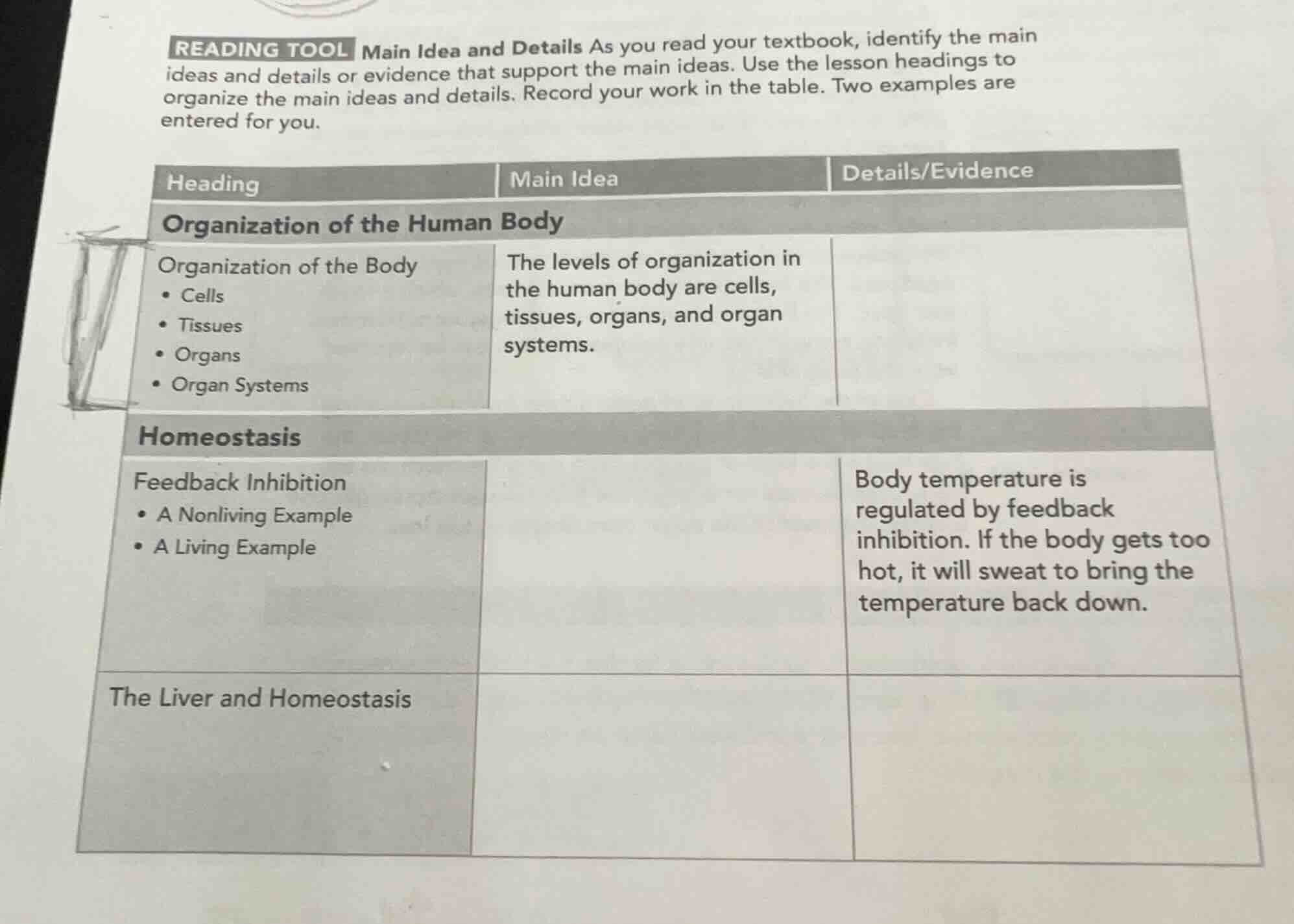
reading tool main idea and details as you read your textbook, identify the main ideas and details or evidence that support the main ideas. use the lesson headings to organize the main ideas and details. record your work in the table. two examples are entered for you.
| heading | main idea | details/evidence |
|---|---|---|
| organization of the body<br>• cells<br>• tissues<br>• organs<br>• organ systems | the levels of organization in the human body are cells, tissues, organs, and organ systems. | |
| homeostasis | ||
| feedback inhibition<br>• a nonliving example<br>• a living example | body temperature is regulated by feedback inhibition. if the body gets too hot, it will sweat to bring the temperature back down. | |
| the liver and homeostasis |
To complete the table, we analyze each section:
1. “Organization of the Body” (Details/Evidence)
The main idea is about body organization levels (cells, tissues, organs, organ systems). Details can include:
- Cells: Basic structural/functional units (e.g., muscle cells, nerve cells).
- Tissues: Groups of similar cells (e.g., muscle tissue, epithelial tissue).
- Organs: Groups of tissues (e.g., heart, liver).
- Organ Systems: Groups of organs (e.g., circulatory system, respiratory system).
2. “Feedback Inhibition” (Main Idea)
The details use body temperature regulation. The main idea is: Feedback inhibition (negative feedback) maintains homeostasis by reversing changes to return to a set point.
3. “The Liver and Homeostasis” (Main Idea + Details)
- Main Idea: The liver plays a key role in maintaining homeostasis (e.g., in blood sugar, detoxification).
- Details/Evidence:
- Blood sugar: Stores glucose as glycogen (when blood sugar is high) or breaks down glycogen (when low).
- Detoxification: Filters toxins from blood (e.g., processes alcohol, drugs).
Filled Table (Key Entries):
| Heading | Main Idea | Details/Evidence |
|---|---|---|
| Feedback Inhibition <br> • A Nonliving Example <br> • A Living Example | Feedback inhibition (negative feedback) maintains homeostasis by reversing changes to return to a set point. | Body temperature is regulated by feedback inhibition. If the body gets too hot, it will sweat to bring the temperature back down. <br> (Nonliving example: Thermostat regulating room temperature.) |
| The Liver and Homeostasis | The liver maintains homeostasis (e.g., blood sugar, detoxification). | - Blood sugar: Stores glucose as glycogen (high blood sugar) or releases glucose (low blood sugar). <br> - Detoxification: Filters toxins (e.g., alcohol, drugs) from the blood. |
This structure aligns with the “Main Idea and Details” reading tool, organizing content by headings.

Snap & solve any problem in the app
Get step-by-step solutions on Sovi AI
Photo-based solutions with guided steps
Explore more problems and detailed explanations
To complete the table, we analyze each section:
1. “Organization of the Body” (Details/Evidence)
The main idea is about body organization levels (cells, tissues, organs, organ systems). Details can include:
- Cells: Basic structural/functional units (e.g., muscle cells, nerve cells).
- Tissues: Groups of similar cells (e.g., muscle tissue, epithelial tissue).
- Organs: Groups of tissues (e.g., heart, liver).
- Organ Systems: Groups of organs (e.g., circulatory system, respiratory system).
2. “Feedback Inhibition” (Main Idea)
The details use body temperature regulation. The main idea is: Feedback inhibition (negative feedback) maintains homeostasis by reversing changes to return to a set point.
3. “The Liver and Homeostasis” (Main Idea + Details)
- Main Idea: The liver plays a key role in maintaining homeostasis (e.g., in blood sugar, detoxification).
- Details/Evidence:
- Blood sugar: Stores glucose as glycogen (when blood sugar is high) or breaks down glycogen (when low).
- Detoxification: Filters toxins from blood (e.g., processes alcohol, drugs).
Filled Table (Key Entries):
| Heading | Main Idea | Details/Evidence |
|---|---|---|
| Feedback Inhibition <br> • A Nonliving Example <br> • A Living Example | Feedback inhibition (negative feedback) maintains homeostasis by reversing changes to return to a set point. | Body temperature is regulated by feedback inhibition. If the body gets too hot, it will sweat to bring the temperature back down. <br> (Nonliving example: Thermostat regulating room temperature.) |
| The Liver and Homeostasis | The liver maintains homeostasis (e.g., blood sugar, detoxification). | - Blood sugar: Stores glucose as glycogen (high blood sugar) or releases glucose (low blood sugar). <br> - Detoxification: Filters toxins (e.g., alcohol, drugs) from the blood. |
This structure aligns with the “Main Idea and Details” reading tool, organizing content by headings.