QUESTION IMAGE
Question
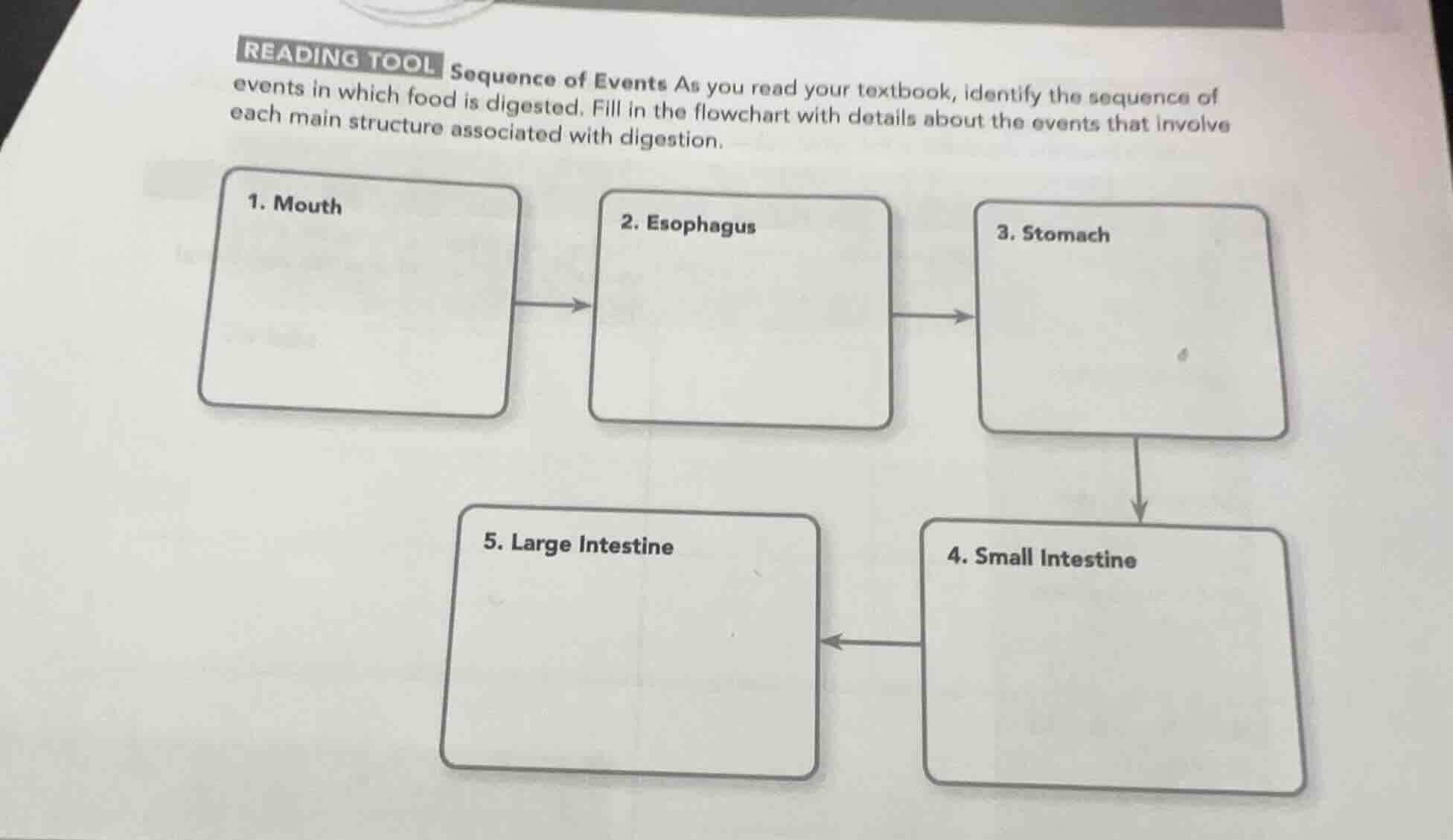
reading tool sequence of events as you read your textbook, identify the sequence of events in which food is digested. fill in the flowchart with details about the events that involve each main structure associated with digestion. 1. mouth 2. esophagus 3. stomach 4. small intestine 5. large intestine
Brief Explanations
To fill the flowchart, we analyze each digestive structure:
- Mouth: Food is chewed (mechanical digestion) and mixed with saliva (contains amylase for chemical digestion of starch), forming a bolus.
- Esophagus: The bolus is transported to the stomach via peristalsis (muscular contractions).
- Stomach: Food is mixed with gastric juices (hydrochloric acid, pepsin) for protein digestion; mechanical churning occurs, forming chyme.
- Small Intestine: Chyme mixes with bile (emulsifies fat) and pancreatic/intestinal enzymes (digest carbs, proteins, fats); nutrients are absorbed into the bloodstream.
- Large Intestine: Water, salts, and vitamins are absorbed; undigested material (feces) is stored and eliminated.
Filled Flowchart Details:
- Mouth: Chewing (mechanical digestion) breaks food into smaller pieces. Saliva (with amylase) begins chemical digestion of starch. Food forms a bolus.
- Esophagus: Peristalsis (muscular contractions) moves the bolus from the mouth to the stomach.
- Stomach: Gastric juices (HCl, pepsin) chemically digest proteins. Mechanical churning mixes food into chyme.
- Small Intestine: Bile (from liver/gallbladder) emulsifies fats. Pancreatic/intestinal enzymes digest carbs, proteins, fats. Nutrients (sugars, amino acids, fatty acids) are absorbed into blood/lymph.
- Large Intestine: Water, electrolytes, and vitamins are absorbed. Undigested material (feces) is compacted and stored until elimination.

Snap & solve any problem in the app
Get step-by-step solutions on Sovi AI
Photo-based solutions with guided steps
Explore more problems and detailed explanations
To fill the flowchart, we analyze each digestive structure:
- Mouth: Food is chewed (mechanical digestion) and mixed with saliva (contains amylase for chemical digestion of starch), forming a bolus.
- Esophagus: The bolus is transported to the stomach via peristalsis (muscular contractions).
- Stomach: Food is mixed with gastric juices (hydrochloric acid, pepsin) for protein digestion; mechanical churning occurs, forming chyme.
- Small Intestine: Chyme mixes with bile (emulsifies fat) and pancreatic/intestinal enzymes (digest carbs, proteins, fats); nutrients are absorbed into the bloodstream.
- Large Intestine: Water, salts, and vitamins are absorbed; undigested material (feces) is stored and eliminated.
Filled Flowchart Details:
- Mouth: Chewing (mechanical digestion) breaks food into smaller pieces. Saliva (with amylase) begins chemical digestion of starch. Food forms a bolus.
- Esophagus: Peristalsis (muscular contractions) moves the bolus from the mouth to the stomach.
- Stomach: Gastric juices (HCl, pepsin) chemically digest proteins. Mechanical churning mixes food into chyme.
- Small Intestine: Bile (from liver/gallbladder) emulsifies fats. Pancreatic/intestinal enzymes digest carbs, proteins, fats. Nutrients (sugars, amino acids, fatty acids) are absorbed into blood/lymph.
- Large Intestine: Water, electrolytes, and vitamins are absorbed. Undigested material (feces) is compacted and stored until elimination.