QUESTION IMAGE
Question
recovery plans
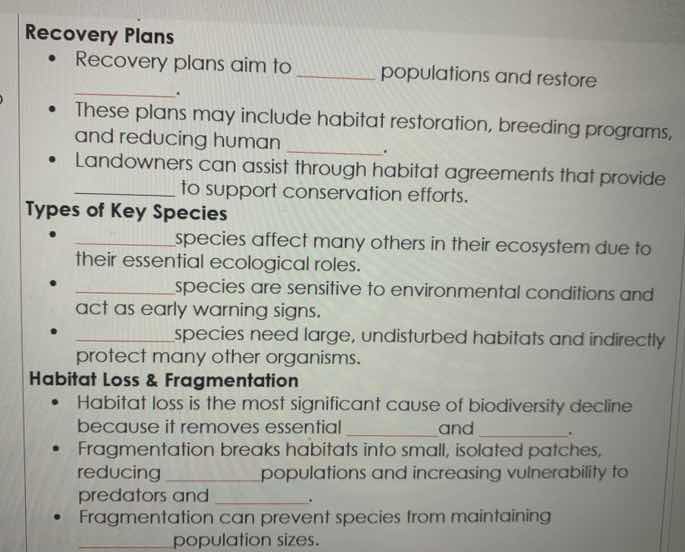
- recovery plans aim to ____ populations and restore ____.
- these plans may include habitat restoration, breeding programs, and reducing human ______.
- landowners can assist through habitat agreements that provide ______ to support conservation efforts.
types of key species
- ______ species affect many others in their ecosystem due to their essential ecological roles.
- ______ species are sensitive to environmental conditions and act as early warning signs.
- ______ species need large, undisturbed habitats and indirectly protect many other organisms.
habitat loss & fragmentation
- habitat loss is the most significant cause of biodiversity decline because it removes essential ____ and ____.
- fragmentation breaks habitats into small, isolated patches, reducing ____ populations and increasing vulnerability to predators and ____.
- fragmentation can prevent species from maintaining ______ population sizes.
Brief Explanations
These are fill-in-the-blank questions focused on conservation biology concepts, covering recovery plans, key species types, and habitat loss impacts. Each blank is filled with standard terminology from the field.

Snap & solve any problem in the app
Get step-by-step solutions on Sovi AI
Photo-based solutions with guided steps
Explore more problems and detailed explanations
Recovery Plans
- Recovery plans aim to rebuild populations and restore ecosystem health.
- These plans may include habitat restoration, breeding programs, and reducing human disturbance.
- Landowners can assist through habitat agreements that provide funding/resources to support conservation efforts.
Types of Key Species
- Keystone species affect many others in their ecosystem due to their essential ecological roles.
- Indicator species are sensitive to environmental conditions and act as early warning signs.
- Umbrella species need large, undisturbed habitats and indirectly protect many other organisms.
Habitat Loss & Fragmentation
- Habitat loss is the most significant cause of biodiversity decline because it removes essential food sources and shelter.
- Fragmentation breaks habitats into small, isolated patches, reducing genetically diverse populations and increasing vulnerability to predators and environmental stressors.
- Fragmentation can prevent species from maintaining viable population sizes.