QUESTION IMAGE
Question
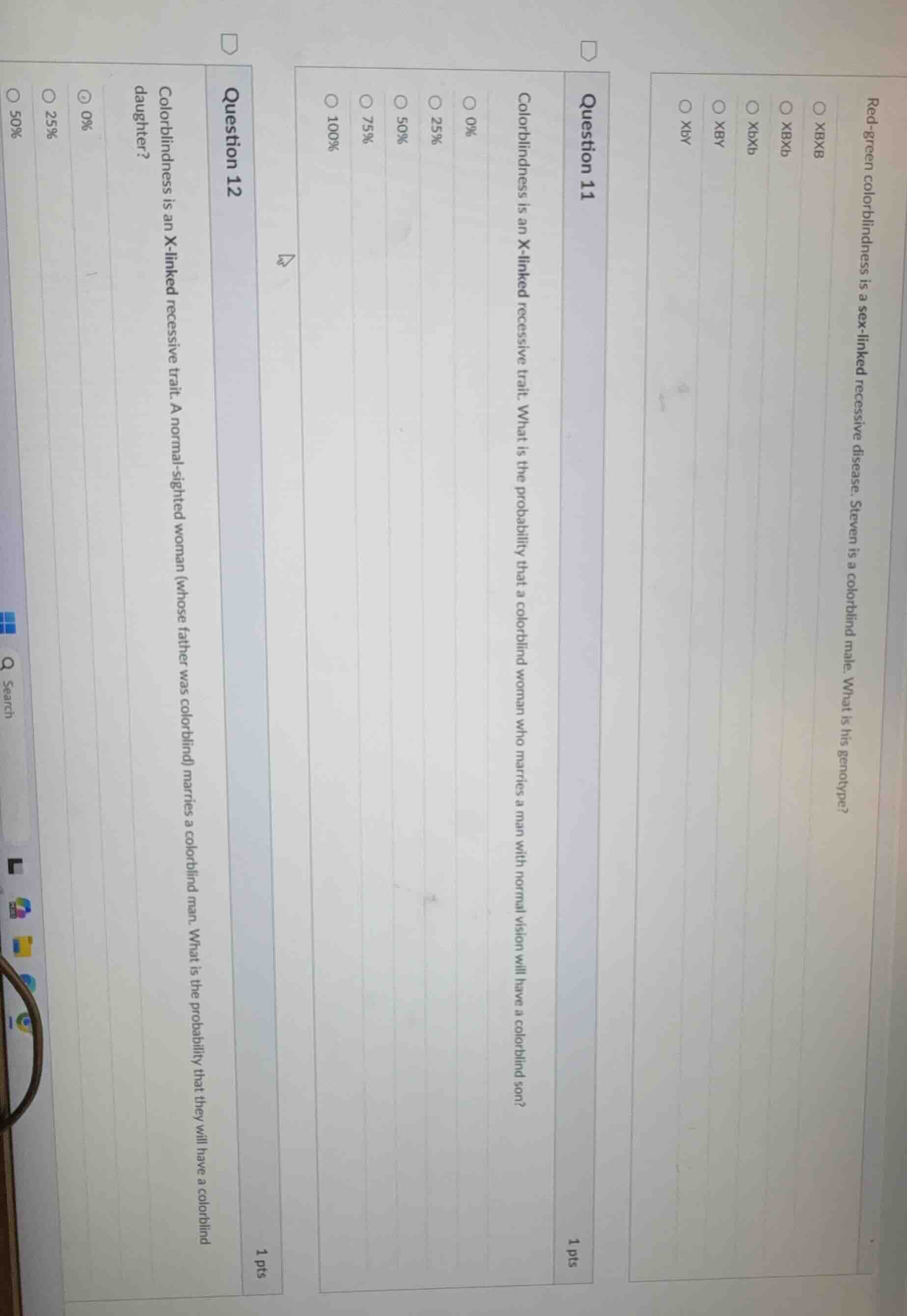
red - green colorblindness is a sex - linked recessive disease. steven is a colorblind male. what is his genotype?
options: xbxb, xbxb, xbxb, xby, xby
question 11
colorblindness is an x - linked recessive trait. what is the probability that a colorblind woman who marries a man with normal vision will have a colorblind son?
options: 0%, 25%, 50%, 75%, 100%
question 12
colorblindness is an x - linked recessive trait. a normal - sighted woman (whose father was colorblind) marries a colorblind man. what is the probability that they will have a colorblind daughter?
options: 0%, 25%, 50%
Question (Rightmost, about Steven's genotype):
Red - green colorblindness is X - linked recessive. Males have one X and one Y chromosome. A colorblind male (Steven) must have the recessive allele on his X chromosome (since Y can't carry the allele). So his genotype is XbY (where Xb has the colorblind allele). Among the options, XbY is the correct genotype for a colorblind male.
Step 1: Determine genotypes
A colorblind woman has genotype $X^bX^b$ (since X - linked recessive, she needs two recessive alleles). A man with normal vision has genotype $X^BY$ (Y has no allele, X has dominant normal allele).
Step 2: Analyze offspring for sons
Sons get X from mother and Y from father. Mother gives $X^b$ (only allele she has), father gives Y. So son's genotype is $X^bY$ (colorblind). The probability of having a son is 50% (since sex ratio is 50% male), and all sons from this cross will be colorblind. Wait, no: Wait, the cross is $X^bX^b$ (mother) × $X^BY$ (father). For sons: X from mom ($X^b$) and Y from dad. So all sons (50% of offspring) are colorblind? Wait, no, the probability of having a son is 50%, and the probability that the son is colorblind is 100% (since mom gives Xb, dad gives Y). Wait, but the question is "probability that a colorblind woman who marries a man with normal vision will have a colorblind son". So first, probability of having a son: 50% (since each child has 50% chance to be male). Then, given it's a son, the probability he is colorblind: since mom is $X^bX^b$ (gives Xb) and dad is $X^BY$ (gives Y), so son's genotype is $X^bY$ (colorblind). So the probability is 50% (chance of son) × 100% (chance son is colorblind) = 50%? Wait, no, wait: the possible offspring are: daughters: $X^BX^b$ (normal), sons: $X^bY$ (colorblind). So half of the offspring are sons, and all sons are colorblind. So the probability of having a colorblind son is 50% (since 50% of children are sons, and all sons are colorblind). Wait, but let's do Punnett square:
| $X^B$ | $Y$ | |
|---|---|---|
| $X^b$ | $X^BX^b$ | $X^bY$ |
So there are 4 possible offspring: 2 daughters ($X^BX^b$) and 2 sons ($X^bY$). So the probability of a colorblind son is 2/4 = 50%.
Step 1: Set up Punnett square
Mother: $X^bX^b$, Father: $X^BY$. Gametes: Mother gives $X^b$ (both), Father gives $X^B$ or $Y$.
Step 2: Calculate offspring
Offspring: $X^BX^b$ (daughter, normal), $X^bY$ (son, colorblind), $X^BX^b$ (daughter, normal), $X^bY$ (son, colorblind).
Step 3: Find probability of colorblind son
Total offspring: 4. Colorblind sons: 2. Probability = $\frac{2}{4}$ = 50%.
Step 1: Determine genotypes
A normal - sighted woman whose father was colorblind: Father was colorblind, so he had genotype $X^bY$. He gave his X to daughter, so daughter (the woman) has $X^b$ from father. Since she is normal - sighted, she must be a carrier: $X^BX^b$ (B is dominant normal allele, b is recessive colorblind allele). The colorblind man has genotype $X^bY$.
Step 2: Set up Punnett square
Gametes: Woman gives $X^B$ or $X^b$; Man gives $X^b$ or $Y$.
| $X^b$ | $Y$ | |
|---|---|---|
| $X^b$ | $X^bX^b$ (daughter, colorblind) | $X^bY$ (son, colorblind) |
Step 3: Calculate probability of colorblind daughter
Total offspring: 4. Colorblind daughters: 1 ($X^bX^b$). Probability = $\frac{1}{4}$ = 25%? Wait, no: Wait, the woman is $X^BX^b$, man is $X^bY$. Offspring:
- Daughters: $X^BX^b$ (normal, 50% of daughters) and $X^bX^b$ (colorblind, 50% of daughters). The probability of having a daughter is 50% (since 50% of children are female). Then, given it's a daughter, the probability she is colorblind is 50% (since 50% of daughters are colorblind). So overall probability: 50% (daughter) × 50% (colorblind daughter) = 25%? Wait, let's count the Punnett square: 4 offspring. Daughters: 2 ($X^BX^b$ and $X^bX^b$). So colorblind daughter is 1 out of 4 total offspring? Wait no, 2 daughters, 1 is colorblind. So probability of colorblind daughter: number of colorblind daughters / total offspring = 1/4 = 25%? Wait, no: the Punnett square has 4 cells:
- $X^BX^b$ (daughter, normal)
- $X^BY$ (son, normal)
- $X^bX^b$ (daughter, colorblind)
- $X^bY$ (son, colorblind)
So colorblind daughter is 1 out of 4, so 25%? Wait, but the options are 0%, 25%, 50%. Wait, let's re - check the woman's genotype. Her father was colorblind ($X^bY$), so she got $X^b$ from father. She is normal - sighted, so she has $X^B$ from mother. So her genotype is $X^BX^b$. The man is colorblind: $X^bY$. So when they have children:
- For daughters: they get X from father ($X^b$) and X from mother ($X^B$ or $X^b$). So possible daughter genotypes: $X^BX^b$ (normal) and $X^bX^b$ (colorblind). Each with 50% chance (since mother has 50% chance to give $X^B$ or $X^b$). The probability of having a daughter is 50% (since 50% of children are female). So the probability of having a colorblind daughter is (probability of daughter) × (probability daughter is colorblind) = 0.5 × 0.5 = 0.25 (25%).
Step 1: Identify genotypes
Woman: $X^BX^b$ (carrier, normal - sighted, father colorblind), Man: $X^bY$ (colorblind).
Step 2: Construct Punnett square
| $X^b$ (Father) | $Y$ (Father) | |
|---|---|---|
| $X^b$ (Mother) | $X^bX^b$ (Daughter, Colorblind) | $X^bY$ (Son, Colorblind) |
Step 3: Calculate probability
Total offspring: 4. Colorblind daughters: 1 ($X^bX^b$). Probability = $\frac{1}{4}$ = 25%.

Snap & solve any problem in the app
Get step-by-step solutions on Sovi AI
Photo-based solutions with guided steps
Explore more problems and detailed explanations
XbY