QUESTION IMAGE
Question
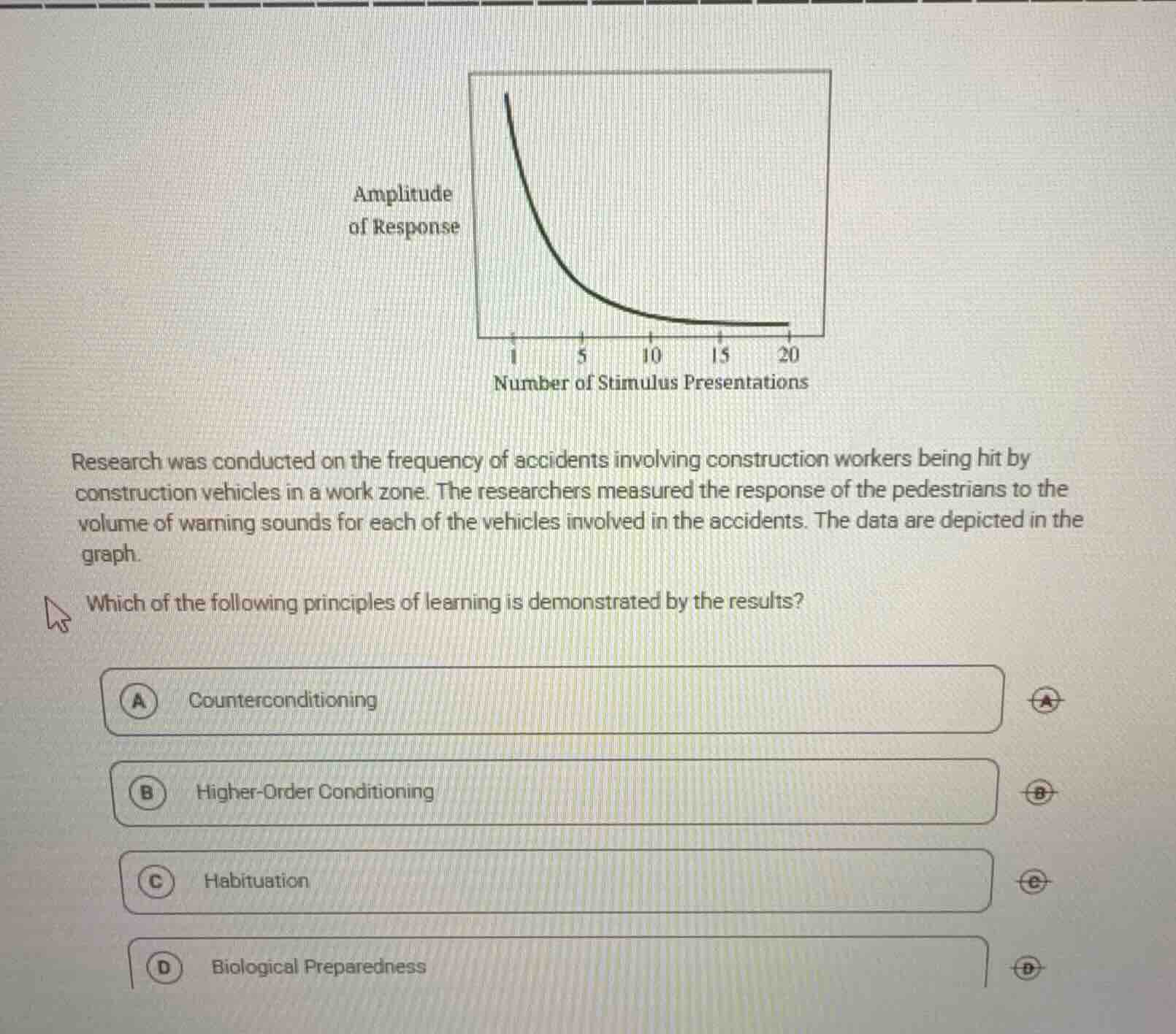
research was conducted on the frequency of accidents involving construction workers being hit by construction vehicles in a work zone. the researchers measured the response of the pedestrians to the volume of warning sounds for each of the vehicles involved in the accidents. the data are depicted in the graph. which of the following principles of learning is demonstrated by the results? a counterconditioning b higher-order conditioning c habituation d biological preparedness
Brief Explanations
- Option A (Counterconditioning): Involves replacing an unwanted response with a desired one (e.g., systematic desensitization), not related to reduced response with repeated stimuli. Eliminate A.
- Option B (Higher - Order Conditioning): Occurs when a neutral stimulus becomes a conditioned stimulus by pairing with an existing conditioned stimulus. The graph shows a response to a repeated stimulus, not new conditioning. Eliminate B.
- Option C (Habituation): Is the decrease in response amplitude as a stimulus is repeatedly presented. The graph shows the amplitude of response decreasing as the number of stimulus presentations (warning sounds) increases, which matches habituation.
- Option D (Biological Preparedness): Refers to an organism's innate tendency to learn certain associations (e.g., fear of snakes) easily, not related to reduced response with repetition. Eliminate D.

Snap & solve any problem in the app
Get step-by-step solutions on Sovi AI
Photo-based solutions with guided steps
Explore more problems and detailed explanations
C. Habituation