QUESTION IMAGE
Question
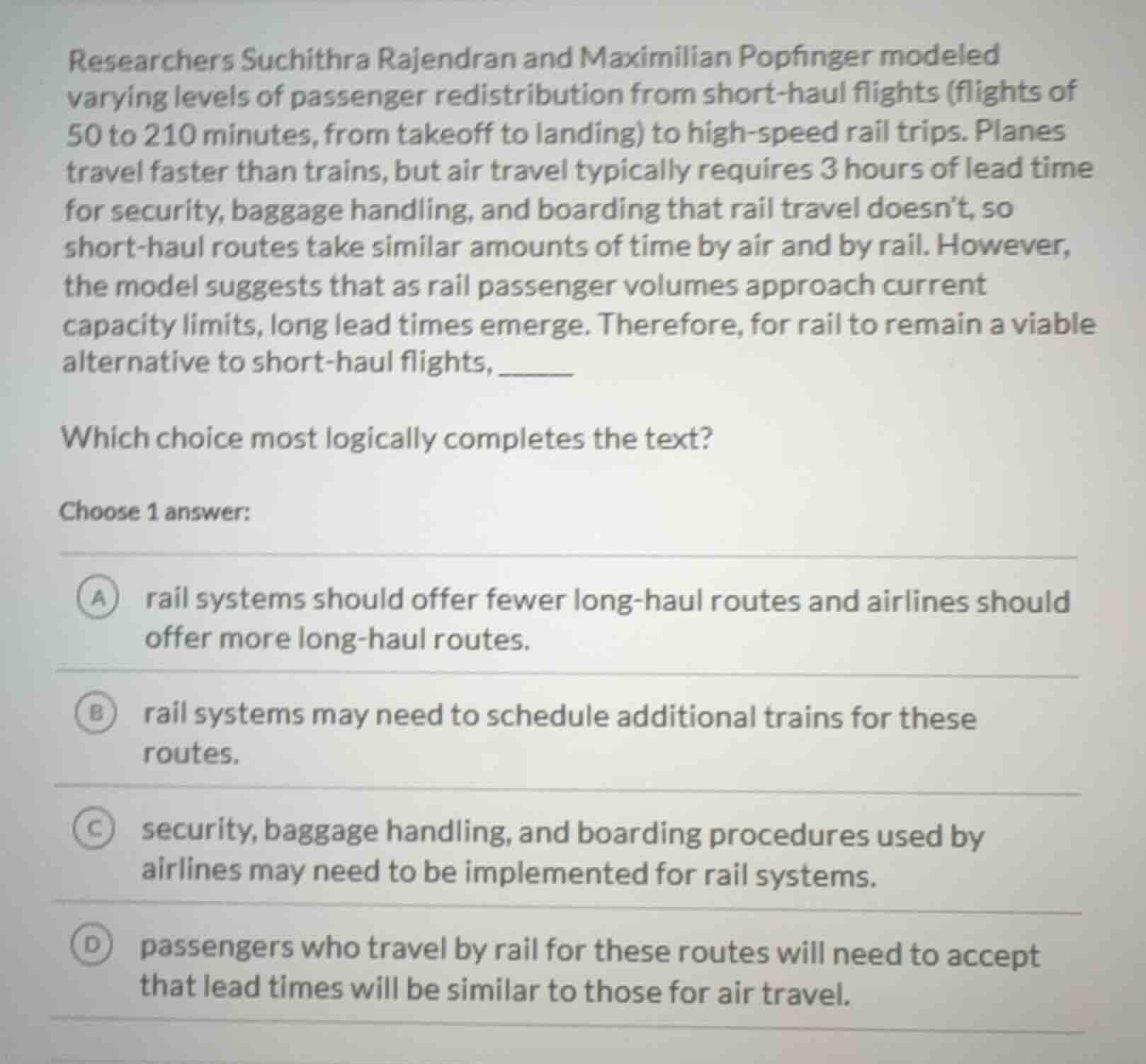
researchers suchithra rajendran and maximilian popfinger modeled varying levels of passenger redistribution from short - haul flights (flights of 50 to 210 minutes, from takeoff to landing) to high - speed rail trips. planes travel faster than trains, but air travel typically requires 3 hours of lead time for security, baggage handling, and boarding that rail travel doesnt, so short - haul routes take similar amounts of time by air and by rail. however, the model suggests that as rail passenger volumes approach current capacity limits, long lead times emerge. therefore, for rail to remain a viable alternative to short - haul flights, ______
which choice most logically completes the text?
choose 1 answer:
a rail systems should offer fewer long - haul routes and airlines should offer more long - haul routes.
b rail systems may need to schedule additional trains for these routes.
c security, baggage handling, and boarding procedures used by airlines may need to be implemented for rail systems.
d passengers who travel by rail for these routes will need to accept that lead times will be similar to those for air travel.
To solve this, we analyze the context: The problem is about maintaining rail as a viable alternative to short - haul flights. The key issue is that as rail passenger volumes approach capacity, long lead times emerge. We need to find a solution that addresses this.
- Option A: The text is about short - haul routes, not long - haul. So this option is irrelevant.
- Option B: If rail systems schedule additional trains, it can increase the capacity. This would prevent passenger volumes from reaching the capacity limit, and thus avoid long lead times. This makes rail a viable alternative.
- Option C: Implementing airline procedures (which cause long lead times for air travel) on rail would make rail less attractive, not more viable.
- Option D: Asking passengers to accept long lead times is not a way to keep rail viable as an alternative (since one of the advantages of rail was no long lead times initially).

Snap & solve any problem in the app
Get step-by-step solutions on Sovi AI
Photo-based solutions with guided steps
Explore more problems and detailed explanations
B. rail systems may need to schedule additional trains for these routes.