QUESTION IMAGE
Question
review and recall
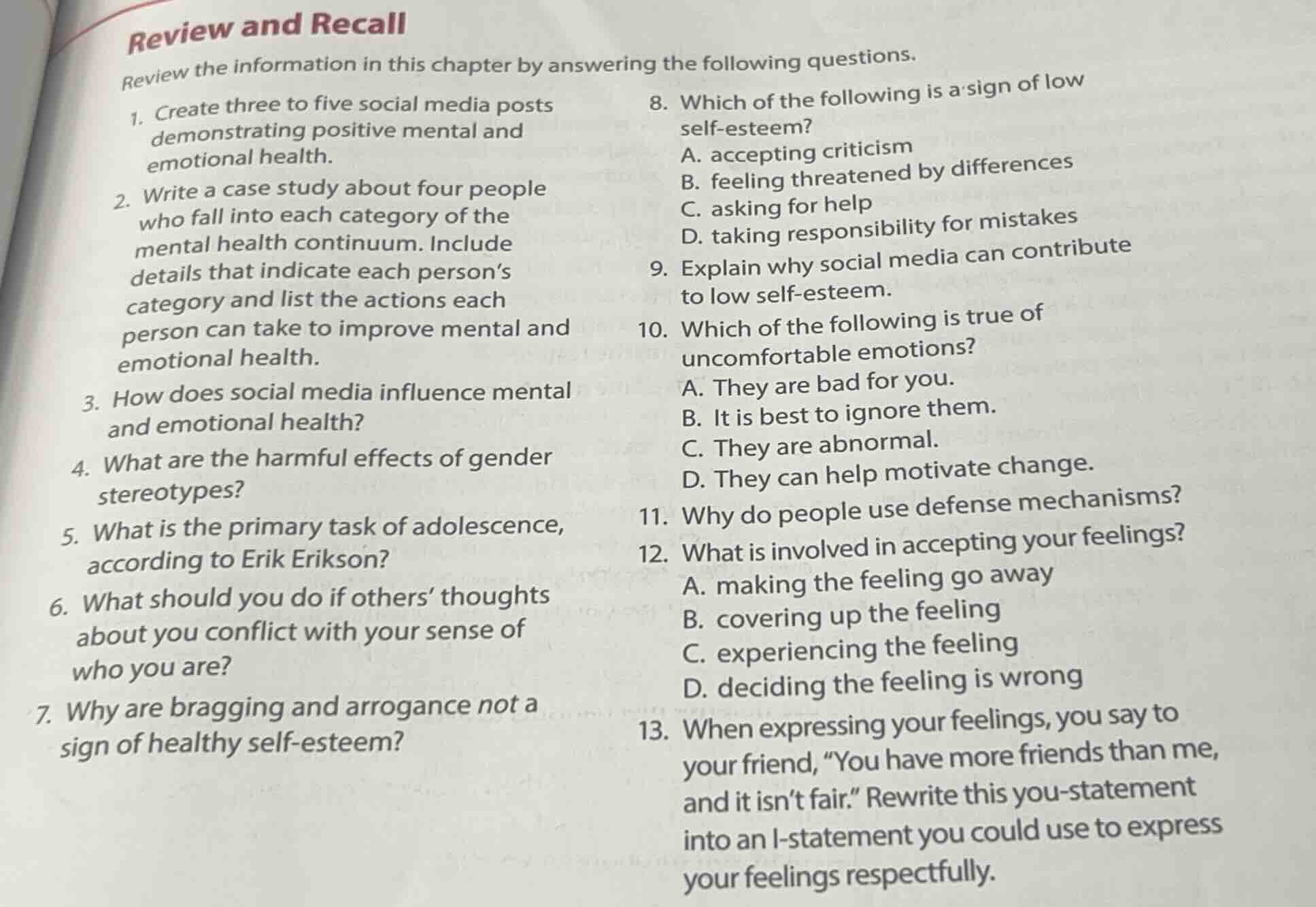
review the information in this chapter by answering the following questions.
- create three to five social media posts demonstrating positive mental and emotional health.
- write a case study about four people who fall into each category of the mental health continuum. include details that indicate each persons category and list the actions each person can take to improve mental and emotional health.
- how does social media influence mental and emotional health?
- what are the harmful effects of gender stereotypes?
- what is the primary task of adolescence, according to erik erikson?
- what should you do if others thoughts about you conflict with your sense of who you are?
- why are bragging and arrogance not a sign of healthy self-esteem?
- which of the following is a sign of low self-esteem?
a. accepting criticism
b. feeling threatened by differences
c. asking for help
d. taking responsibility for mistakes
- explain why social media can contribute to low self-esteem.
- which of the following is true of uncomfortable emotions?
a. they are bad for you.
b. it is best to ignore them.
c. they are abnormal.
d. they can help motivate change.
- why do people use defense mechanisms?
- what is involved in accepting your feelings?
a. making the feeling go away
b. covering up the feeling
c. experiencing the feeling
d. deciding the feeling is wrong
- when expressing your feelings, you say to your friend, \you have more friends than me, and it isnt fair.\ rewrite this you-statement into an i-statement you could use to express your feelings respectfully.
Brief Explanations
- Q1: Posts focus on positive mental health actions, validation, and community.
- Post 1: "Just spent 20 mins journaling about small wins today—reminding myself progress > perfection. What's one tiny win you had? 💛"
- Post 2: "Check-in: If you're feeling overwhelmed, it's okay to pause and say 'I need a break.' Your mental health comes first. 🧘"
- Post 3: "Grateful for my friend who listened when I was stressed. Reaching out isn't weakness—it's courage. Who's your support system? 🙌"
- Post 4: "Today I practiced reframing negative thoughts: instead of 'I messed up,' I said 'I learned what not to do.' Progress takes time! ✨"
- Q2: The mental health continuum has four categories: thriving, coping, struggling, in crisis.
- Thriving (Alex): A college student who maintains a balanced schedule, meets friends weekly, and uses mindfulness when stressed. Action: Continue regular check-ins with a mentor to sustain momentum.
- Coping (Sam): A barista who feels tired after shifts but still cooks meals and texts family daily, though skips hobbies. Action: Schedule 1 hour of weekly hobby time to reconnect with joy.
- Struggling (Riley): A teacher who has stopped socializing, struggles to grade papers, and feels sad most days. Action: Contact a school counselor to create a gradual self-care plan.
- In Crisis (Jordan): A freelancer who can't get out of bed, misses deadlines, and has suicidal thoughts. Action: Seek immediate care from a mental health emergency service.
- Q3: Social media has both positive and negative impacts. Positively, it can connect isolated people, provide mental health resources, and build supportive communities. Negatively, it can lead to social comparison, cyberbullying, fear of missing out (FOMO), and distorted self-perceptions from curated content, which harm mental and emotional health.
- Q4: Gender stereotypes limit opportunities (e.g., women being discouraged from STEM, men from care work), cause emotional suppression (e.g., men being told not to cry), lead to discrimination in work/education, and contribute to poor mental health from pressure to fit rigid norms.
- Q5: Erik Erikson defined the primary task of adolescence as developing a sense of identity (vs. role confusion), where teens explore their values, beliefs, and social roles to form a coherent self-concept.
- Q6: First, reflect on your core values to ground your self-identity. Then, communicate your perspective calmly to others if safe, and set boundaries if their comments are harmful. Prioritize self-trust over others' opinions, and seek support from people who validate your true self.
- Q7: Bragging and arrogance are often masks for underlying insecurities, not genuine self-respect. Healthy self-esteem involves balanced self-awareness, respect for others, and humility, rather than putting others down to feel superior.
- Q8: Options A, C, and D are signs of healthy self-esteem. Feeling threatened by differences stems from insecurity and low self-worth.
- Q9: Social media often shows curated, idealized versions of others' lives, leading to unfair social comparison. Cyberbullying, FOMO, and pressure to gain likes/followers can make people feel inadequate, unworthy, or disconnected, all contributing to low self-esteem.
- Q10: Uncomfortable emotions (e.g., sadness, anger) are normal and provide insight: they signal unmet needs or areas for growth, which can motivate positive change. The other options are myths about these emotions.
- Q11: People use defense…

Snap & solve any problem in the app
Get step-by-step solutions on Sovi AI
Photo-based solutions with guided steps
Explore more problems and detailed explanations
- - Post 1: "Just spent 20 mins journaling about small wins today—reminding myself progress > perfection. What's one tiny win you had? 💛"
- Post 2: "Check-in: If you're feeling overwhelmed, it's okay to pause and say 'I need a break.' Your mental health comes first. 🧘"
- Post 3: "Grateful for my friend who listened when I was stressed. Reaching out isn't weakness—it's courage. Who's your support system? 🙌"
- Post 4: "Today I practiced reframing negative thoughts: instead of 'I messed up,' I said 'I learned what not to do.' Progress takes time! ✨"
- - Thriving (Alex): Balanced college student; action: weekly mentor check-ins
- Coping (Sam): Tired barista; action: scheduled weekly hobby time
- Struggling (Riley): Withdrawn teacher; action: school counselor referral
- In Crisis (Jordan): Isolated freelancer; action: immediate emergency mental health care
- Social media can positively connect isolated people and provide mental health resources, but it can also lead to harmful social comparison, cyberbullying, FOMO, and distorted self-perceptions from curated content, which damage mental and emotional health.
- Gender stereotypes limit opportunities, enforce emotional suppression, cause discrimination, and contribute to poor mental health by pressuring people to fit rigid, narrow norms.
- According to Erik Erikson, the primary task of adolescence is developing a coherent sense of identity (vs. role confusion).
- Reflect on your core values, communicate your perspective calmly if safe, set boundaries with harmful comments, and prioritize self-trust over others' opinions.
- Bragging and arrogance stem from insecurity, not genuine self-respect; healthy self-esteem involves humility and respect for others.
- B. feeling threatened by differences
- Social media's curated, idealized content fuels unfair social comparison; cyberbullying, FOMO, and pressure for likes make people feel inadequate, lowering self-esteem.
- D. They can help motivate change.
- People use defense mechanisms unconsciously to protect themselves from overwhelming anxiety, guilt, or distressing emotions.
- C. experiencing the feeling
- "I feel left out and sad when I think about how many friends you have, and I wish we could spend more time together."