QUESTION IMAGE
Question
review
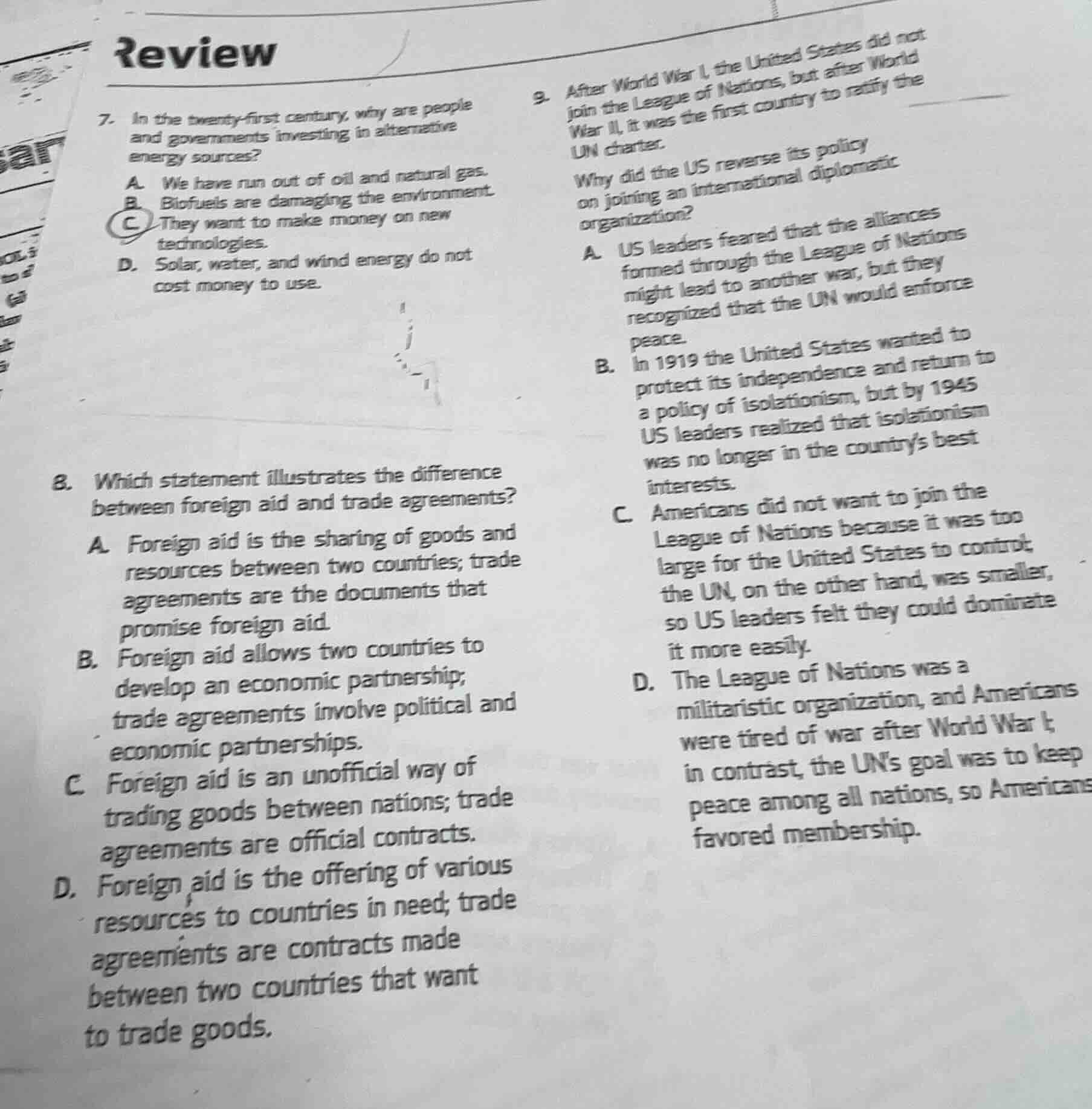
- in the twenty-first century, why are people and governments investing in alternative energy sources?
a. we have run out of oil and natural gas.
b. biofuels are damaging the environment.
c. they want to make money on new technologies.
d. solar, water, and wind energy do not cost money to use.
- which statement illustrates the difference between foreign aid and trade agreements?
a. foreign aid is the sharing of goods and resources between two countries; trade agreements are the documents that promise foreign aid.
b. foreign aid allows two countries to develop an economic partnership; trade agreements involve political and economic partnerships.
c. foreign aid is an unofficial way of trading goods between nations; trade agreements are official contracts.
d. foreign aid is the offering of various resources to countries in need; trade agreements are contracts made between two countries that want to trade goods.
- after world war i, the united states did not join the league of nations, but after world war ii, it was the first country to ratify the un charter.
why did the us reverse its policy on joining an international diplomatic organization?
a. us leaders feared that the alliances formed through the league of nations might lead to another war, but they recognized that the un would enforce peace.
b. in 1919 the united states wanted to protect its independence and return to a policy of isolationism, but by 1945 us leaders realized that isolationism was no longer in the countrys best interests.
c. americans did not want to join the league of nations because it was too large for the united states to control; the un, on the other hand, was smaller, so us leaders felt they could dominate it more easily.
d. the league of nations was a militaristic organization, and americans were tired of war after world war i; in contrast, the uns goal was to keep peace among all nations, so americans favored membership.
- Oil and natural gas are not exhausted (A is wrong); biofuels can have environmental impacts but this is not a reason to invest in alternatives (B is wrong); renewable energy infrastructure has upfront costs (D is wrong). Governments and private entities invest in alternative energy to develop and profit from emerging green technologies.
- Foreign aid is typically resources given to nations in need, while trade agreements are formal contracts for mutual trade of goods/services. Option A misdefines trade agreements; B mixes up the nature of the two; C incorrectly labels foreign aid as unofficial trading.
- After WWI, the US pursued isolationism, rejecting the League of Nations to avoid being drawn into foreign conflicts. By WWII, US leaders recognized isolationism was no longer viable, as global interdependence and the threat of future wars made UN membership necessary for US interests and global stability. Option A is incorrect (US did not see UN as enforcer initially); C is wrong (UN was larger than the League); D misrepresents the League's core purpose (it was focused on peace, not militarism).

Snap & solve any problem in the app
Get step-by-step solutions on Sovi AI
Photo-based solutions with guided steps
Explore more problems and detailed explanations
- C. They want to make money on new technologies.
- D. Foreign aid is the offering of various resources to countries in need; trade agreements are contracts made between two countries that want to trade goods.
- B. In 1919 the United States wanted to protect its independence and return to a policy of isolationism, but by 1945 US leaders realized that isolationism was no longer in the country's best interests.