QUESTION IMAGE
Question
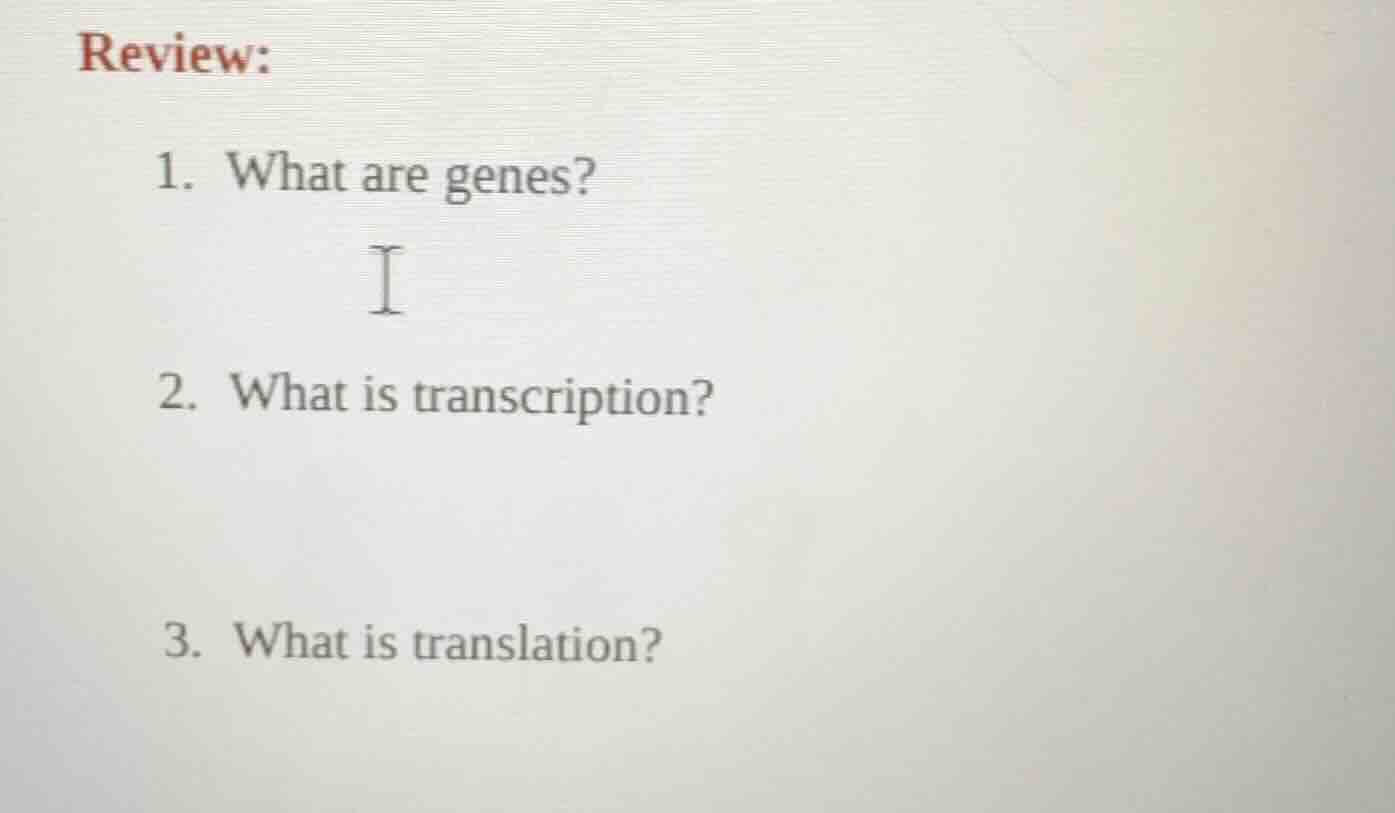
review:
- what are genes?
- what is transcription?
- what is translation?
1. What are genes?
Genes are segments of DNA (or RNA in some viruses) that contain the instructions for making functional products, usually proteins. They are the basic units of heredity, carrying the information that determines an organism's traits, such as physical characteristics, biochemical processes, and susceptibility to certain diseases. Genes are located on chromosomes within the cell nucleus (in eukaryotes) or in the cytoplasm (in prokaryotes and some viruses) and are passed from parents to offspring during reproduction.
Transcription is the first step of gene expression, occurring in the cell nucleus (in eukaryotes) or cytoplasm (in prokaryotes). During transcription, an enzyme called RNA polymerase reads a specific segment of DNA (a gene) and synthesizes a complementary RNA molecule, typically messenger RNA (mRNA). The DNA sequence is used as a template, with the base - pairing rules (A - U, T - A, G - C, C - G) guiding the formation of the RNA strand. This mRNA then carries the genetic information from the DNA to the ribosomes, where it will be used in the next step of gene expression, translation.
Translation is the second step of gene expression, taking place at ribosomes in the cytoplasm (in eukaryotes) or within the cell (in prokaryotes). During translation, the mRNA molecule is used as a template to synthesize a polypeptide chain (a protein). Transfer RNA (tRNA) molecules bring the appropriate amino acids to the ribosome, and the ribosome reads the codons (three - nucleotide sequences) on the mRNA. Each codon corresponds to a specific amino acid, and as the ribosome moves along the mRNA, it links the amino acids together in the order specified by the mRNA sequence, eventually forming a functional protein.

Snap & solve any problem in the app
Get step-by-step solutions on Sovi AI
Photo-based solutions with guided steps
Explore more problems and detailed explanations
Genes are DNA (or RNA) segments carrying hereditary instructions for functional products (usually proteins), determining an organism's traits and passed in reproduction.