QUESTION IMAGE
Question
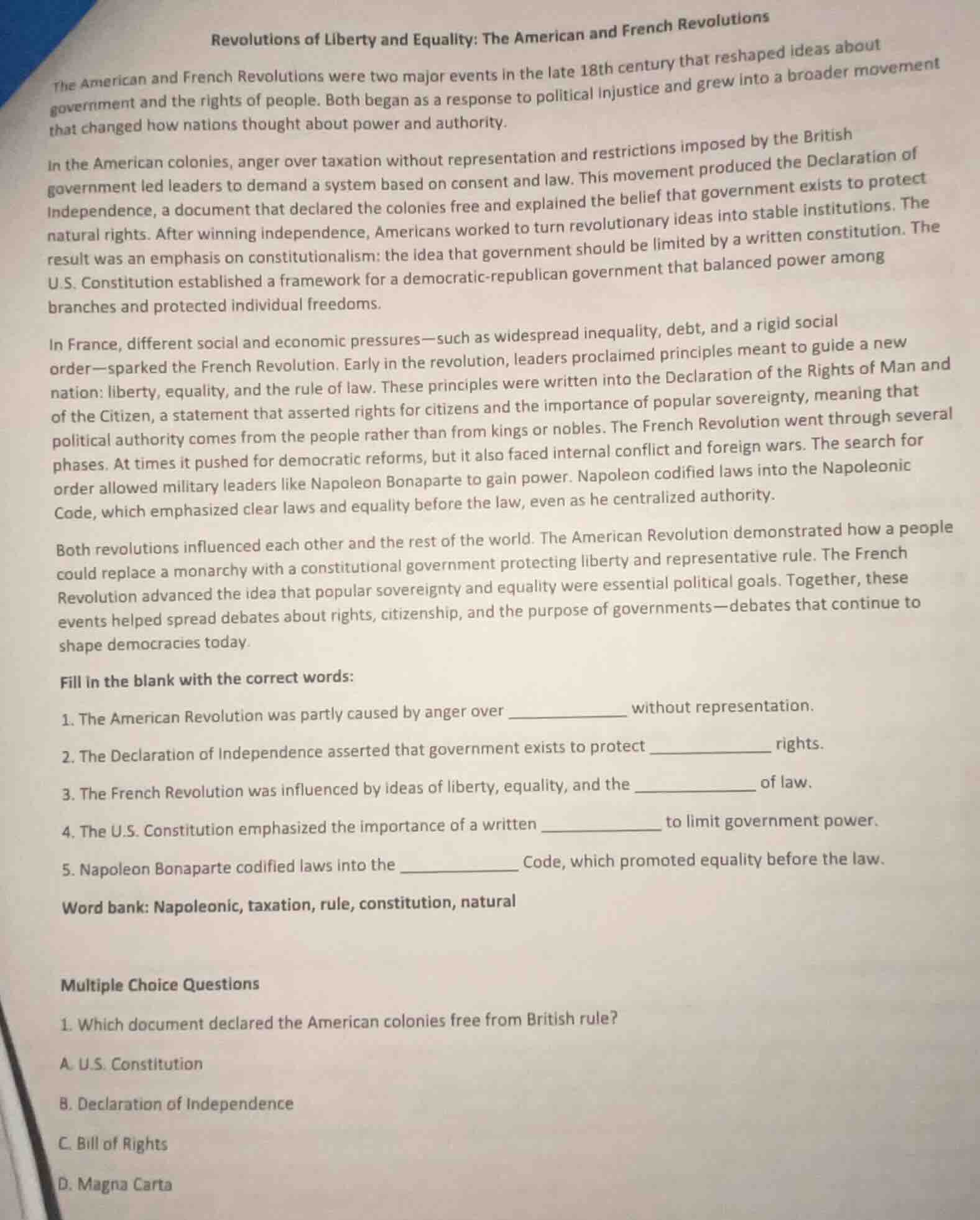
revolutions of liberty and equality: the american and french revolutions
the american and french revolutions were two major events in the late 18th century that reshaped ideas about
government and the rights of people. both began as a response to political injustice and grew into a broader movement
that changed how nations thought about power and authority.
in the american colonies, anger over taxation without representation and restrictions imposed by the british
government led leaders to demand a system based on consent and law. this movement produced the declaration of
independence, a document that declared the colonies free and explained the belief that government exists to protect
natural rights. after winning independence, americans worked to turn revolutionary ideas into stable institutions. the
result was an emphasis on constitutionalism: the idea that government should be limited by a written constitution. the
u.s. constitution established a framework for a democratic - republican government that balanced power among
branches and protected individual freedoms.
in france, different social and economic pressures—such as widespread inequality, debt, and a rigid social
order—sparked the french revolution. early in the revolution, leaders proclaimed principles meant to guide a new
nation: liberty, equality, and the rule of law. these principles were written into the declaration of the rights of man and
of the citizen, a statement that asserted rights for citizens and the importance of popular sovereignty, meaning that
political authority comes from the people rather than from kings or nobles. the french revolution went through several
phases. at times it pushed for democratic reforms, but it also faced internal conflict and foreign wars. the search for
order allowed military leaders like napoleon bonaparte to gain power. napoleon codified laws into the napoleonic
code, which emphasized clear laws and equality before the law, even as he centralized authority.
both revolutions influenced each other and the rest of the world. the american revolution demonstrated how a people
could replace a monarchy with a constitutional government protecting liberty and representative rule. the french
revolution advanced the idea that popular sovereignty and equality were essential political goals. together, these
events helped spread debates about rights, citizenship, and the purpose of governments—debates that continue to
shape democracies today.
fill in the blank with the correct words:
- the american revolution was partly caused by anger over __________ without representation.
- the declaration of independence asserted that government exists to protect __________ rights.
- the french revolution was influenced by ideas of liberty, equality, and the __________ of law.
- the u.s. constitution emphasized the importance of a written __________ to limit government power.
- napoleon bonaparte codified laws into the __________ code, which promoted equality before the law.
word bank: napoleonic, taxation, rule, constitution, natural
multiple choice questions
- which document declared the american colonies free from british rule?
a. u.s. constitution
b. declaration of independence
c. bill of rights
d. magna carta
Fill in the blank
1.
From the text: "In the American colonies, anger over taxation without representation and restrictions imposed by the British government...", so the word is taxation.
The text says: "This movement produced the Declaration of Independence, a document that declared the colonies free and explained the belief that government exists to protect natural rights.", so the word is natural.
From the text: "Early in the revolution, leaders proclaimed principles meant to guide a new nation: liberty, equality, and the rule of law.", so the word is rule.

Snap & solve any problem in the app
Get step-by-step solutions on Sovi AI
Photo-based solutions with guided steps
Explore more problems and detailed explanations
taxation
2.