QUESTION IMAGE
Question
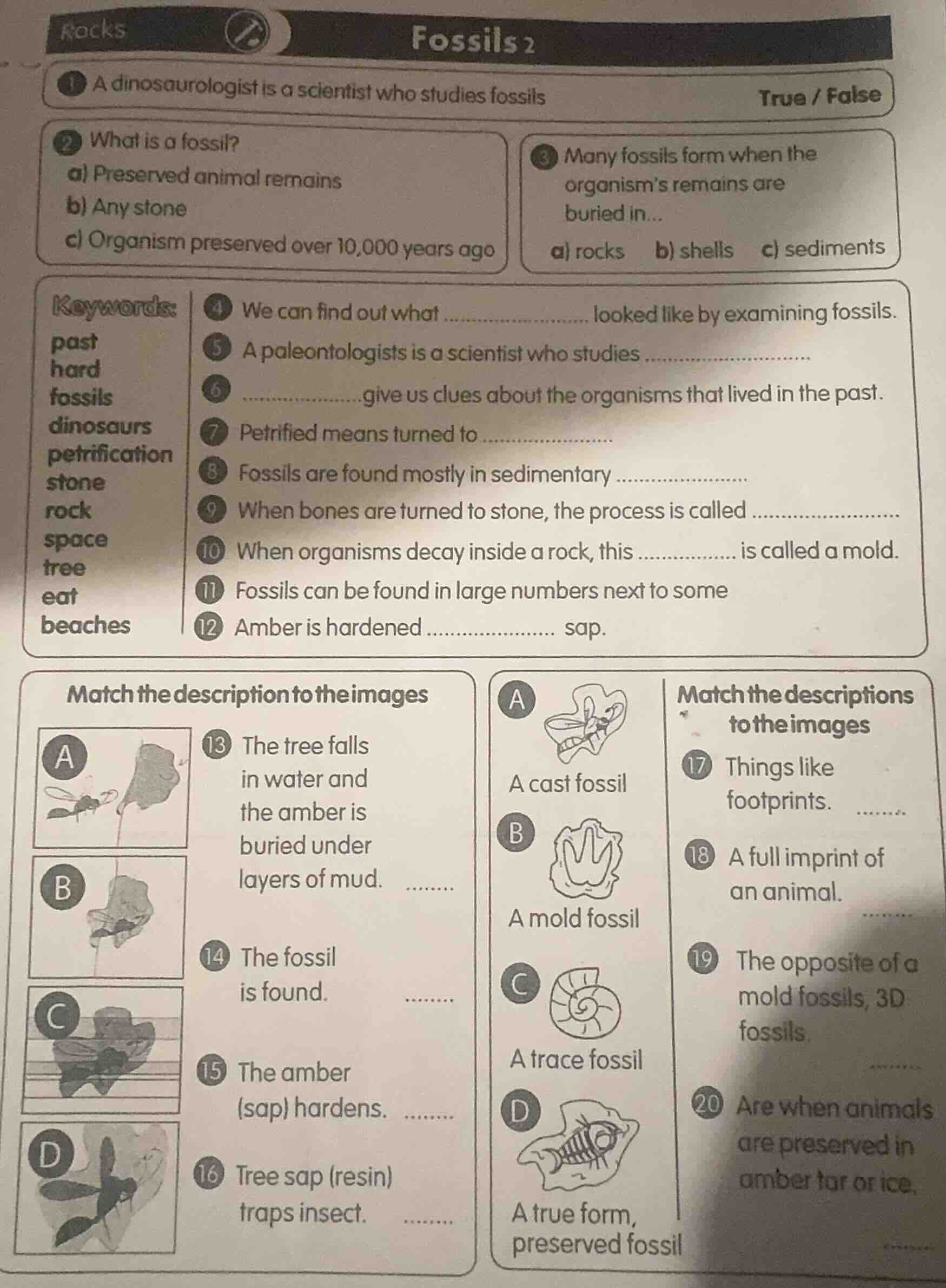
rocks fossils 2 1 a dinosaurologist is a scientist who studies fossils true / false 2 what is a fossil? a) preserved animal remains b) any stone c) organism preserved over 10,000 years ago 3 many fossils form when the organism’s remains are buried in... a) rocks b) shells c) sediments keywords: past hard fossils dinosaurs petrification stone rock space tree eat beaches 4 we can find out what ..................... looked like by examining fossils. 5 a paleontologists is a scientist who studies ......................... 6 ................... give us clues about the organisms that lived in the past. 7 petrified means turned to ..................... 8 fossils are found mostly in sedimentary ..................... 9 when bones are turned to stone, the process is called ......................... 10 when organisms decay inside a rock, this ............... is called a mold. 11 fossils can be found in large numbers next to some 12 amber is hardened ..................... sap. match the description to the images a b c d 13 the tree falls in water and the amber is buried under layers of mud. ....... 14 the fossil is found. ....... 15 the amber (sap) hardens. ....... 16 tree sap (resin) traps insect. ....... a a cast fossil b a mold fossil c a trace fossil d a true form, preserved fossil match the descriptions to the images 17 things like footprints. ...... 18 a full imprint of an animal. ...... 19 the opposite of a mold fossils, 3d fossils. ...... 20 are when animals are preserved in amber tar or ice.
- Question 1: A dinosaurologist focuses on dinosaurs, a subset of fossil study, so the statement is true.
- Question 2: Fossils are preserved remains/traces of ancient organisms; option (a) is the most accurate basic definition.
- Question 3: Most fossils form when remains are buried in sediments, which later harden into rock.
- Question 4: Fossils show physical traits of ancient organisms from the past.
- Question 5: Paleontologists are scientists who study fossils (ancient life).
- Question 6: Fossils are the primary clues about past organisms.
- Question 7: Petrification is the process of organic material turning to stone.
- Question 8: Sedimentary rocks form from layered sediments, which most often trap and preserve fossils.
- Question 9: The process of bones turning to stone is called petrification.
- Question 10: A mold fossil forms when an organism decays, leaving an empty imprint in rock.
- Question 11: Fossils are often eroded out and found in large numbers near beaches.
- Question 12: Amber forms when tree sap hardens over time.
- Question 13: The sequence of a tree falling, amber being buried matches image C.
- Question 14: Finding the finished fossil matches image B.
- Question 15: Sap hardening into amber matches image D.
- Question 16: Tree sap trapping an insect matches image A.
- Question 17: Footprints are a type of trace fossil (image B).
- Question 18: A full animal imprint is a mold fossil (image C).
- Question 19: A 3D opposite of a mold is a cast fossil (image D).
- Question 20: Animals preserved in amber are true form fossils (image A).

Snap & solve any problem in the app
Get step-by-step solutions on Sovi AI
Photo-based solutions with guided steps
Explore more problems and detailed explanations
- True
- a) Preserved animal remains
- c) sediments
- dinosaurs
- fossils
- Fossils
- stone
- rock
- petrification
- imprint
- beaches
- tree
- C
- B
- D
- A
- B
- C
- D
- A