QUESTION IMAGE
Question
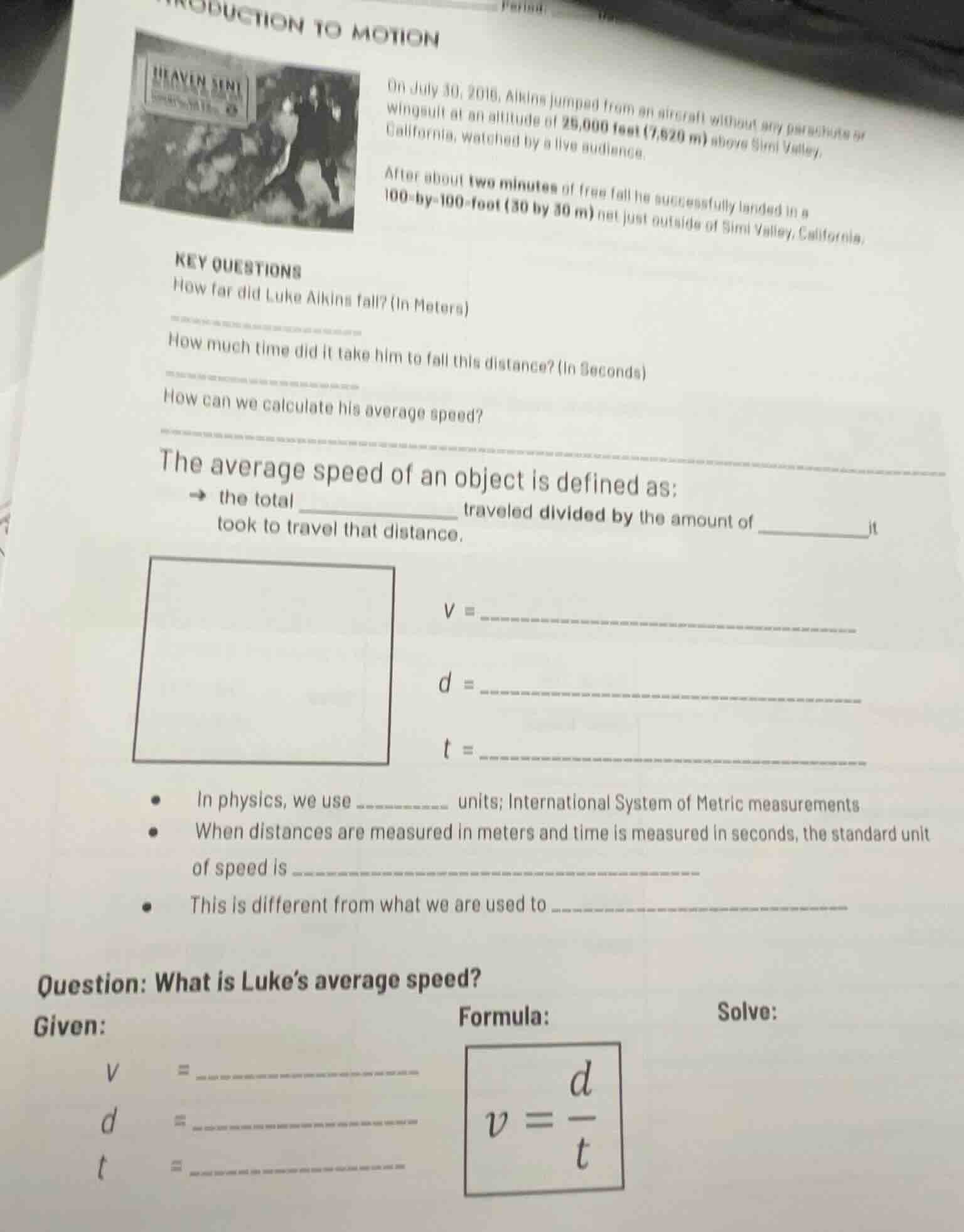
roduction to motion
on july 30, 2016, aikins jumped from an aircraft without any parachute or wingsuit at an altitude of 25,000 feet (7,620 m) above simi valley, california, watched by a live audience.
after about two minutes of free fall he successfully landed in a 100-by-100-foot (30 by 30 m) net just outside of simi valley, california.
key questions
how far did luke aikins fall? (in meters)
how much time did it take him to fall this distance? (in seconds)
how can we calculate his average speed?
the average speed of an object is defined as:
→ the total __________ traveled divided by the amount of __________ it took to travel that distance.
$v = $
$d = $
$t = $
- in physics, we use ________ units; international system of metric measurements
- when distances are measured in meters and time is measured in seconds, the standard unit of speed is ________
- this is different from what we are used to ________
question: what is lukes average speed?
given:
$v = $
$d = $
$t = $
formula:
$v = \frac{d}{t}$
solve:
Step1: Find fall distance (meters)
From text: $d=7620$ m
Step2: Convert fall time to seconds
$t=2\text{ minutes}=2\times60=120$ s
Step3: Recall average speed definition
Average speed = $\frac{\text{total distance}}{\text{total time}}$
Step4: Fill definition blanks
First blank: distance; Second blank: time
Step5: Derive speed-related formulas
From $v=\frac{d}{t}$:
$d=v\times t$, $t=\frac{d}{v}$
Step6: Fill physics unit blanks
- SI (metric) units; 2. m/s; 3. mph (imperial speed unit)
Step7: Calculate average speed
Substitute values: $v=\frac{7620}{120}=63.5$ m/s

Snap & solve any problem in the app
Get step-by-step solutions on Sovi AI
Photo-based solutions with guided steps
Explore more problems and detailed explanations
- 7620 meters
- 120 seconds
- Average speed = total distance / total time
- distance; time
- $v=\frac{d}{t}$; $d=v\times t$; $t=\frac{d}{v}$
- SI; meters per second (m/s); miles per hour (mph)
- 63.5 m/s