QUESTION IMAGE
Question
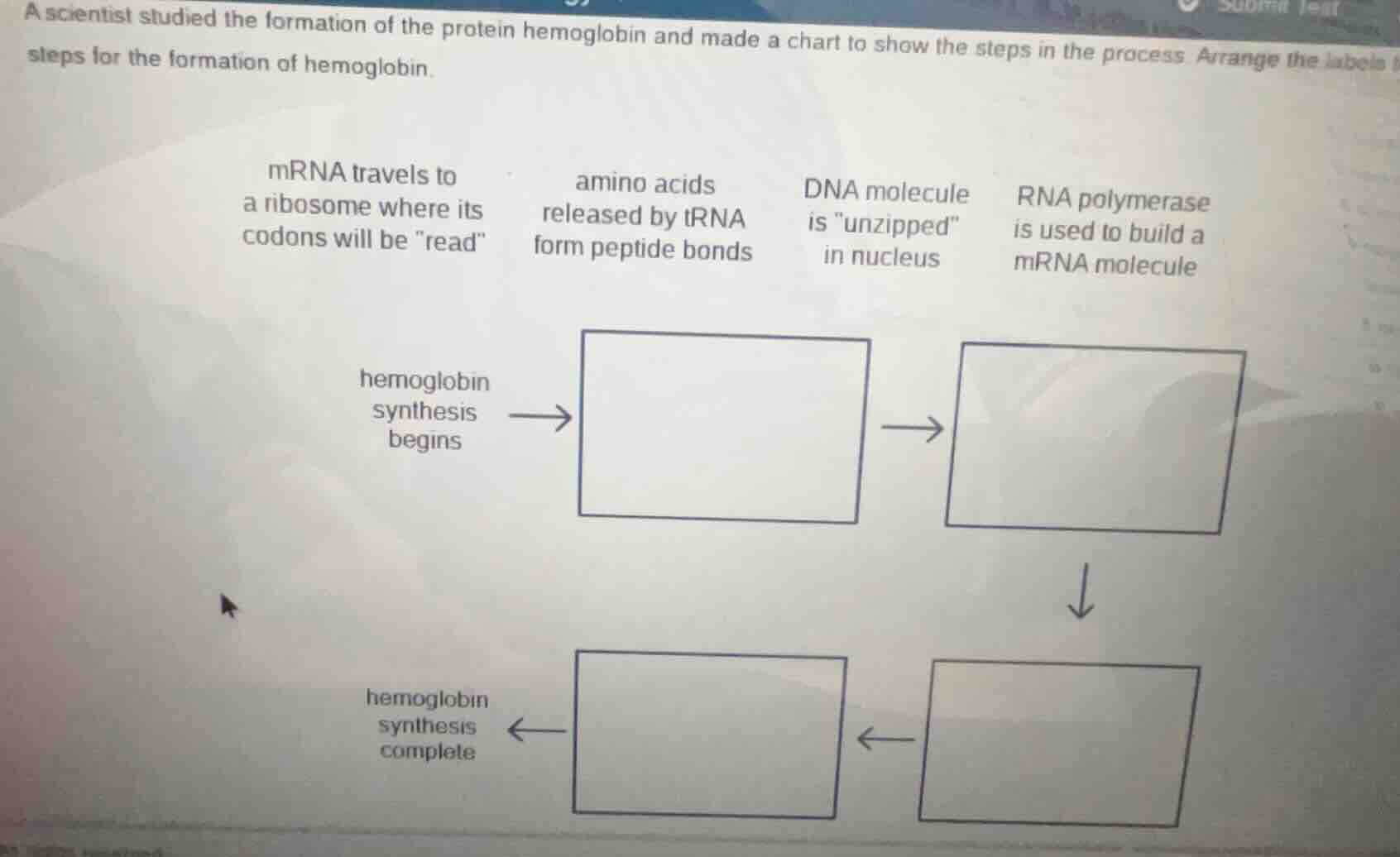
a scientist studied the formation of the protein hemoglobin and made a chart to show the steps in the process arrange the labels steps for the formation of hemoglobin.
mrna travels to
a ribosome where its
codons will be
ead\
amino acids
released by trna
form peptide bonds
dna molecule
is \unzipped\
in nucleus
rna polymerase
is used to build a
mrna molecule
hemoglobin
synthesis
begins
hemoglobin
synthesis
complete
Brief Explanations
This is the sequential process of protein (hemoglobin) synthesis, starting with transcription in the nucleus, followed by translation at the ribosome.
- First, the DNA molecule must unwind to expose the gene for hemoglobin.
- Next, RNA polymerase uses the unwound DNA to build a complementary mRNA strand.
- The mRNA then leaves the nucleus and travels to a ribosome to be translated.
- At the ribosome, tRNA delivers amino acids, which are linked by peptide bonds to form a polypeptide chain.
- Finally, the polypeptide folds into the functional hemoglobin protein.

Snap & solve any problem in the app
Get step-by-step solutions on Sovi AI
Photo-based solutions with guided steps
Explore more problems and detailed explanations
- First box (after synthesis begins): DNA molecule is "unzipped" in nucleus
- Second box: RNA polymerase is used to build a mRNA molecule
- Third box: mRNA travels to a ribosome where its codons will be "read"
- Fourth box (before synthesis complete): amino acids released by tRNA form peptide bonds