QUESTION IMAGE
Question
scientists use near-infrared waves, a type of infrared wave with wavelengths close to those of visible light, to monitor the health of earths plants. typically, healthy plants reflect more near-infrared waves than unhealthy plants. the opposite is true for visible light. healthy plants reflect less visible light than unhealthy plants.
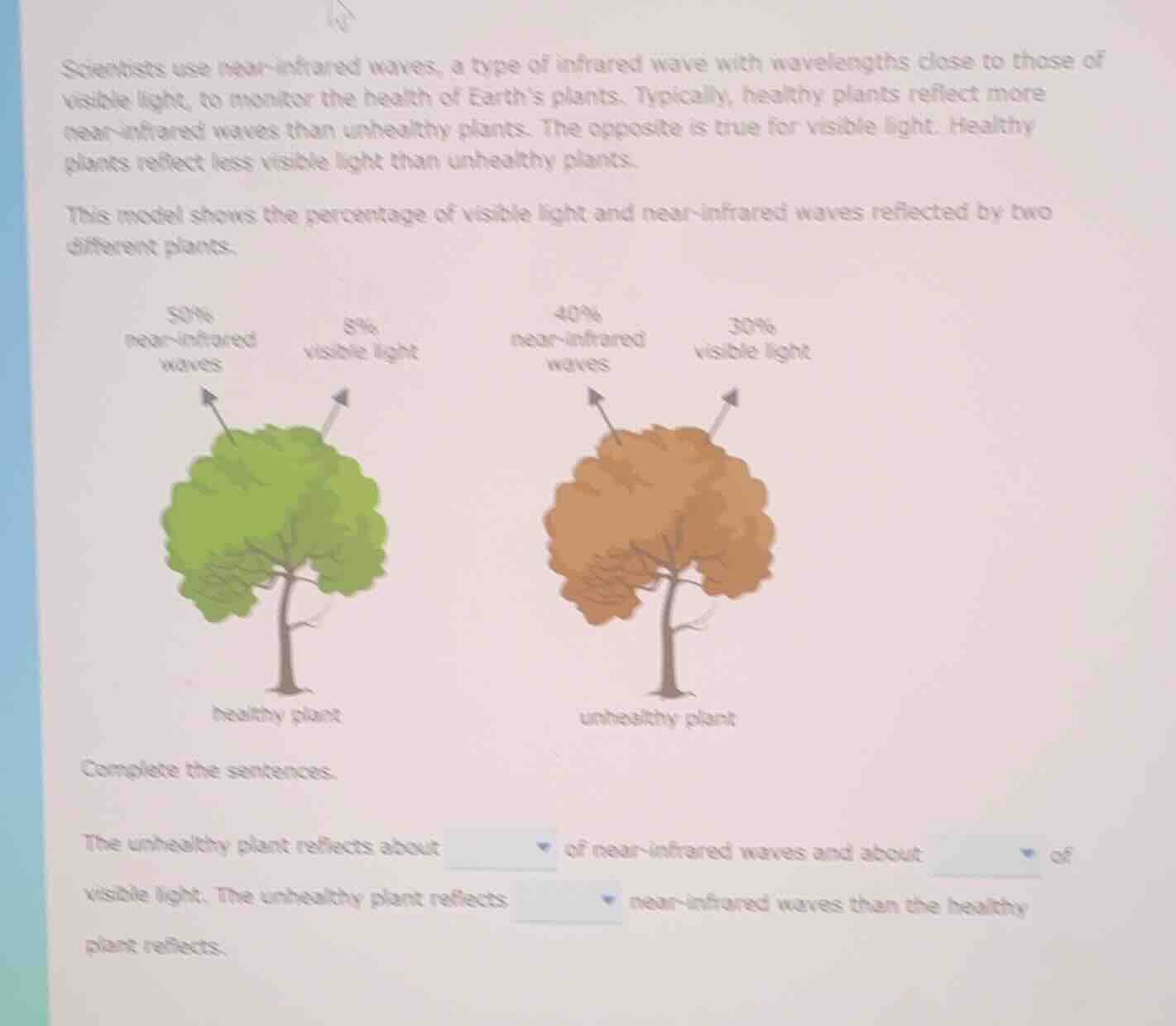
this model shows the percentage of visible light and near-infrared waves reflected by two different plants.
healthy plant
unhealthy plant
complete the sentences.
the unhealthy plant reflects about ____ of near-infrared waves and about __ of visible light. the unhealthy plant reflects ____ near-infrared waves than the healthy plant reflects.
Step1: Extract unhealthy plant's near-IR value
From the model, the unhealthy plant reflects 40% of near-infrared waves.
Step2: Extract unhealthy plant's visible light value
From the model, the unhealthy plant reflects 30% of visible light.
Step3: Compare near-IR reflection amounts
Healthy plant: 50% near-IR; Unhealthy plant: 40% near-IR. $40\% < 50\%$, so the unhealthy plant reflects less.

Snap & solve any problem in the app
Get step-by-step solutions on Sovi AI
Photo-based solutions with guided steps
Explore more problems and detailed explanations
The unhealthy plant reflects about 40% of near-infrared waves and about 30% of visible light. The unhealthy plant reflects less near-infrared waves than the healthy plant reflects.