QUESTION IMAGE
Question
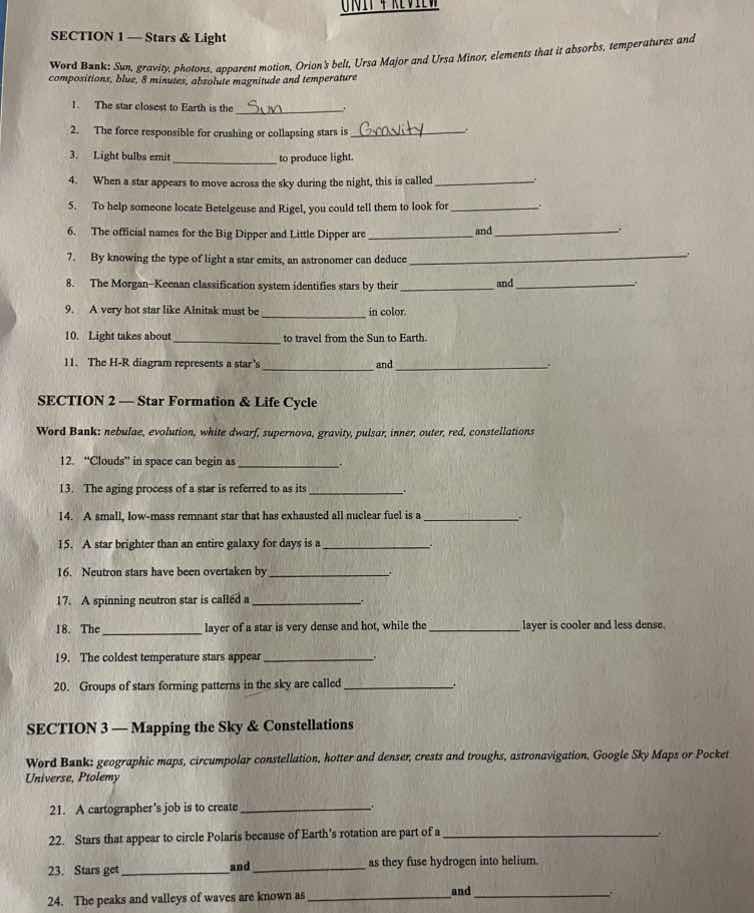
section 1 — stars & light
word bank: sun, gravity, photons, apparent motion, orion’s belt, ursa major and ursa minor, elements that it absorbs, temperatures and compositions, blue, 8 minutes, absolute magnitude and temperature
- the star closest to earth is the ______.
- the force responsible for crushing or collapsing stars is ______.
- light bulbs emit ______ to produce light.
- when a star appears to move across the sky during the night, this is called ______.
- to help someone locate betelgeuse and rigel, you could tell them to look for ______.
- the official names for the big dipper and little dipper are ____ and ____.
- by knowing the type of light a star emits, an astronomer can deduce ______.
- the morgan - keenan classification system identifies stars by their ____ and ____.
- a very hot star like alnitak must be ______ in color.
- light takes about ______ to travel from the sun to earth.
- the h - r diagram represents a star’s ____ and ____.
section 2 — star formation & life cycle
word bank: nebulae, evolution, white dwarf, supernova, gravity, pulsar, inner, outer, red, constellations
- “clouds” in space can begin as ______.
- the aging process of a star is referred to as its ______.
- a small, low - mass remnant star that has exhausted all nuclear fuel is a ______.
- a star brighter than an entire galaxy for days is a ______.
- neutron stars have been overtaken by ______.
- a spinning neutron star is called a ______.
- the ____ layer of a star is very dense and hot, while the ____ layer is cooler and less dense.
- the coldest temperature stars appear ______.
- groups of stars forming patterns in the sky are called ______.
section 3 — mapping the sky & constellations
word bank: geographic maps, circumpolar constellation, hotter and denser, crests and troughs, astronavigation, google sky maps or pocket universe, ptolemy
- a cartographer’s job is to create ______.
- stars that appear to circle polaris because of earth’s rotation are part of a ______.
- stars get ____ and ____ as they fuse hydrogen into helium.
- the peaks and valleys of waves are known as ____ and ____.
Each answer is matched to the corresponding term from the provided word banks based on astronomical definitions and facts.

Snap & solve any problem in the app
Get step-by-step solutions on Sovi AI
Photo-based solutions with guided steps
Explore more problems and detailed explanations
SECTION 1 — Stars & Light
- Sun
- gravity
- photons
- apparent motion
- Orion's belt
- Ursa Major; Ursa Minor
- temperatures and compositions
- absolute magnitude; temperature
- blue
- 8 minutes
- absolute magnitude; temperature
SECTION 2 — Star Formation & Life Cycle
- nebulae
- evolution
- white dwarf
- supernova
- gravity
- pulsar
- inner; outer
- red
- constellations
SECTION 3 — Mapping the Sky & Constellations
- geographic maps
- circumpolar constellation
- hotter; denser
- crests; troughs