QUESTION IMAGE
Question
select all that apply
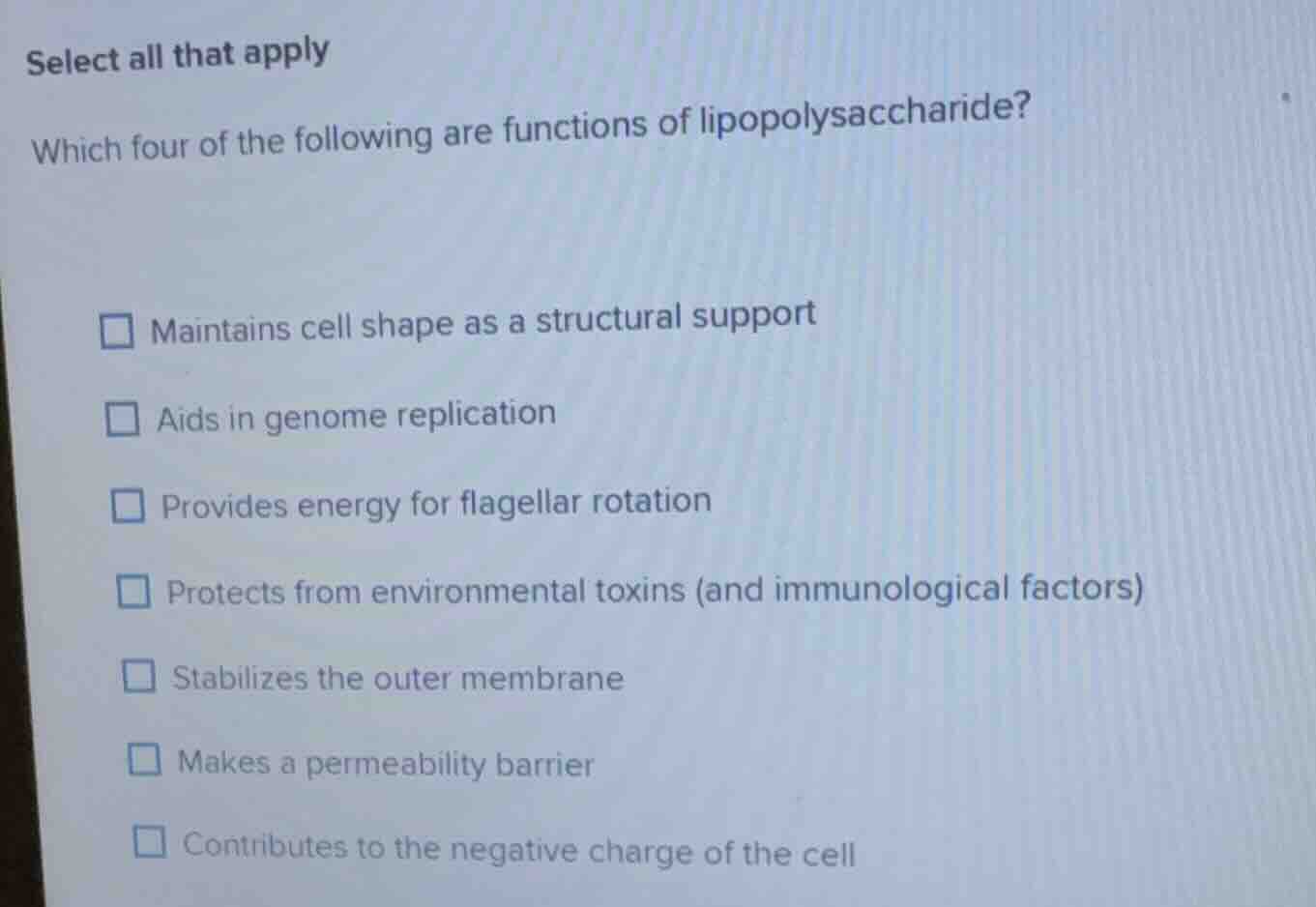
which four of the following are functions of lipopolysaccharide?
maintains cell shape as a structural support
aids in genome replication
provides energy for flagellar rotation
protects from environmental toxins (and immunological factors)
stabilizes the outer membrane
makes a permeability barrier
contributes to the negative charge of the cell
Brief Explanations
Lipopolysaccharide (LPS) is part of the outer membrane of Gram - negative bacteria.
- Protects from environmental toxins (and immunological factors): LPS acts as a barrier, preventing harmful substances like toxins and components of the immune system from entering the cell easily.
- Stabilizes the outer membrane: It is an important structural component that helps maintain the integrity and stability of the outer membrane.
- Makes a permeability barrier: The outer membrane with LPS restricts the passage of many molecules, acting as a permeability barrier.
- Contributes to the negative charge of the cell: The polysaccharide part of LPS has negatively charged groups, which contribute to the overall negative charge of the bacterial cell surface.
- "Maintains cell shape as a structural support" is a function of peptidoglycan, not LPS.
- "Aids in genome replication" is not a function of LPS; genome replication is carried out by enzymes and other cellular machinery related to DNA.
- "Provides energy for flagellar rotation" is done by the proton - motive force, not LPS.

Snap & solve any problem in the app
Get step-by-step solutions on Sovi AI
Photo-based solutions with guided steps
Explore more problems and detailed explanations
- Protects from environmental toxins (and immunological factors)
- Stabilizes the outer membrane
- Makes a permeability barrier
- Contributes to the negative charge of the cell