QUESTION IMAGE
Question
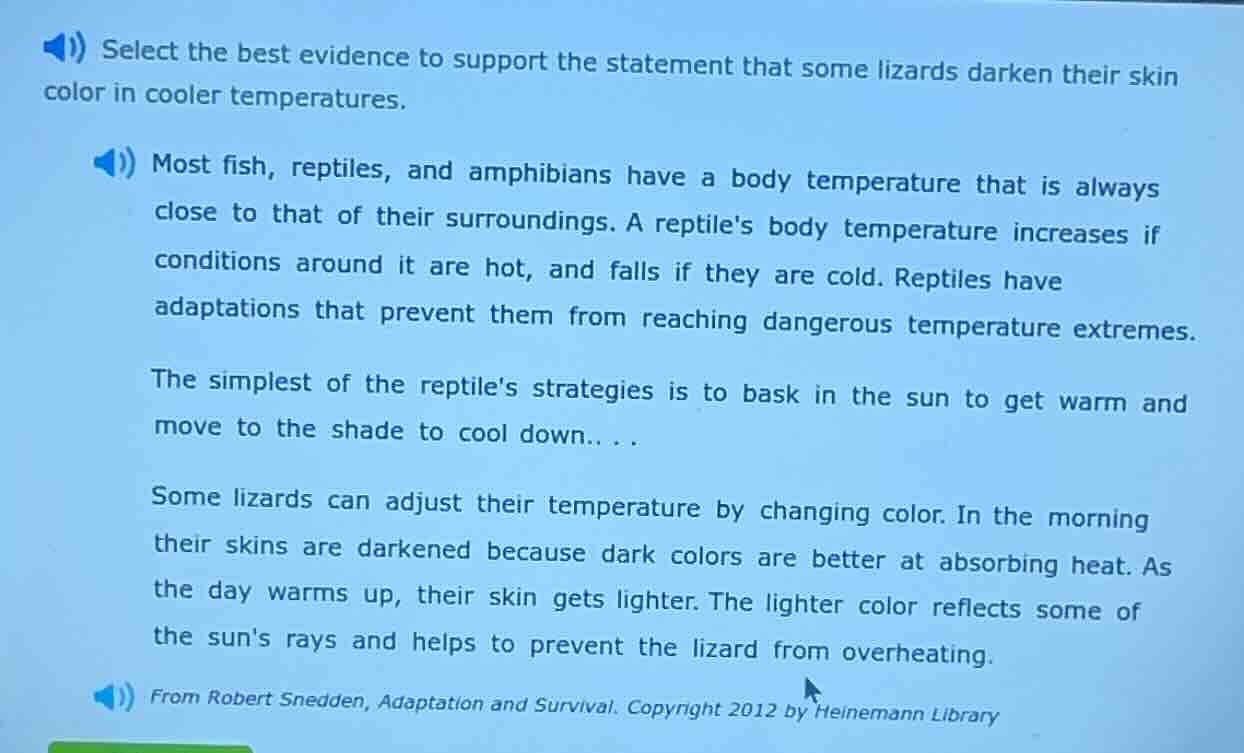
select the best evidence to support the statement that some lizards darken their skin color in cooler temperatures. most fish, reptiles, and amphibians have a body temperature that is always close to that of their surroundings. a reptiles body temperature increases if conditions around it are hot, and falls if they are cold. reptiles have adaptations that prevent them from reaching dangerous temperature extremes. the simplest of the reptiles strategies is to bask in the sun to get warm and move to the shade to cool down.... some lizards can adjust their temperature by changing color. in the morning their skins are darkened because dark colors are better at absorbing heat. as the day warms up, their skin gets lighter. the lighter color reflects some of the suns rays and helps to prevent the lizard from overheating. from robert snedden, adaptation and survival. copyright 2012 by heinemann library
To support the statement that some lizards darken their skin in cooler temperatures, we look for evidence connecting lizard skin color change to temperature. The relevant part is: "Some lizards can adjust their temperature by changing color. In the morning their skins are darkened because dark colors are better at absorbing heat. As the day warms up, their skin gets lighter." Mornings are typically cooler, and this text explains that lizards darken their skin (to absorb heat) in the cooler morning and lighten as it warms, directly supporting the statement.

Snap & solve any problem in the app
Get step-by-step solutions on Sovi AI
Photo-based solutions with guided steps
Explore more problems and detailed explanations
Some lizards can adjust their temperature by changing color. In the morning their skins are darkened because dark colors are better at absorbing heat. As the day warms up, their skin gets lighter.