QUESTION IMAGE
Question
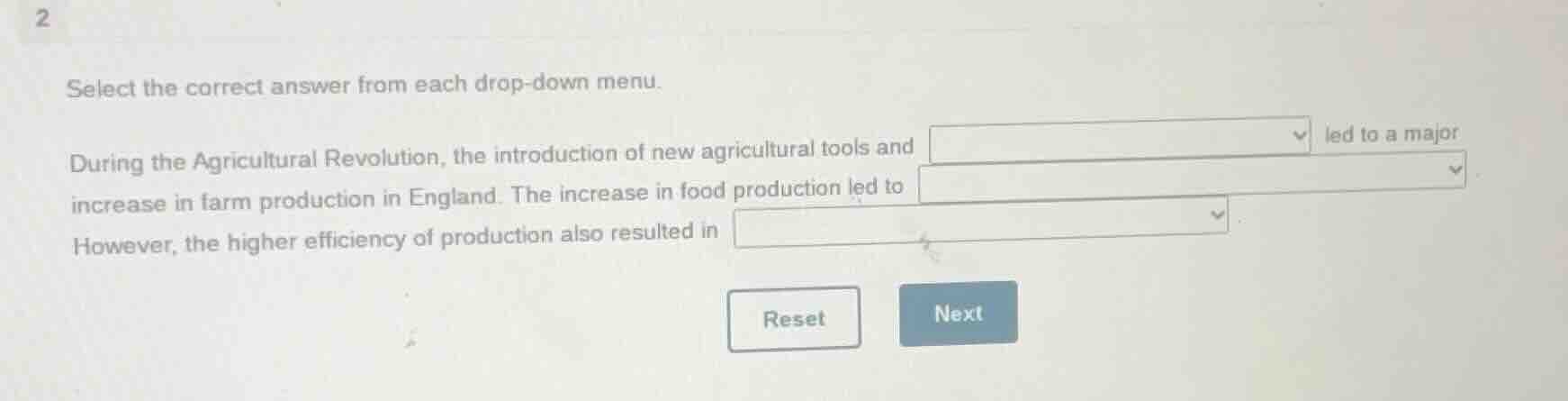
select the correct answer from each drop - down menu.
during the agricultural revolution, the introduction of new agricultural tools and led to a major increase in farm production in england. the increase in food production led to
however, the higher efficiency of production also resulted in
To solve this, we analyze the context of the Agricultural Revolution:
First Drop - down (new agricultural tools and what?):
New agricultural tools and farming techniques (e.g., crop rotation, enclosure movement - related practices) led to increased farm production. So the first blank likely has an option like "farming techniques".
Second Drop - down (increase in food production led to?):
More food means more people can be supported, so it led to a population increase (since food availability is a key factor in population growth).
Third Drop - down (higher efficiency resulted in?):
Higher efficiency in farming meant fewer workers were needed on farms, so it resulted in rural - to - urban migration (as displaced farm workers moved to cities for industrial jobs) or unemployment in rural areas (since less labor was required for farming).
Since the exact options in the drop - downs are not provided, but based on historical knowledge of the Agricultural Revolution:
- First blank: farming techniques (or similar option about agricultural practices)
- Second blank: population increase (or growth)
- Third blank: rural unemployment (or migration to cities)
If we assume typical options (e.g., from common history curricula):
- First drop - down: farming techniques
- Second drop - down: a population increase
- Third drop - down: rural workers moving to cities (or unemployment in rural areas)
For example, a complete sentence would be:
"During the Agricultural Revolution, the introduction of new agricultural tools and \(\boldsymbol{\text{farming techniques}}\) led to a major increase in farm production in England. The increase in food production led to \(\boldsymbol{\text{a population increase}}\). However, the higher efficiency of production also resulted in \(\boldsymbol{\text{rural workers moving to cities}}\)."

Snap & solve any problem in the app
Get step-by-step solutions on Sovi AI
Photo-based solutions with guided steps
Explore more problems and detailed explanations
To solve this, we analyze the context of the Agricultural Revolution:
First Drop - down (new agricultural tools and what?):
New agricultural tools and farming techniques (e.g., crop rotation, enclosure movement - related practices) led to increased farm production. So the first blank likely has an option like "farming techniques".
Second Drop - down (increase in food production led to?):
More food means more people can be supported, so it led to a population increase (since food availability is a key factor in population growth).
Third Drop - down (higher efficiency resulted in?):
Higher efficiency in farming meant fewer workers were needed on farms, so it resulted in rural - to - urban migration (as displaced farm workers moved to cities for industrial jobs) or unemployment in rural areas (since less labor was required for farming).
Since the exact options in the drop - downs are not provided, but based on historical knowledge of the Agricultural Revolution:
- First blank: farming techniques (or similar option about agricultural practices)
- Second blank: population increase (or growth)
- Third blank: rural unemployment (or migration to cities)
If we assume typical options (e.g., from common history curricula):
- First drop - down: farming techniques
- Second drop - down: a population increase
- Third drop - down: rural workers moving to cities (or unemployment in rural areas)
For example, a complete sentence would be:
"During the Agricultural Revolution, the introduction of new agricultural tools and \(\boldsymbol{\text{farming techniques}}\) led to a major increase in farm production in England. The increase in food production led to \(\boldsymbol{\text{a population increase}}\). However, the higher efficiency of production also resulted in \(\boldsymbol{\text{rural workers moving to cities}}\)."