QUESTION IMAGE
Question
select the correct answer.
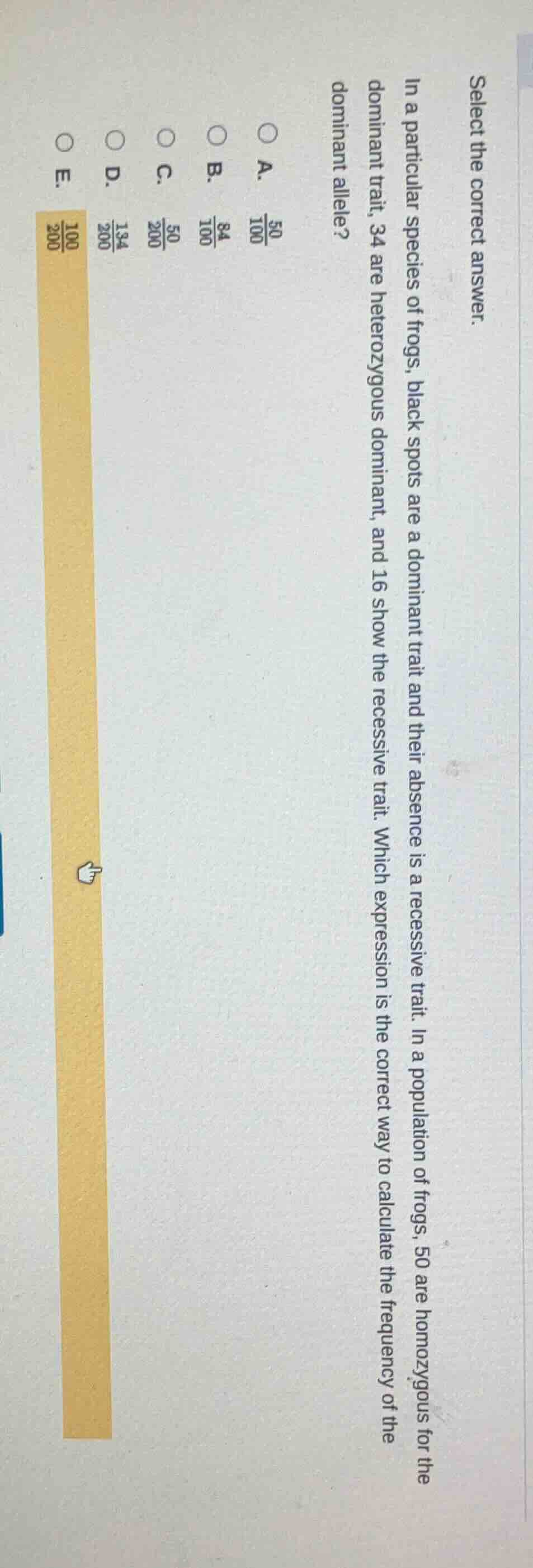
in a particular species of frogs, black spots are a dominant trait and their absence is a recessive trait. in a population of frogs, 50 are homozygous for the dominant trait, 34 are heterozygous dominant, and 16 show the recessive trait. which expression is the correct way to calculate the frequency of the dominant allele?
a. $\frac{50}{100}$
b. $\frac{84}{100}$
c. $\frac{50}{200}$
d. $\frac{134}{200}$
e. $\frac{100}{200}$
Step1: Determine total number of frogs
First, we find the total number of frogs in the population. The number of homozygous dominant frogs is 50, heterozygous dominant is 34, and recessive (homozygous recessive) is 16. So total number \( N = 50 + 34 + 16 = 100 \) frogs. But since each frog has 2 alleles, the total number of alleles is \( 2\times100 = 200 \).
Step2: Calculate number of dominant alleles
Homozygous dominant frogs (50) have 2 dominant alleles each, so they contribute \( 50\times2 = 100 \) dominant alleles. Heterozygous dominant frogs (34) have 1 dominant allele each, so they contribute \( 34\times1 = 34 \) dominant alleles. The total number of dominant alleles is \( 100 + 34 = 134 \)? Wait, no, wait. Wait, the formula for allele frequency: for a dominant allele (let's say \( p \)), the frequency is \( \frac{(2\times \text{homozygous dominant}) + (\text{heterozygous})}{2\times \text{total population}} \). Wait, homozygous dominant is 50, heterozygous is 34, recessive is 16. Total population is \( 50 + 34 + 16 = 100 \) individuals. Total alleles: \( 100\times2 = 200 \). Number of dominant alleles: homozygous dominant have 2 each, so \( 50\times2 = 100 \), heterozygous have 1 each, so \( 34\times1 = 34 \). So total dominant alleles: \( 100 + 34 = 134 \)? Wait, but let's check the options. Option D is \( \frac{134}{200} \)? Wait, no, wait the options: A is \( \frac{50}{100} \), B \( \frac{84}{100} \), C \( \frac{50}{200} \), D \( \frac{134}{200} \), E \( \frac{100}{200} \). Wait, maybe I made a mistake. Wait, homozygous dominant is 50 (so 50 individuals with 2 dominant alleles: 502=100), heterozygous is 34 (34 individuals with 1 dominant allele: 341=34), so total dominant alleles: 100 + 34 = 134. Total alleles: 2(50+34+16)=2100=200. So the frequency is \( \frac{134}{200} \), which is option D? Wait, but let's re-express. Wait, the formula for allele frequency: if \( p \) is the frequency of dominant allele, \( q \) recessive. Then \( p = \frac{(2N_{AA}) + N_{Aa}}{2N} \), where \( N_{AA} \) is number of homozygous dominant, \( N_{Aa} \) heterozygous, \( N \) total individuals. So \( N_{AA} = 50 \), \( N_{Aa} = 34 \), \( N = 100 \). So \( p = \frac{(250) + 34}{2100} = \frac{100 + 34}{200} = \frac{134}{200} \), which is option D. Wait, but let's check the options again. Option D is \( \frac{134}{200} \), yes. So the correct expression is \( \frac{134}{200} \), which is option D.
Wait, maybe I messed up earlier. Let's recalculate:
Total individuals: 50 (AA) + 34 (Aa) + 16 (aa) = 100.
Total alleles: 100 * 2 = 200.
Number of A alleles (dominant): AA individuals have 2 A each: 502=100. Aa individuals have 1 A each: 341=34. So total A alleles: 100 + 34 = 134.
So frequency of A allele is \( \frac{134}{200} \), which is option D.

Snap & solve any problem in the app
Get step-by-step solutions on Sovi AI
Photo-based solutions with guided steps
Explore more problems and detailed explanations
D. \(\frac{134}{200}\)