QUESTION IMAGE
Question
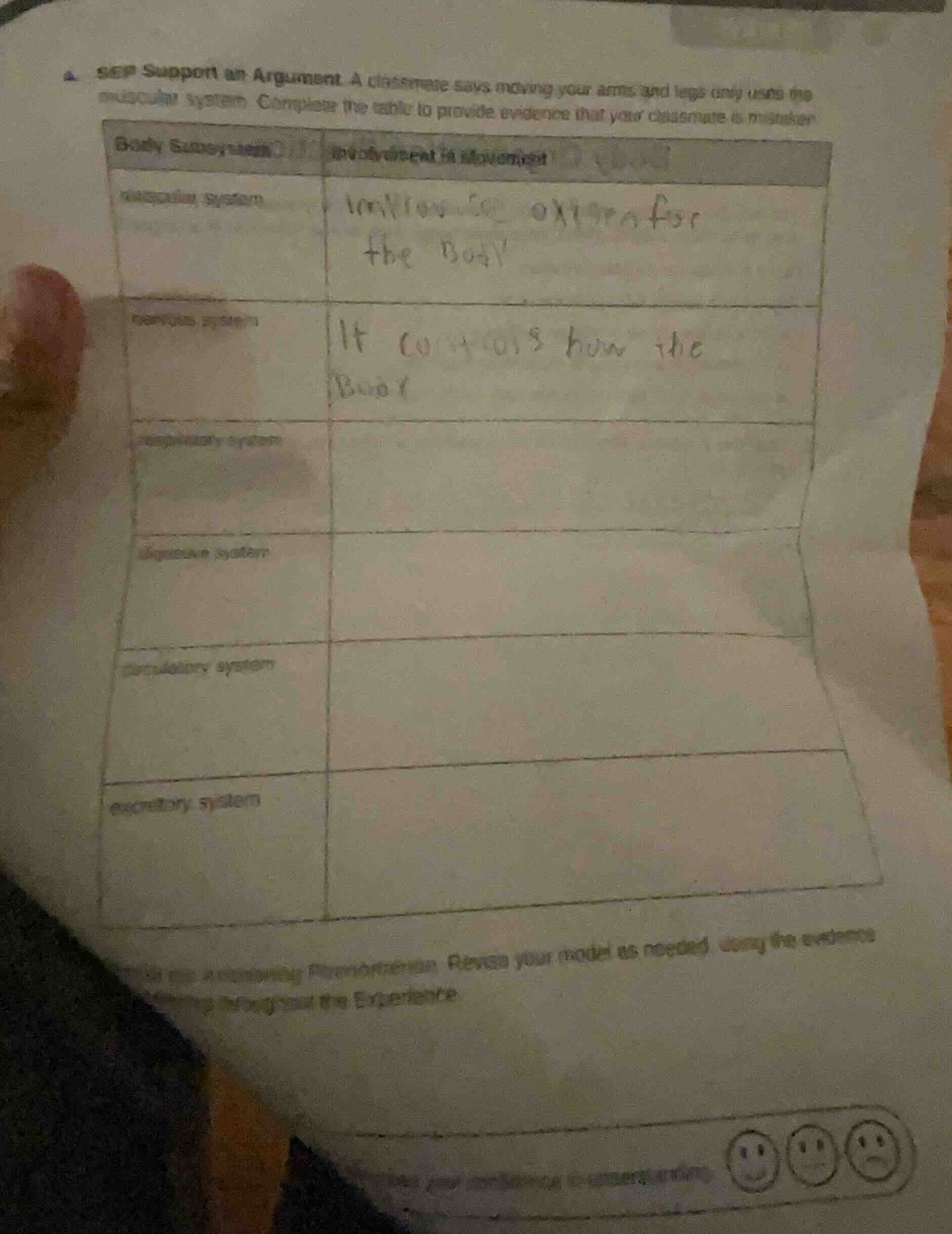
- sep support an argument. a classmate says moving your arms and legs only uses the muscular system. complete the table to provide evidence that your classmate is mistaken.
body systems | involved in movement? | evidence
muscular system | |
nervous system | |
another system (partially visible) | |
digestive system | |
circulatory system | |
respiratory system | |
additional text about revising model and evidence, and a confidence rating with smiley faces
To solve this, we analyze each body system's role in arm/leg movement:
Muscular System
Muscles contract to generate the force needed for movement (e.g., biceps/triceps for arms, quadriceps/hamstrings for legs).
Nervous System
Sends electrical signals (via neurons) to muscles to initiate and control movement (e.g., brain/spinal cord coordinate actions).
Skeletal System
Provides the rigid structure (bones) that muscles pull on to create movement (e.g., humerus in arms, femur in legs act as levers).
Digestive System
Breaks down food into nutrients (e.g., glucose) which are absorbed and used by muscles as energy for movement.
Circulatory System
Transports oxygen (from lungs) and nutrients (from digestive system) to muscles; removes waste (like CO₂) from muscle cells during movement.
Respiratory System
Takes in oxygen (via lungs) and releases carbon dioxide. Muscles need oxygen for aerobic respiration to produce ATP (energy) for movement.
| Body System | How it is Involved in Movement |
|---|---|
| Nervous System | Sends electrical signals to muscles to initiate/control movement (brain coordinates actions). |
| Skeletal System | Bones act as levers; muscles pull on bones to create movement (e.g., humerus, femur). |
| Digestive System | Provides nutrients (e.g., glucose) as energy for muscle contraction. |
| Circulatory System | Delivers oxygen/nutrients to muscles; removes waste (e.g., CO₂) from muscle cells. |
| Respiratory System | Supplies oxygen for aerobic respiration (ATP production) in muscles during movement. |
This table shows multiple systems (not just muscular) are involved, proving the classmate is mistaken.

Snap & solve any problem in the app
Get step-by-step solutions on Sovi AI
Photo-based solutions with guided steps
Explore more problems and detailed explanations
To solve this, we analyze each body system's role in arm/leg movement:
Muscular System
Muscles contract to generate the force needed for movement (e.g., biceps/triceps for arms, quadriceps/hamstrings for legs).
Nervous System
Sends electrical signals (via neurons) to muscles to initiate and control movement (e.g., brain/spinal cord coordinate actions).
Skeletal System
Provides the rigid structure (bones) that muscles pull on to create movement (e.g., humerus in arms, femur in legs act as levers).
Digestive System
Breaks down food into nutrients (e.g., glucose) which are absorbed and used by muscles as energy for movement.
Circulatory System
Transports oxygen (from lungs) and nutrients (from digestive system) to muscles; removes waste (like CO₂) from muscle cells during movement.
Respiratory System
Takes in oxygen (via lungs) and releases carbon dioxide. Muscles need oxygen for aerobic respiration to produce ATP (energy) for movement.
| Body System | How it is Involved in Movement |
|---|---|
| Nervous System | Sends electrical signals to muscles to initiate/control movement (brain coordinates actions). |
| Skeletal System | Bones act as levers; muscles pull on bones to create movement (e.g., humerus, femur). |
| Digestive System | Provides nutrients (e.g., glucose) as energy for muscle contraction. |
| Circulatory System | Delivers oxygen/nutrients to muscles; removes waste (e.g., CO₂) from muscle cells. |
| Respiratory System | Supplies oxygen for aerobic respiration (ATP production) in muscles during movement. |
This table shows multiple systems (not just muscular) are involved, proving the classmate is mistaken.