QUESTION IMAGE
Question
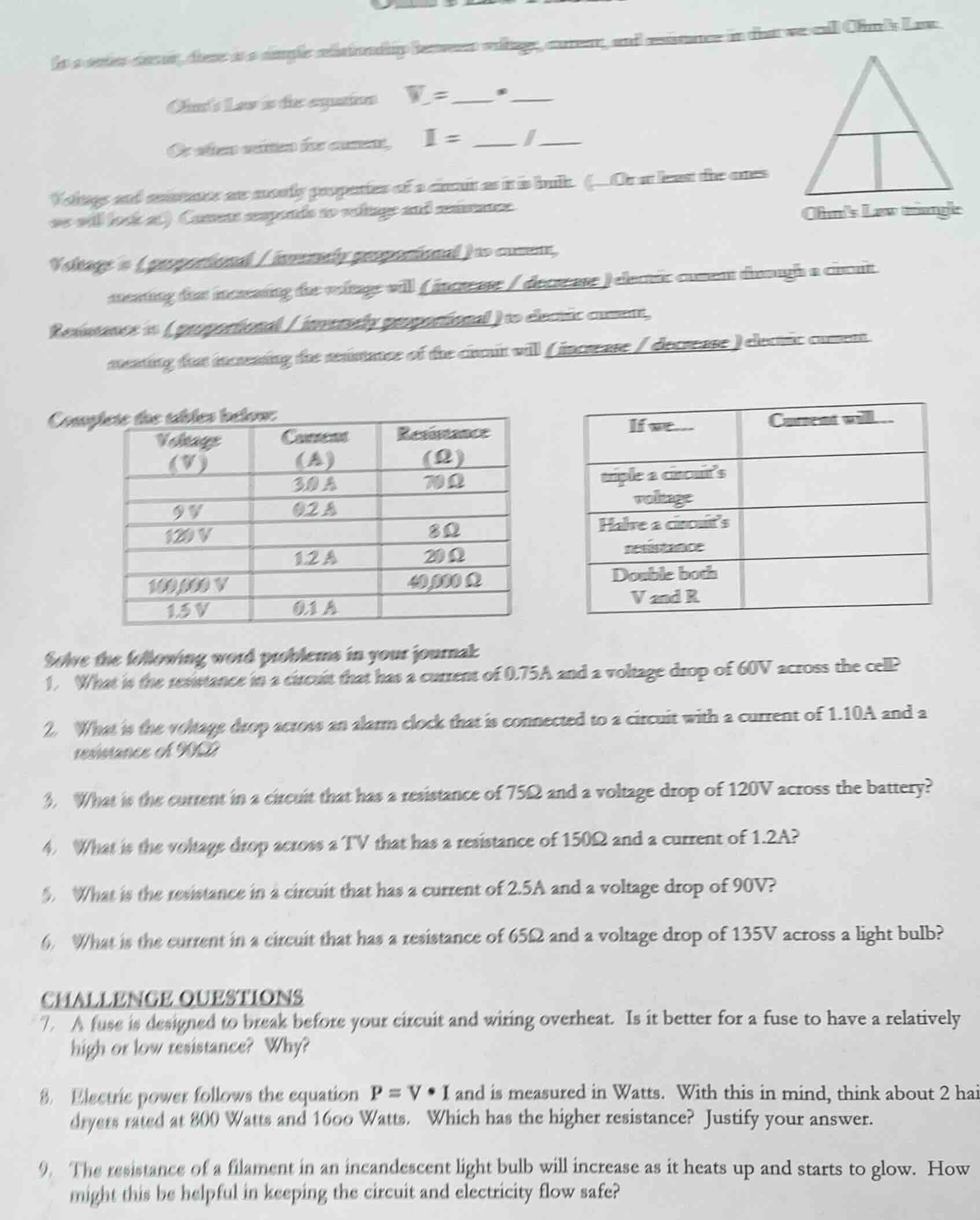
in a series circuit, there is a simple relationship between voltage, current, and resistance in that we call ohms law.ohms law is the equation $\boldsymbol{v} = \boldsymbol{___} cdot \boldsymbol{___}$or when written for current, $\boldsymbol{i} = \boldsymbol{___} / \boldsymbol{___}$voltage and resistance are mostly properties of a circuit as it is built. (...or at least the ones we will look at.) current responds to voltage and resistance.voltage is (proportional / inversely proportional) to current,meaning that increasing the voltage will (increase / decrease) electric current through a circuit.resistance is (proportional / inversely proportional) to electric current,meaning that increasing the resistance of the circuit will (increase / decrease) electric current.complete the tables below:| voltage (v) | current (a) | resistance ($omega$) || ---- | ---- | ---- || | 3.0 a | $70 omega$ || 9 v | 0.2 a | || 120 v | | $8 omega$ || | 1.2 a | $20 omega$ || 100,000 v | | $40,000 omega$ || 1.5 v | 0.1 a | || if we... | current will... || ---- | ---- || triple a circuits voltage | || halve a circuits resistance | || double both v and r | |solve the following word problems in your journal:1. what is the resistance in a circuit that has a current of 0.75a and a voltage drop of 60v across the cell?2. what is the voltage drop across an alarm clock that is connected to a circuit with a current of 1.10a and a resistance of $90omega$?3. what is the current in a circuit that has a resistance of $75omega$ and a voltage drop of 120v across the battery?4. what is the voltage drop across a tv that has a resistance of $150omega$ and a current of 1.2a?5. what is the resistance in a circuit that has a current of 2.5a and a voltage drop of 90v?6. what is the current in a circuit that has a resistance of $65omega$ and a voltage drop of 135v across a light bulb?challenge questions7. a fuse is designed to break before your circuit and wiring overheat. is it better for a fuse to have a relatively high or low resistance? why?8. electric power follows the equation $\boldsymbol{p = v cdot i}$ and is measured in watts. with this in mind, think about 2 hair dryers rated at 800 watts and 1600 watts. which has the higher resistance? justify your answer.9. the resistance of a filament in an incandescent light bulb will increase as it heats up and starts to glow. how might this be helpful in keeping the circuit and electricity flow safe?
Step1: Recall Ohm's Law formula
$V = I \cdot R$
$I = \frac{V}{R}$
$R = \frac{V}{I}$
Step2: Fill equation blanks
From Ohm's Law:
$V = I \cdot R$
$I = \frac{V}{R}$
Step3: Identify proportional relationships
Voltage is proportional to current: increasing voltage increases current.
Resistance is inversely proportional to current: increasing resistance decreases current.
Step4: Complete first table
Row1: $V = 3.0 \cdot 70 = 210$ V
Row2: $R = \frac{9}{0.2} = 45$ $\Omega$
Row3: $I = \frac{120}{8} = 15$ A
Row4: $V = 1.2 \cdot 20 = 24$ V
Row5: $I = \frac{100000}{40000} = 2.5$ A
Row6: $R = \frac{1.5}{0.1} = 15$ $\Omega$
Step5: Complete second table
- Triple voltage: Current triples (since $I \propto V$)
- Halve resistance: Current doubles (since $I \propto \frac{1}{R}$)
- Double V and R: $I = \frac{2V}{2R} = \frac{V}{R}$, so current stays same
Step6: Solve word problem 1
$R = \frac{60}{0.75} = 80$ $\Omega$
Step7: Solve word problem 2
$V = 1.10 \cdot 90 = 99$ V
Step8: Solve word problem 3
$I = \frac{120}{75} = 1.6$ A
Step9: Solve word problem 4
$V = 1.2 \cdot 150 = 180$ V
Step10: Solve word problem 5
$R = \frac{90}{2.5} = 36$ $\Omega$
Step11: Solve word problem 6
$I = \frac{135}{65} \approx 2.08$ A
Step12: Answer challenge 7
High resistance; more resistance generates more heat ($P=I^2R$), so it melts first to break the circuit.
Step13: Answer challenge 8
800W dryer has higher resistance. For fixed household voltage ($V$), $R = \frac{V^2}{P}$, so lower power means higher resistance.
Step14: Answer challenge 9
As resistance increases with heat, current decreases ($I=\frac{V}{R}$), limiting heat generation and preventing overheating/fire.

Snap & solve any problem in the app
Get step-by-step solutions on Sovi AI
Photo-based solutions with guided steps
Explore more problems and detailed explanations
Equation Blanks:
$V = I \cdot R$
$I = \frac{V}{R}$
Proportional Relationships:
Voltage is (proportional) to current, meaning that increasing the voltage will (increase) electric current through a circuit.
Resistance is (inversely proportional) to electric current, meaning that increasing the resistance of the circuit will (decrease) electric current.
First Table:
| Voltage (V) | Current (A) | Resistance ($\Omega$) |
|---|---|---|
| 9 V | 0.2 A | 45 |
| 120 V | 15 | 8 $\Omega$ |
| 24 | 1.2 A | 20 $\Omega$ |
| 100,000 V | 2.5 | 40,000 $\Omega$ |
| 1.5 V | 0.1 A | 15 |
Second Table:
| If we... | Current will... |
|---|---|
| Halve a circuit's resistance | double |
| Double both V and R | stay the same |
Word Problems:
- $80$ $\Omega$
- $99$ V
- $1.6$ A
- $180$ V
- $36$ $\Omega$
- $\approx 2.08$ A
Challenge Questions:
- It is better for a fuse to have relatively high resistance. A higher resistance generates more heat (via $P=I^2R$) for the same current, so it melts and breaks the circuit quickly before the wiring overheats.
- The 800 Watts hair dryer has higher resistance. For standard household voltage (constant $V$), resistance follows $R=\frac{V^2}{P}$; lower power corresponds to higher resistance.
- As the filament heats up, its resistance increases, which reduces the current in the circuit (via $I=\frac{V}{R}$). This reduced current limits additional heat generation, preventing the circuit from overheating and keeping the electrical flow safe.