QUESTION IMAGE
Question
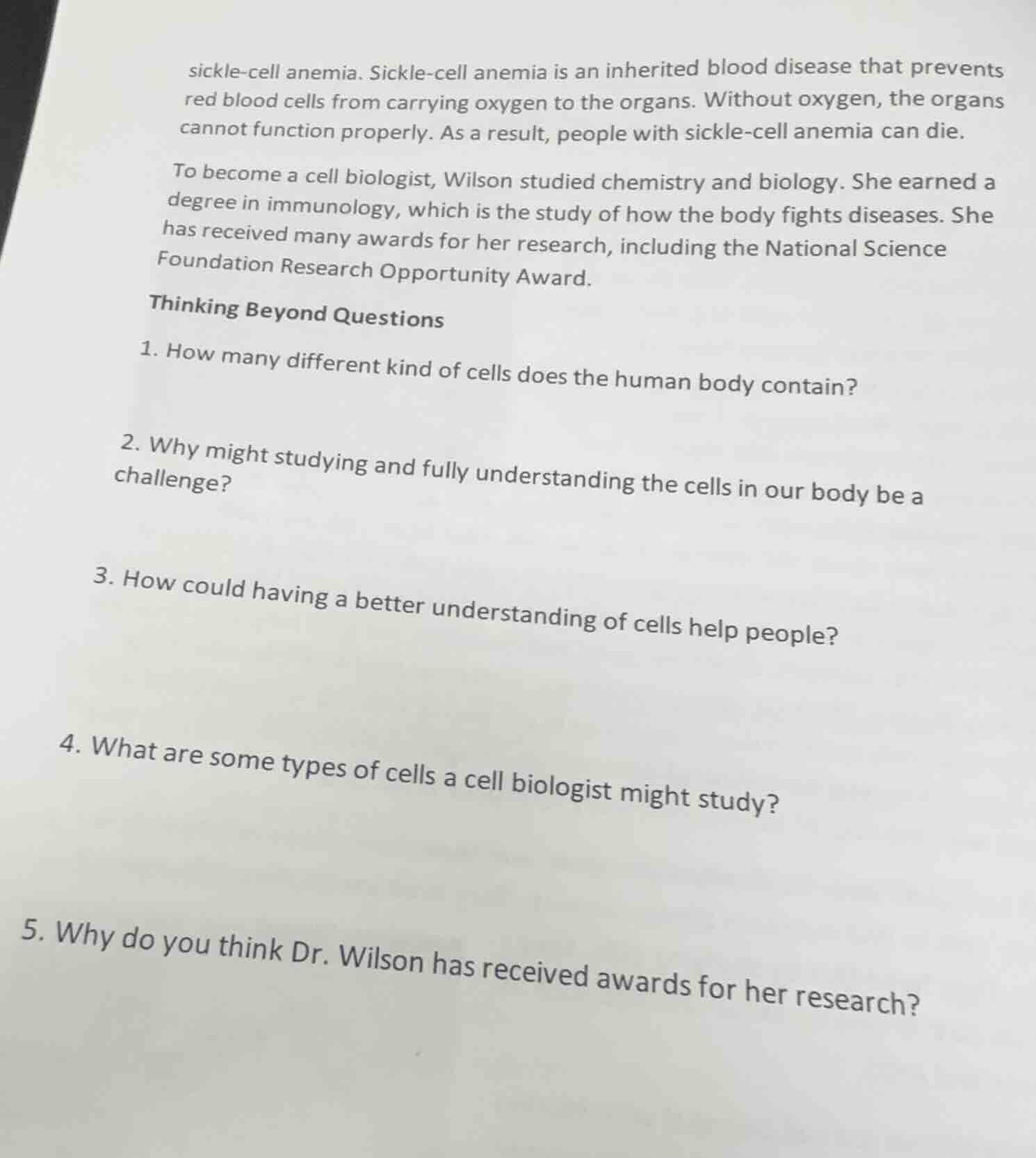
sickle-cell anemia. sickle-cell anemia is an inherited blood disease that prevents red blood cells from carrying oxygen to the organs. without oxygen, the organs cannot function properly. as a result, people with sickle-cell anemia can die.
to become a cell biologist, wilson studied chemistry and biology. she earned a degree in immunology, which is the study of how the body fights diseases. she has received many awards for her research, including the national science foundation research opportunity award.
thinking beyond questions
- how many different kind of cells does the human body contain?
- why might studying and fully understanding the cells in our body be a challenge?
- how could having a better understanding of cells help people?
- what are some types of cells a cell biologist might study?
- why do you think dr. wilson has received awards for her research?
Brief Explanations
- Cites established biological research on human cell diversity.
- Lists key barriers to cell study complexity.
- Links cell understanding to real-world health applications.
- Names common cell types relevant to cell biology research.
- Connects Dr. Wilson's work to impactful scientific contributions.

Snap & solve any problem in the app
Get step-by-step solutions on Sovi AI
Photo-based solutions with guided steps
Explore more problems and detailed explanations
- The human body contains around 200 different kinds of cells.
- This is a challenge because cells are extremely small, have diverse structures and functions, interact in complex systems, and can change their behavior in different contexts.
- Better cell understanding can lead to new treatments for diseases like sickle-cell anemia, improved diagnostic tools, regenerative medicine (such as growing replacement tissues), and more targeted therapies for conditions like cancer.
- A cell biologist might study red blood cells (like those affected in sickle-cell anemia), immune cells (relevant to immunology), nerve cells, muscle cells, and cancer cells.
- Dr. Wilson has likely received awards because her immunology and cell biology research has advanced scientific understanding, potentially led to breakthroughs in treating or preventing diseases, and contributed valuable knowledge to the scientific community.