QUESTION IMAGE
Question
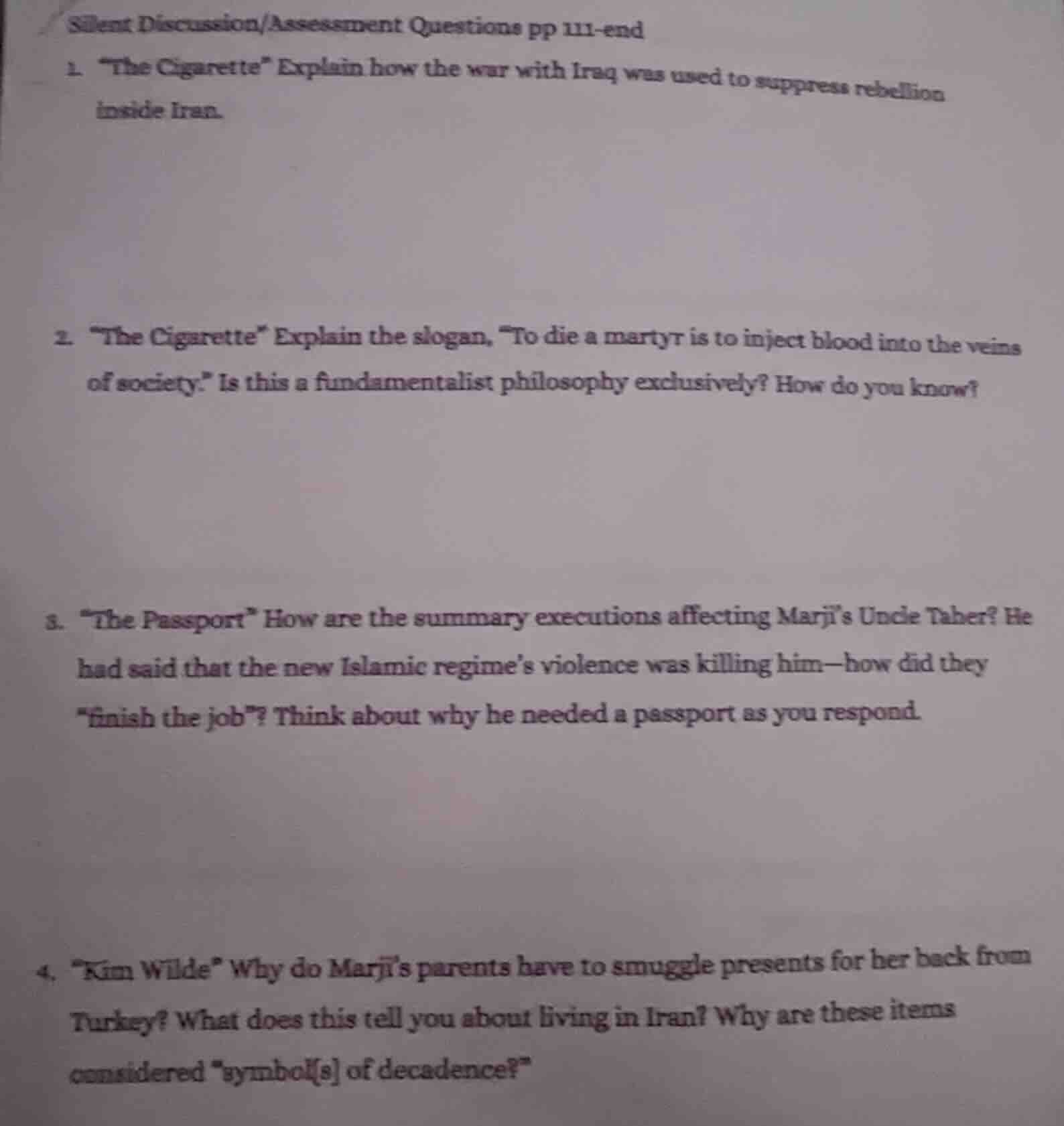
silent discussion/assessment questions pp 111 - end
- “the cigarette” explain how the war with iraq was used to suppress rebellion inside iran.
- “the cigarette” explain the slogan, “to die a martyr is to inject blood into the veins of society.” is this a fundamentalist philosophy exclusively? how do you know?
- “the passport” how are the summary executions affecting marji’s uncle taher? he had said that the new islamic regime’s violence was killing him—how did they “finish the job”? think about why he needed a passport as you respond.
- “kim wilde” why do marji’s parents have to smuggle presents for her back from turkey? what does this tell you about living in iran? why are these items considered “symbols of decadence?”
Brief Explanations
- For question 1: The Iraqi war let Iran's regime frame internal dissent as unpatriotic, divert resources to suppress protests, and use martial law to target opposition groups, tying rebellion to aiding Iraq.
- For question 2: The slogan frames martyrdom as revitalizing society via sacrifice. It is not exclusive to fundamentalism; secular movements (e.g., socialist resistance) also use martyrdom rhetoric to rally collective action, framing death for a cause as sustaining community strength.
- For question 3: Summary executions traumatized Uncle Taher, worsening his heart condition. When his passport request (to seek medical care abroad) was denied, the regime's refusal to let him access treatment led to his death, effectively "finishing the job."
- For question 4: Iran's Islamic regime banned Western pop culture items as un-Islamic. Smuggling shows strict censorship and restricted access to global culture. These items are seen as symbols of decadence because they represent Western consumerism, individualism, and values the regime viewed as corrupting traditional Iranian society.

Snap & solve any problem in the app
Get step-by-step solutions on Sovi AI
Photo-based solutions with guided steps
Explore more problems and detailed explanations
- The Iran-Iraq war allowed the Iranian regime to label internal rebels as threats to national security during a time of external conflict, justifying harsh crackdowns, deploying military forces domestically to quash uprisings, and using wartime propaganda to paint dissent as aiding Iraq, thus suppressing rebellion.
- The slogan means dying for a cause (martyrdom) is framed as giving life/strength to society. This is not exclusive to fundamentalist philosophy: secular revolutionary groups (like left-wing resistance movements) have used similar rhetoric to frame sacrifice for collective goals as sustaining their community.
- The summary executions caused severe stress that worsened Uncle Taher's heart condition. He needed a passport to get life-saving medical care outside Iran, but the regime denied his request. This lack of access to treatment led to his death, which is how the regime "finished the job."
- Marji's parents smuggle presents (like Kim Wilde items) because the Iranian regime banned Western pop culture and related goods. This shows that Iran had strict censorship and isolation from global popular culture under the regime. These items are called "symbols of decadence" because the regime viewed Western pop culture as promoting consumerism, individualism, and un-Islamic values that would erode traditional Iranian religious and social norms.