QUESTION IMAGE
Question
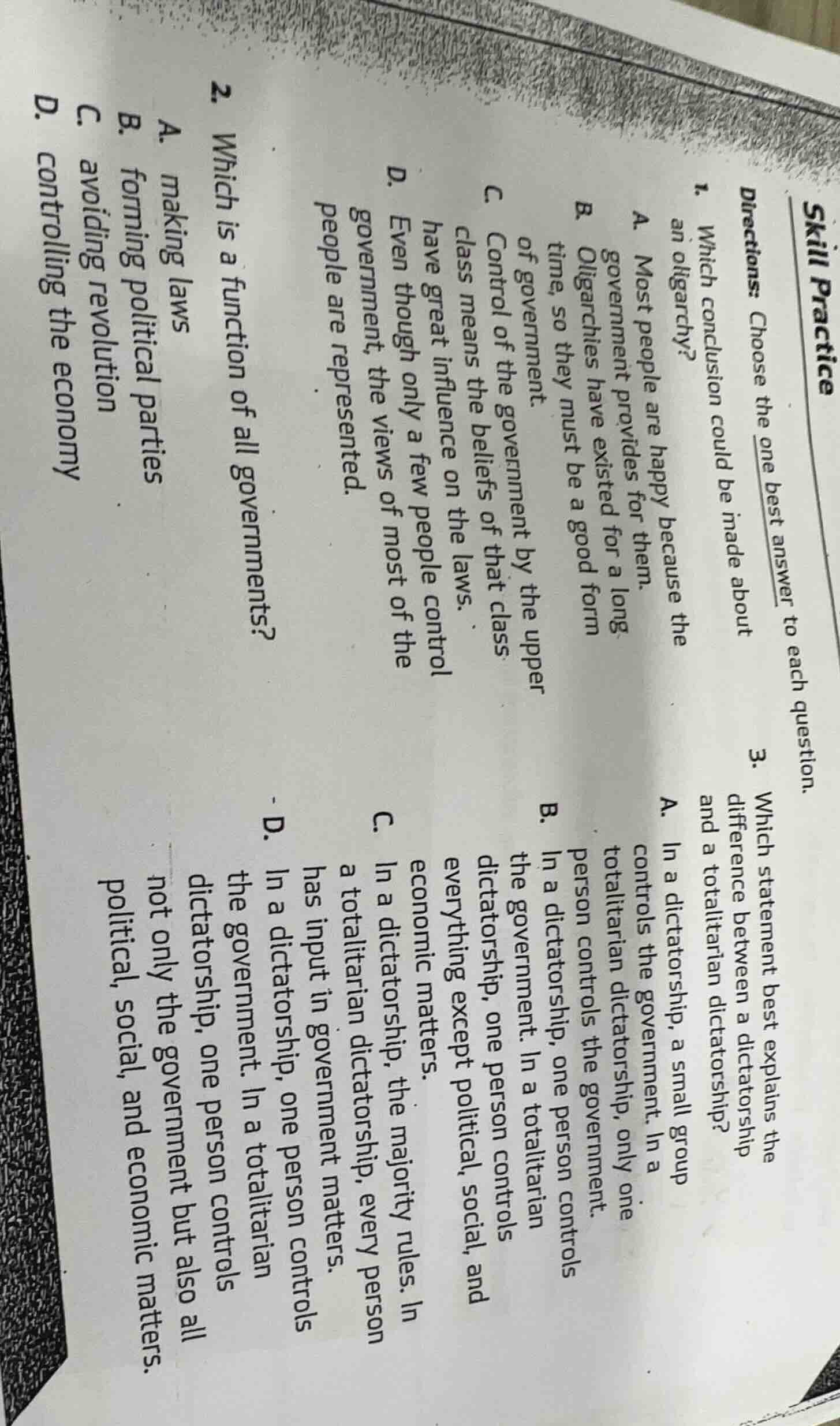
skill practice directions: choose the one best answer to each question. 1. which conclusion could be made about an oligarchy? a. most people are happy because the government provides for them. b. oligarchies have existed for a long time, so they must be a good form of government. c. control of the government by the upper class means the beliefs of that class have great influence on the laws. d. even though only a few people control government, the views of most of the people are represented. 2. which is a function of all governments? a. making laws b. forming political parties c. avoiding revolution d. controlling the economy 3. which statement best explains the difference between a dictatorship and a totalitarian dictatorship? a. in a dictatorship, a small group controls the government. in a totalitarian dictatorship, only one person controls the government. b. in a dictatorship, one person controls the government. in a totalitarian dictatorship, one person controls everything except political, social, and economic matters. c. in a dictatorship, the majority rules. in a totalitarian dictatorship, every person has input in government matters. d. in a dictatorship, one person controls the government. in a totalitarian dictatorship, one person controls not only the government but also all political, social, and economic matters.
Question 1
To determine the conclusion about oligarchy, we analyze each option:
- Option A: Oligarchy is ruled by a small group, not for the happiness of most people, so A is incorrect.
- Option B: Just because oligarchies exist long doesn't mean they are good; this is not a valid conclusion about oligarchy's nature, so B is incorrect.
- Option C: Oligarchy is controlled by the upper class (a small group) who influence laws, which aligns with the definition of oligarchy (rule by a few, often the wealthy/upper class), so C is correct.
- Option D: In oligarchy, the few in power control, and most people's views are not represented, so D is incorrect.
We analyze the functions of government:
- Option A: Making laws is a key function of government (legislative function), so A is correct.
- Option B: Forming political parties is done by political groups/individuals, not a function of all governments (some governments may restrict or not be involved in party formation), so B is incorrect.
- Option C: Avoiding revolution is not a core function of all governments; governments focus on governance, law - making, etc., not specifically avoiding revolution, so C is incorrect.
- Option D: Controlling the economy is not a function of all governments (e.g., in some free - market - oriented governments, the economy is mainly market - driven), so D is incorrect.
We analyze the difference between dictatorship and totalitarian dictatorship:
- Option A: In a dictatorship, it can be a single person or a small group, and in totalitarian dictatorship, the control is more comprehensive, but this option's description is not accurate enough.
- Option B: In a dictatorship, the dictator (or group) controls the government, and in totalitarian dictatorship, the control extends to all aspects (not just “except political, social, and economic matters” as this option misstates), so B is incorrect.
- Option C: In a dictatorship, it's not majority rule (it's rule by one or a few), and in totalitarian dictatorship, it's not that every person has input, so C is incorrect.
- Option D: In a dictatorship, one person (or a small group) controls the government, and in a totalitarian dictatorship, the control extends to all political, social, and economic matters (total control over all aspects of life), which accurately explains the difference, so D is correct.

Snap & solve any problem in the app
Get step-by-step solutions on Sovi AI
Photo-based solutions with guided steps
Explore more problems and detailed explanations
C. Control of the government by the upper class means the beliefs of that class have great influence on the laws.