QUESTION IMAGE
Question
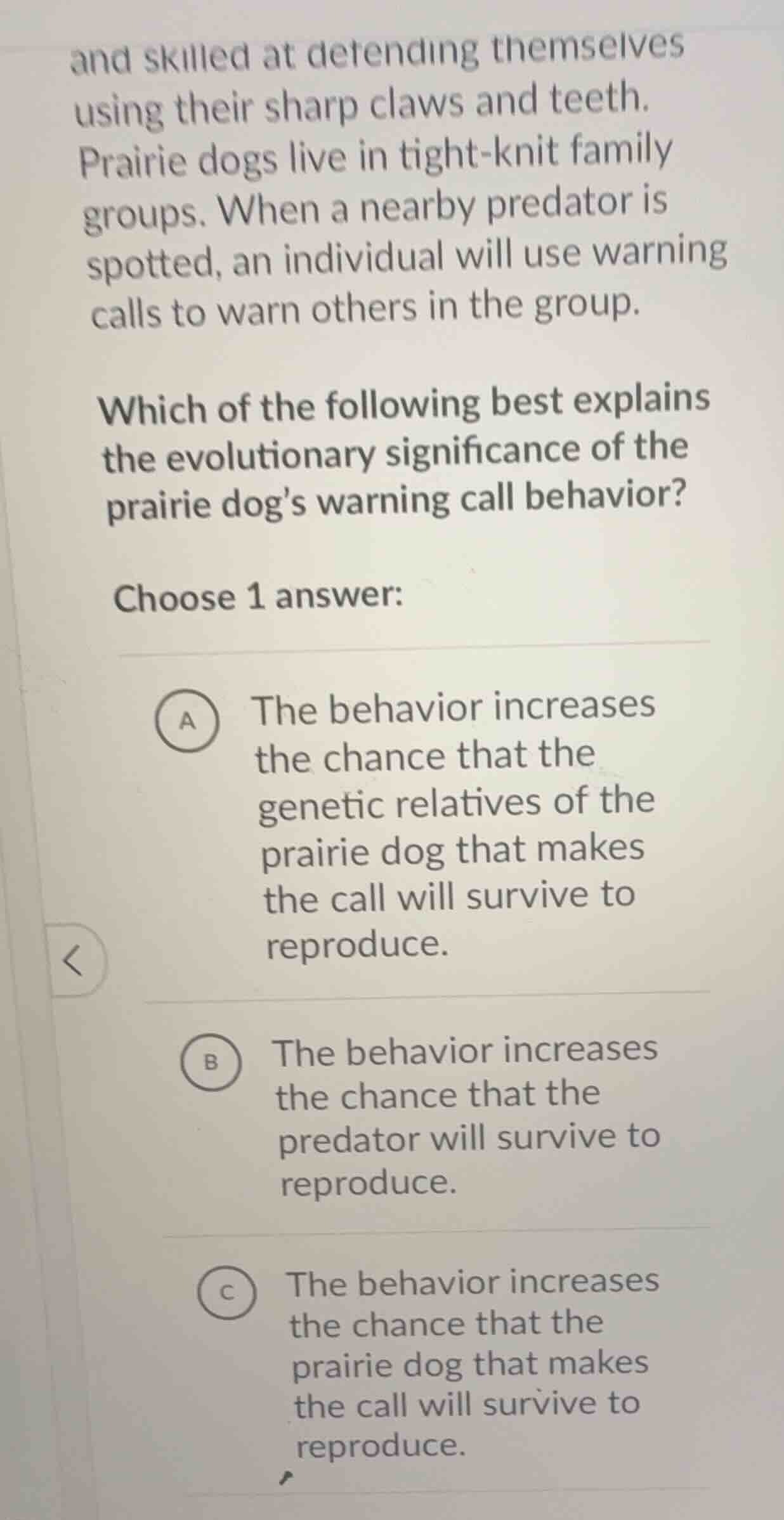
and skilled at defending themselves using their sharp claws and teeth. prairie dogs live in tight - knit family groups. when a nearby predator is spotted, an individual will use warning calls to warn others in the group. which of the following best explains the evolutionary significance of the prairie dog’s warning call behavior? choose 1 answer: a the behavior increases the chance that the genetic relatives of the prairie dog that makes the call will survive to reproduce. b the behavior increases the chance that the predator will survive to reproduce. c the behavior increases the chance that the prairie dog that makes the call will survive to reproduce.
- Option A: Prairie dogs live in family groups (genetic relatives). Warning calls help relatives avoid predators, increasing their survival and reproduction chances. This aligns with kin selection in evolution.
- Option B: Warning calls help prairie dogs, not predators, survive. So this is incorrect.
- Option C: Making a warning call may draw the predator's attention to the caller, reducing the caller's survival chance. The benefit is for relatives, not the caller itself. So this is incorrect.

Snap & solve any problem in the app
Get step-by-step solutions on Sovi AI
Photo-based solutions with guided steps
Explore more problems and detailed explanations
A. The behavior increases the chance that the genetic relatives of the prairie dog that makes the call will survive to reproduce.