QUESTION IMAGE
Question
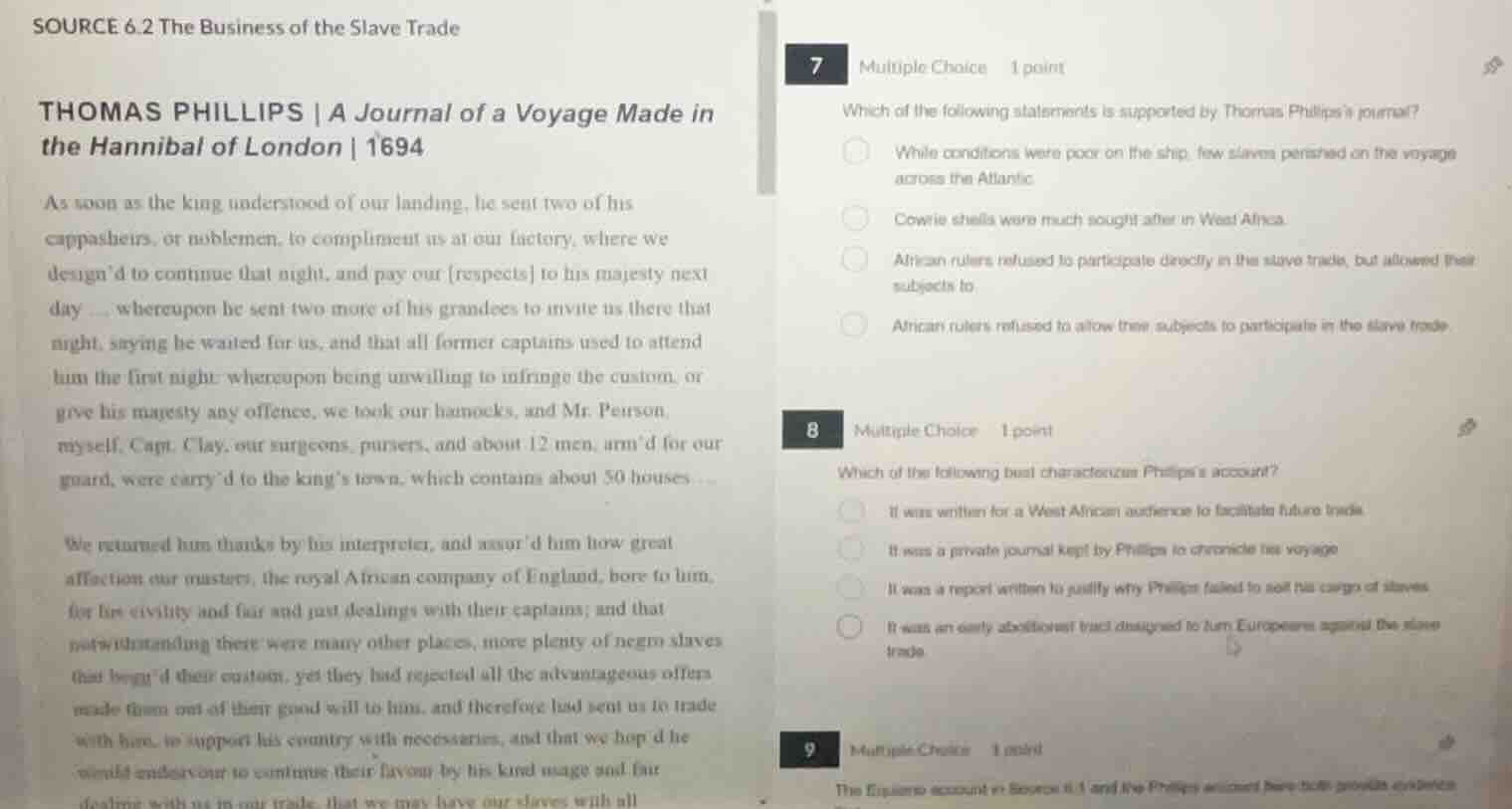
source 6.2 the business of the slave trade
thomas phillips | a journal of a voyage made in
the hannibal of london | 1694
as soon as the king understood of our landing, he sent two of his
cappasheirs, or noblemen, to compliment us at our factory, where we
design’d to continue that night, and pay our respects to his majesty next
day... whereupon he sent two more of his grandees to invite us there that
night, saying he waited for us, and that all former captains used to attend
him the first night: whereupon being unwilling to infringe the custom, or
give his majesty any offence, we took our hammocks, and mr. pearson,
myself, capt. clay, our surgeons, pursers, and about 12 men, arm’d for our
guard, were carry’d to the king’s town, which contains about 50 houses...
we returned him thanks by his interpreter, and assur’d him how great
affection our masters, the royal african company of england, bore to him,
for his civility and fair and just dealings with their captains; and that
notwithstanding there were many other places, more plenty of negro slaves
that begg’d their custom, yet they had rejected all the advantageous offers
made them out of their good will to him, and therefore had sent us to trade
with him, to support his country with necessaries, and that we hop’d he
would endeavour to continue their favour by his kind usage and fair
dealing with us in our trade, that we may have our slaves with all
7 multiple choice 1 point
which of the following statements is supported by thomas phillips’s journal?
white conditions were poor on the ship, few slaves perished on the voyage
across the atlantic.
cowrie shells were much sought after in west africa.
african rulers refused to participate directly in the slave trade, but allowed their
subjects to
african rulers refused to allow their subjects to participate in the slave trade
8 multiple choice 1 point
which of the following best characterizes phillips’s account?
it was written for a west african audience to facilitate future trade.
it was a private journal kept by phillips to chronicle his voyage
it was a report written to justify why phillips failed to sell his cargo of slaves
it was an early abolitionist tract designed to turn europeans against the slave
trade
9 multiple choice 1 point
the egyptian account in source 6.1 and the phillips account have both provide evidence
Question 7
- Analyze each option:
- Option 1: The journal excerpt doesn't mention slave mortality on the voyage, so this is not supported.
- Option 2: There's no mention of cowrie shells in the provided journal text, so this is not supported.
- Option 3: The text shows the king (an African ruler) interacted with the traders and allowed trade (his subjects could be involved), and the traders chose to trade with him over others, implying some rulers (like others) might have been bypassed, so this option fits as African rulers (like the king here) had a role but maybe didn't directly participate in the slave trade but allowed subjects.
- Option 4: The text shows the king was willing to engage in trade (allowing his area to be a place for trade), so this is incorrect as it says rulers refused to allow subjects, which contradicts.
- Analyze each option:
- Option 1: The journal is from a European (Thomas Phillips) about a voyage, not written for a West African audience to facilitate trade.
- Option 2: The title is "A Journal of a Voyage Made in the Hannibal of London | 1694", and the content is a personal account of the voyage (interactions with the king, trade intentions), so it's a private journal to chronicle the voyage.
- Option 3: There's no mention of failing to sell slaves, so this is incorrect.
- Option 4: The journal is a personal account of the voyage, not an abolitionist tract (it's about trade and interactions, not opposing the slave trade).

Snap & solve any problem in the app
Get step-by-step solutions on Sovi AI
Photo-based solutions with guided steps
Explore more problems and detailed explanations
C. African rulers refused to participate directly in the slave trade, but allowed their subjects to