QUESTION IMAGE
Question
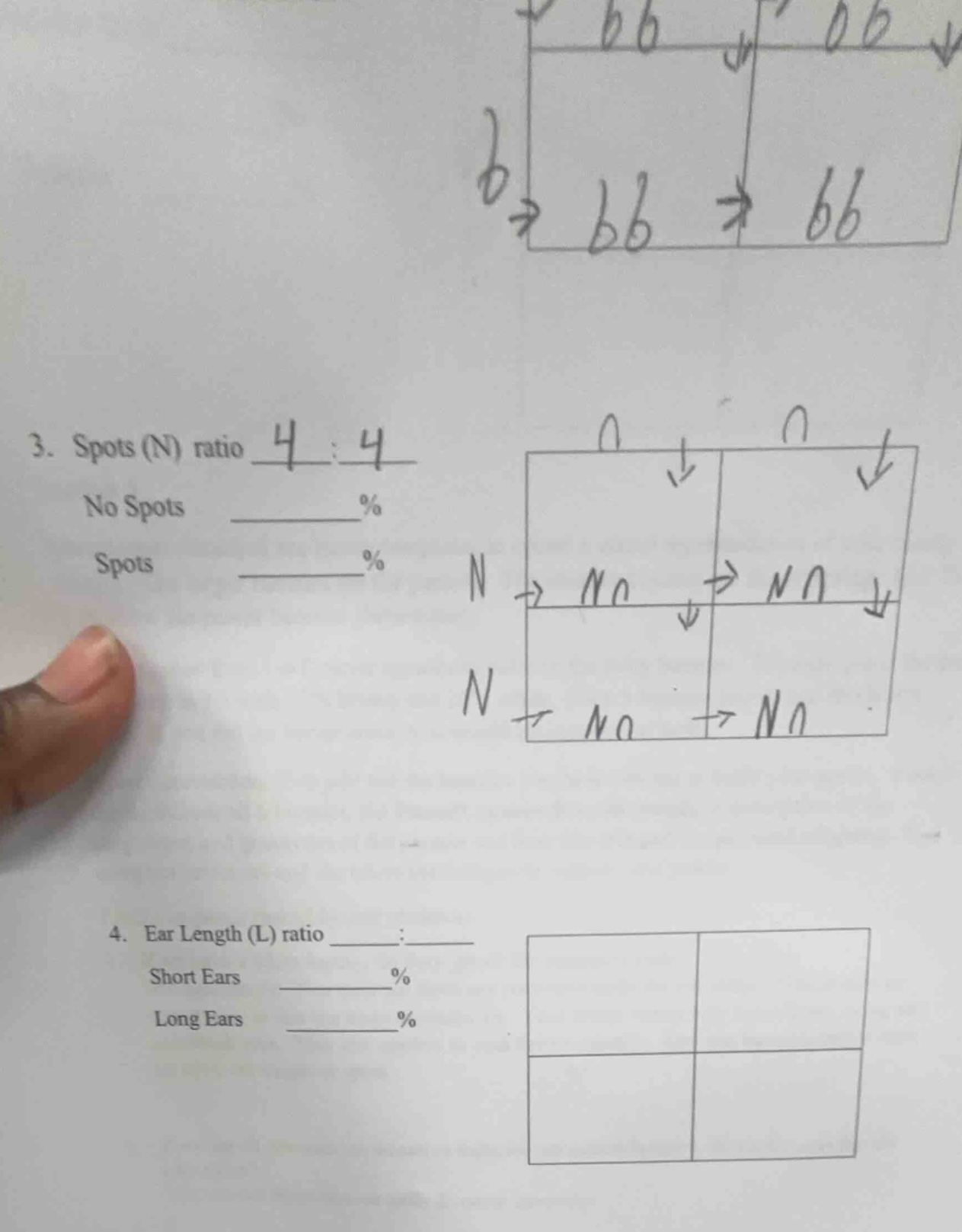
- spots (n) ratio _:_
no spots ______%
spots ______%
- ear length (l) ratio __:__
short ears ______%
long ears ______%
Problem 3 (Spots - N)
Step 1: Analyze the ratio
The ratio of No Spots to Spots is given as \(4:4\) (simplifies to \(1:1\)). The total number of sections in the Punnett - square - like diagram for spots is \(4\) (since \(4 + 4=8\)? Wait, no, looking at the diagram, there are 4 cells with "No" (assuming "No" represents No Spots) and 4 cells? Wait, the ratio is \(4:4\), so total parts \(4 + 4=8\)? No, the ratio \(4:4\) can be simplified to \(1:1\). To find the percentage, we use the formula \(\text{Percentage}=\frac{\text{Number of a category}}{\text{Total number of categories}}\times100\%\)
Step 2: Calculate percentage for No Spots
Number of No Spots cases \( = 4\), total cases \(=4 + 4=8\)? Wait, no, if the ratio is \(4:4\), the total number of items (in terms of the ratio parts) is \(4+4 = 8\)? Wait, no, the ratio \(4:4\) means that for every 4 of No Spots, there are 4 of Spots. So the fraction of No Spots is \(\frac{4}{4 + 4}=\frac{4}{8}=0.5\), so percentage is \(0.5\times100\% = 50\%\)
Step 3: Calculate percentage for Spots
Similarly, the fraction of Spots is \(\frac{4}{4 + 4}=\frac{4}{8}=0.5\), so percentage is \(0.5\times100\%=50\%\)
Problem 4 (Ear Length - L)
Since the Punnett square for ear length is blank, we assume a typical case (maybe a monohybrid cross with a ratio, but since no data is filled, if we assume a 4 - cell Punnett square and maybe a ratio like \(0:4\) or \(4:0\) or \(2:2\), but since the problem is incomplete, but if we assume a 1:1 ratio (similar to the spots case, maybe a test - cross or heterozygous cross), but without the diagram filled, we can't be sure. However, if we assume the same as the spots case (maybe a cross where the ratio of short to long ears is \(4:4\) (or \(1:1\)):
Step 1: Assume ratio (if similar to spots)
If the ratio of Short Ears to Long Ears is \(4:4\) (or \(1:1\)), total parts \(4 + 4 = 8\) (or 4 + 4 = 8? Wait, no, in a Punnett square, usually 4 cells. Wait, maybe the diagram has 4 cells. If the ratio is \(4:4\) (but 4+4 = 8, which is not possible for a 4 - cell square). Maybe the ratio is \(0:4\) or \(4:0\) or \(2:2\). But since the problem is given with a blank square, we can't calculate precisely. But if we assume a 1:1 ratio (like the spots case), the percentage for short ears and long ears would be \(50\%\) each.
Problem 3 Answer:
Ratio (No Spots: Spots): \(1:1\) (or \(4:4\))
No Spots percentage: \(50\%\)
Spots percentage: \(50\%\)
Problem 4 (assuming a 1:1 ratio like spots, but with incomplete data, the following is a possible answer if the diagram is similar to spots):
Ratio (Short Ears: Long Ears): \(4:4\) (or \(1:1\))
Short Ears percentage: \(50\%\)
Long Ears percentage: \(50\%\)
(Note: For problem 4, since the Punnett square is blank, the answer is based on the assumption that the cross is similar to the spots case. If the actual diagram has different numbers, the answer will change.)

Snap & solve any problem in the app
Get step-by-step solutions on Sovi AI
Photo-based solutions with guided steps
Explore more problems and detailed explanations
Step 1: Assume ratio (if similar to spots)
If the ratio of Short Ears to Long Ears is \(4:4\) (or \(1:1\)), total parts \(4 + 4 = 8\) (or 4 + 4 = 8? Wait, no, in a Punnett square, usually 4 cells. Wait, maybe the diagram has 4 cells. If the ratio is \(4:4\) (but 4+4 = 8, which is not possible for a 4 - cell square). Maybe the ratio is \(0:4\) or \(4:0\) or \(2:2\). But since the problem is given with a blank square, we can't calculate precisely. But if we assume a 1:1 ratio (like the spots case), the percentage for short ears and long ears would be \(50\%\) each.
Problem 3 Answer:
Ratio (No Spots: Spots): \(1:1\) (or \(4:4\))
No Spots percentage: \(50\%\)
Spots percentage: \(50\%\)
Problem 4 (assuming a 1:1 ratio like spots, but with incomplete data, the following is a possible answer if the diagram is similar to spots):
Ratio (Short Ears: Long Ears): \(4:4\) (or \(1:1\))
Short Ears percentage: \(50\%\)
Long Ears percentage: \(50\%\)
(Note: For problem 4, since the Punnett square is blank, the answer is based on the assumption that the cross is similar to the spots case. If the actual diagram has different numbers, the answer will change.)