QUESTION IMAGE
Question
the state of states
independent states are the primary building blocks of
the world political map. a state (also called a nation
or country) is a territory with defined boundaries
organized into a political unit and ruled by an
iestablished government that has control over what
happens inside it. when a state has total control over
its affairs, it is called a sovereign state. a location
claimed by a sovereign state is called a territory.
according to the united nations, in 2016, the world
had 193 nations; however, many of those nations
dispute their boundaries.
some nations are stateless. this means that there
are groups of people who share a collective identity
and history, but who have no parcel of land that they
fully control. the palestinians are perhaps the
world’s best - known stateless nation, owed to their
long struggle with israeli jews — some of whom, until
1948, belonged to the previously best - known nation
without a state.
the concept of the modern nation - state began in
europe as a political revolution laid the groundwork
for a sense of nationalism: a feeling of devotion or
loyalty to a specific nation. the term nation refers to
a homogeneous group of people with a common
heritage, language, religion, or political ambition. the
term state refers to the government who controls a
particular area of land. when nations and states
come together, there is a true nation - state, wherein
most citizens share a common heritage and a united
government.
questions:
- what is the difference between a state and a nation?
- what does it mean to be a sovereign state?
- how can a nation be stateless?
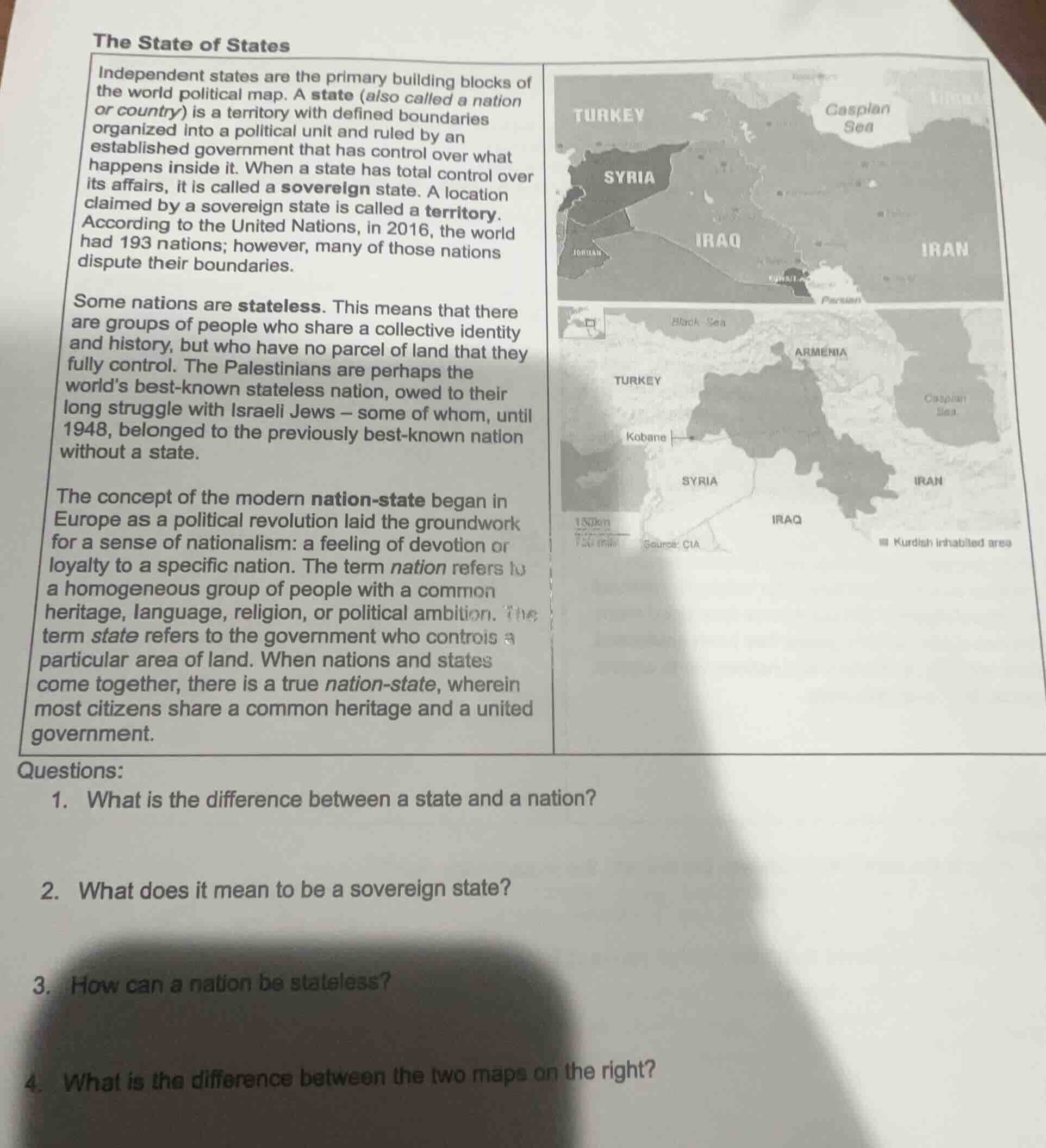
- what is the difference between the two maps on the right?
- The text draws a clear distinction between the two terms: a nation is a group of people with shared traits, while a state is a governing body over territory.
- The definition of a sovereign state is directly stated in the opening section of the text.
- The text explains stateless nations using the Palestinian example, defining the core condition.
- Comparing the two maps, the top one shows recognized sovereign state boundaries, while the bottom one highlights the inhabited area of a stateless national group (Kurds) that crosses state borders.

Snap & solve any problem in the app
Get step-by-step solutions on Sovi AI
Photo-based solutions with guided steps
Explore more problems and detailed explanations
- A nation is a homogeneous group of people sharing common heritage, language, religion, or political ambition. A state is the governing body that controls a specific defined territory with established boundaries.
- A sovereign state is a state that has total, independent control over all its internal and external affairs.
- A nation is stateless when its people share a collective identity and history, but do not have any parcel of land that they fully control as their own territory.
- The top map displays the official, recognized boundaries of sovereign states in the region (Turkey, Syria, Iraq, Iran, etc.). The bottom map shows the geographic area inhabited by the Kurdish people, which spans across the borders of several of those sovereign states, rather than following official state boundaries.