QUESTION IMAGE
Question
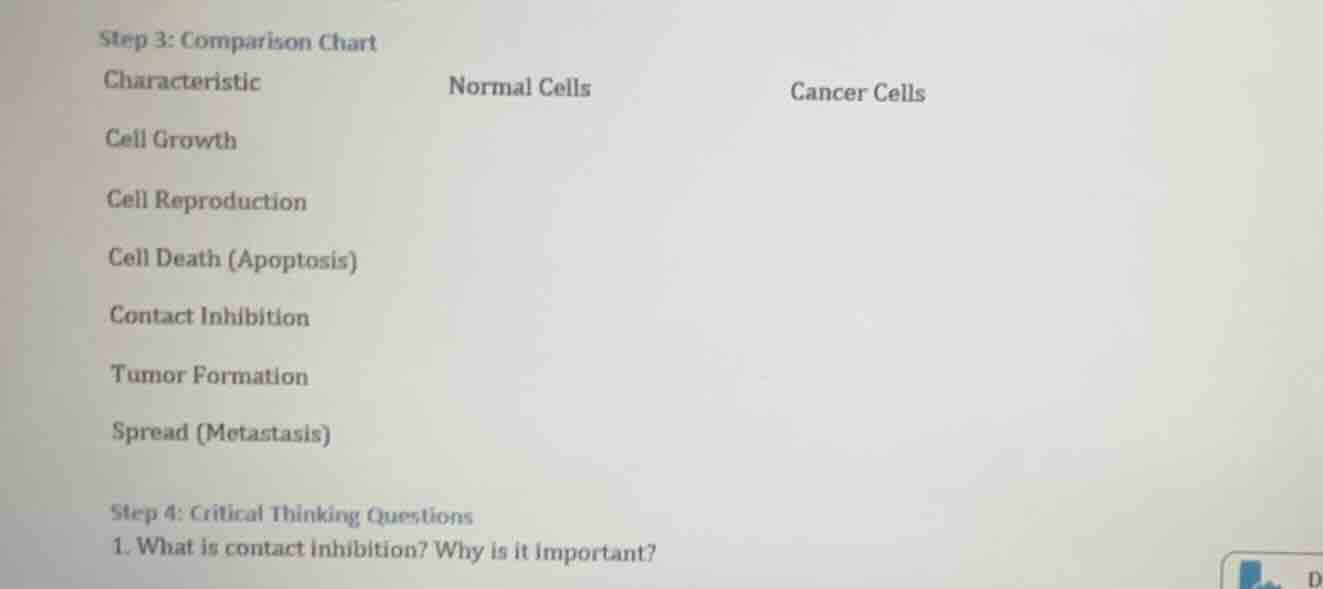
step 3: comparison chart
characteristic normal cells cancer cells
cell growth
cell reproduction
cell death (apoptosis)
contact inhibition
tumor formation
spread (metastasis)
step 4: critical thinking questions
- what is contact inhibition? why is it important?
First, complete the comparison chart by outlining key differences between normal and cancer cells based on cellular biology principles. Then, define contact inhibition and explain its importance in preventing uncontrolled cell growth.
For the comparison chart:
- Cell Growth: Normal cells grow in a regulated, controlled manner, stopping when space or signals are limited. Cancer cells grow uncontrollably, ignoring growth-limiting signals.
- Cell Reproduction: Normal cells reproduce only when needed (e.g., to replace damaged cells) and stop at checkpoints. Cancer cells reproduce continuously, bypassing cell cycle checkpoints.
- Cell Death (Apoptosis): Normal cells undergo programmed cell death if damaged, old, or no longer needed. Cancer cells avoid apoptosis, surviving even when damaged or abnormal.
- Contact Inhibition: Normal cells stop growing when they touch neighboring cells. Cancer cells lack contact inhibition, continuing to grow and pile up.
- Tumor Formation: Normal cells do not form tumors. Cancer cells form masses (tumors) due to uncontrolled growth.
- Spread (Metastasis): Normal cells stay in their original tissue. Cancer cells can break off, invade other tissues, and form new tumors (metastasis).
For the critical thinking question:
Contact inhibition is a cellular mechanism where cells stop dividing and growing when they physically contact other cells. It is important because it maintains tissue structure and prevents overgrowth, ensuring cells only reproduce to fill gaps or replace damaged cells, which stops the formation of abnormal cell masses (tumors).

Snap & solve any problem in the app
Get step-by-step solutions on Sovi AI
Photo-based solutions with guided steps
Explore more problems and detailed explanations
Comparison Chart
| Characteristic | Normal Cells | Cancer Cells |
|---|---|---|
| Cell Reproduction | Occurs only when needed, follows cycle checkpoints | Continuous, bypasses cell cycle checkpoints |
| Cell Death (Apoptosis) | Undergoes programmed death if damaged/unneeded | Evades apoptosis, survives despite damage/abnormality |
| Contact Inhibition | Stops growth when touching neighboring cells | Lacks this mechanism, grows and piles up on other cells |
| Tumor Formation | Does not form tumors | Forms abnormal cell masses (tumors) |
| Spread (Metastasis) | Remains in original tissue | Breaks off, invades other tissues, forms new tumors elsewhere in the body |
Critical Thinking Question 1
Contact inhibition is a cellular response where cells cease dividing and growing upon physical contact with adjacent cells. It is critical because it maintains proper tissue structure and prevents uncontrolled cell overgrowth, which is a key defense against the formation of abnormal tumors and the development of cancer.