QUESTION IMAGE
Question
stickleback fish protect themselves from predators with a thick covering of brownish plates. they feed on small aquatic organisms and are preyed upon by bigger fish like trout. in a certain lake, the number of stickleback fish was documented over a period of 30 years. during this time, the clarity of the lake water also changed.
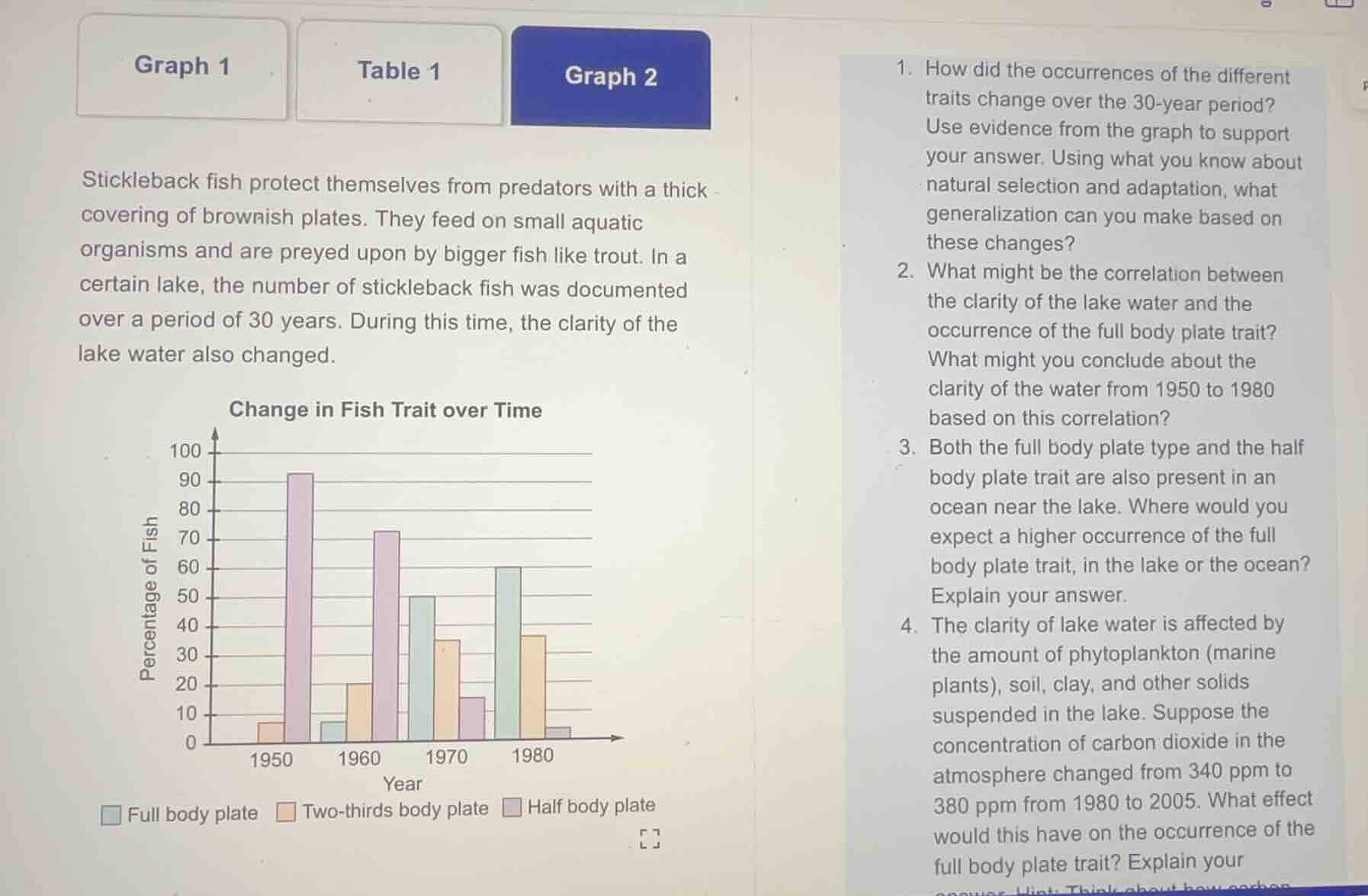
(graph: change in fish trait over time, with year on x - axis (1950, 1960, 1970, 1980) and percentage of fish on y - axis. legend: full body plate (blue), two - thirds body plate (orange), half body plate (purple))
- how did the occurrences of the different traits change over the 30 - year period? use evidence from the graph to support your answer. using what you know about natural selection and adaptation, what generalization can you make based on these changes?
- what might be the correlation between the clarity of the lake water and the occurrence of the full body plate trait? what might you conclude about the clarity of the water from 1950 to 1980 based on this correlation?
- both the full body plate type and the half body plate trait are also present in an ocean near the lake. where would you expect a higher occurrence of the full body plate trait, in the lake or the ocean? explain your answer.
- the clarity of lake water is affected by the amount of phytoplankton (marine plants), soil, clay, and other solids suspended in the lake. suppose the concentration of carbon dioxide in the atmosphere changed from 340 ppm to 380 ppm from 1980 to 2005. what effect would this have on the occurrence of the full body plate trait? explain your answer. (hint: think about how...
Question 1
To answer how the occurrences of different traits changed over 30 years, we analyze the bar graph. In 1950, the half - body plate trait (purple bar) had a high percentage (around 90%), while full - body (blue) and two - thirds (orange) were low. By 1960, half - body decreased, full - body and two - thirds increased. In 1970, half - body was lower, full - body and two - thirds had moderate levels. In 1980, full - body (blue) was relatively high, half - body (purple) was low, and two - thirds (orange) was moderate. From the perspective of natural selection, traits that help survival (like body plates for predator defense) become more common if the environment favors them. The change in trait frequencies suggests that the environment (e.g., predator presence, water clarity) changed, leading to natural selection favoring different plate traits over time. For example, if water became clearer, predators might see better, so more protective plate traits (maybe full - body) could be favored, or vice versa. The generalization is that over time, natural selection acts on stickleback traits, changing their frequencies based on environmental pressures (like predation, water clarity) to increase survival and reproduction.
First, we assume a relationship: if full - body plate trait is more common in less clear water (since maybe predators have less visibility, so less need for full protection, or more clear water means more predation, so full - body is favored). From the graph, when full - body plate frequency increased (e.g., from 1950 to 1980 in some years), we can infer water clarity. If full - body plate is favored in clearer water (predators see better, so more protection needed), and its frequency increased over time (from 1950 low to 1980 higher), then water clarity likely increased from 1950 to 1980 (since full - body became more common, implying more predation pressure from clearer water). The correlation: If full - body plate is more common with clearer water, then as full - body plate frequency increased over 30 years, water clarity likely increased.
Oceans generally have more predators (like larger fish, marine mammals) and different environmental conditions than lakes. Full - body plates are for protection against predators. In the ocean, with more predation pressure, the full - body plate trait (which offers more protection) would be favored by natural selection. In the lake, the environment (predators, water clarity) might be less harsh, so full - body plate might be less common. So we expect higher occurrence of full - body plate in the ocean.

Snap & solve any problem in the app
Get step-by-step solutions on Sovi AI
Photo-based solutions with guided steps
Explore more problems and detailed explanations
- Trait change: In 1950, the half - body plate trait was most common (≈90% of fish), full - body and two - thirds were rare. By 1960, half - body decreased, full - body and two - thirds increased. In 1970, half - body was lower, full - body and two - thirds were moderate. In 1980, full - body was relatively high, half - body was low, two - thirds was moderate.
- Generalization: Natural selection changes trait frequencies over time; traits (body plates) that enhance survival (e.g., against predators) become more common as the environment (e.g., water clarity, predation) changes.