QUESTION IMAGE
Question
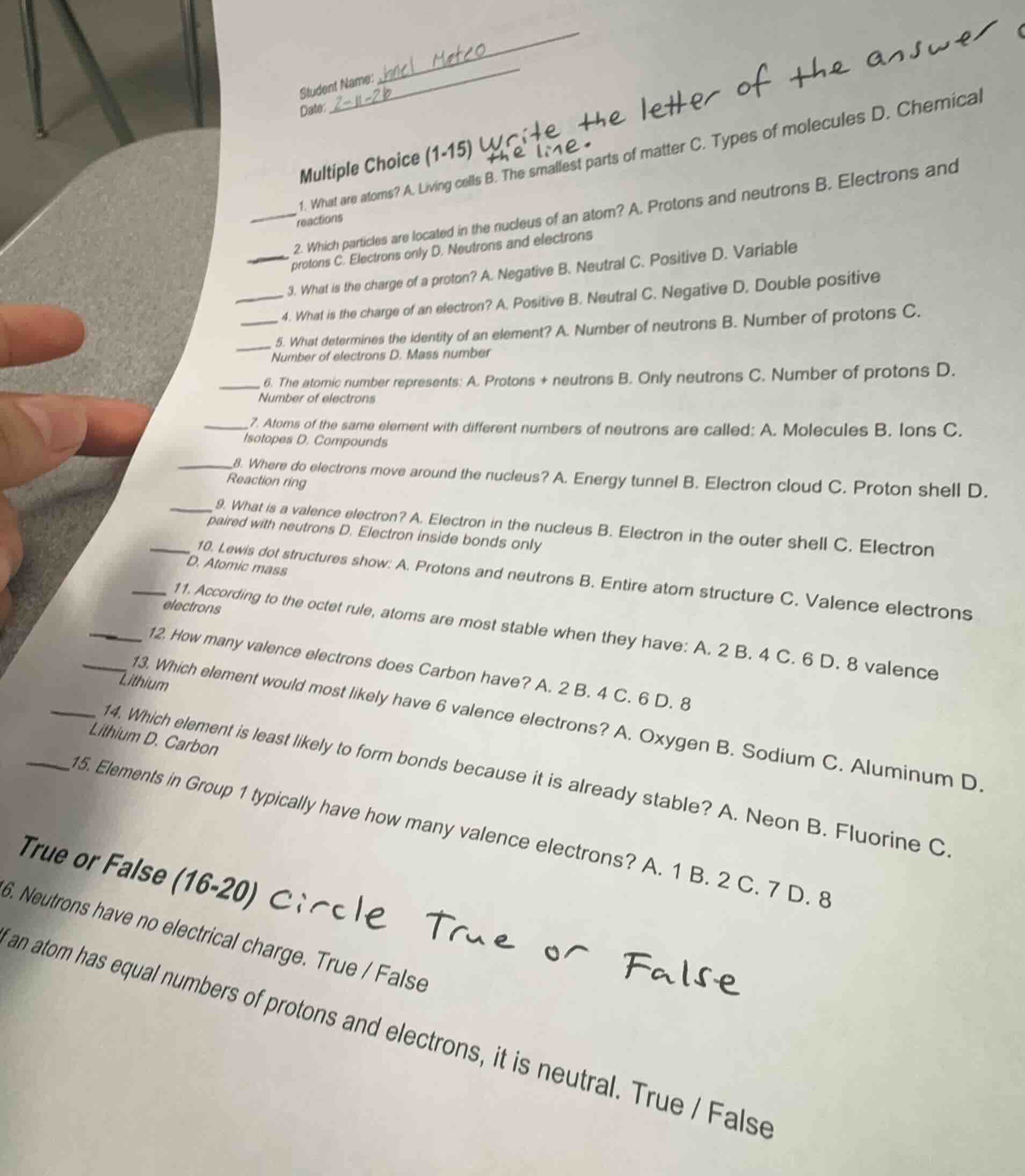
student name:date:multiple choice (1-15) write the letter of the answer on the line.1. what are atoms? a. living cells b. the smallest parts of matter c. types of molecules d. chemical reactions2. which particles are located in the nucleus of an atom? a. protons and neutrons b. electrons and protons c. electrons only d. neutrons and electrons3. what is the charge of a proton? a. negative b. neutral c. positive d. variable4. what is the charge of an electron? a. positive b. neutral c. negative d. double positive5. what determines the identity of an element? a. number of neutrons b. number of protons c. number of electrons d. mass number6. the atomic number represents: a. protons + neutrons b. only neutrons c. number of protons d. number of electrons7. atoms of the same element with different numbers of neutrons are called: a. molecules b. ions c. isotopes d. compounds8. where do electrons move around the nucleus? a. energy tunnel b. electron cloud c. proton shell d. reaction ring9. what is a valence electron? a. electron in the nucleus b. electron in the outer shell c. electron paired with neutrons d. electron inside bonds only10. lewis dot structures show: a. protons and neutrons b. entire atom structure c. valence electrons d. atomic mass11. according to the octet rule, atoms are most stable when they have: a. 2 b. 4 c. 6 d. 8 valence electrons12. how many valence electrons does carbon have? a. 2 b. 4 c. 6 d. 813. which element would most likely have 6 valence electrons? a. oxygen b. sodium c. aluminum d. lithium14. which element is least likely to form bonds because it is already stable? a. neon b. fluorine c. lithium d. carbon15. elements in group 1 typically have how many valence electrons? a. 1 b. 2 c. 7 d. 8true or false (16-20) circle true or false16. neutrons have no electrical charge. true / false17. if an atom has equal numbers of protons and electrons, it is neutral. true / false
- Atoms are the fundamental building blocks of matter.
- The atomic nucleus contains protons and neutrons.
- Protons carry a positive electrical charge.
- Electrons carry a negative electrical charge.
- The number of protons defines an element's identity.
- Atomic number equals the number of protons in an atom.
- Isotopes are same elements with different neutron counts.
- Electrons move in the electron cloud around the nucleus.
- Valence electrons occupy the atom's outermost shell.
- Lewis dot structures visualize valence electrons.
- The octet rule states 8 valence electrons mean stability.
- Carbon (Group 14) has 4 valence electrons.
- Oxygen (Group 16) has 6 valence electrons.
- Neon is a noble gas with a full stable valence shell.
- Group 1 elements have 1 valence electron.
- Neutrons are electrically neutral subatomic particles.
- Equal protons and electrons balance an atom's charge.

Snap & solve any problem in the app
Get step-by-step solutions on Sovi AI
Photo-based solutions with guided steps
Explore more problems and detailed explanations
Multiple Choice (1-15)
- B. The smallest parts of matter
- A. Protons and neutrons
- C. Positive
- C. Negative
- B. Number of protons
- C. Number of protons
- C. Isotopes
- B. Electron cloud
- B. Electron in the outer shell
- C. Valence electrons
- D. 8 valence electrons
- B. 4
- A. Oxygen
- A. Neon
- A. 1
True or False (16-17)
- True
- True