QUESTION IMAGE
Question
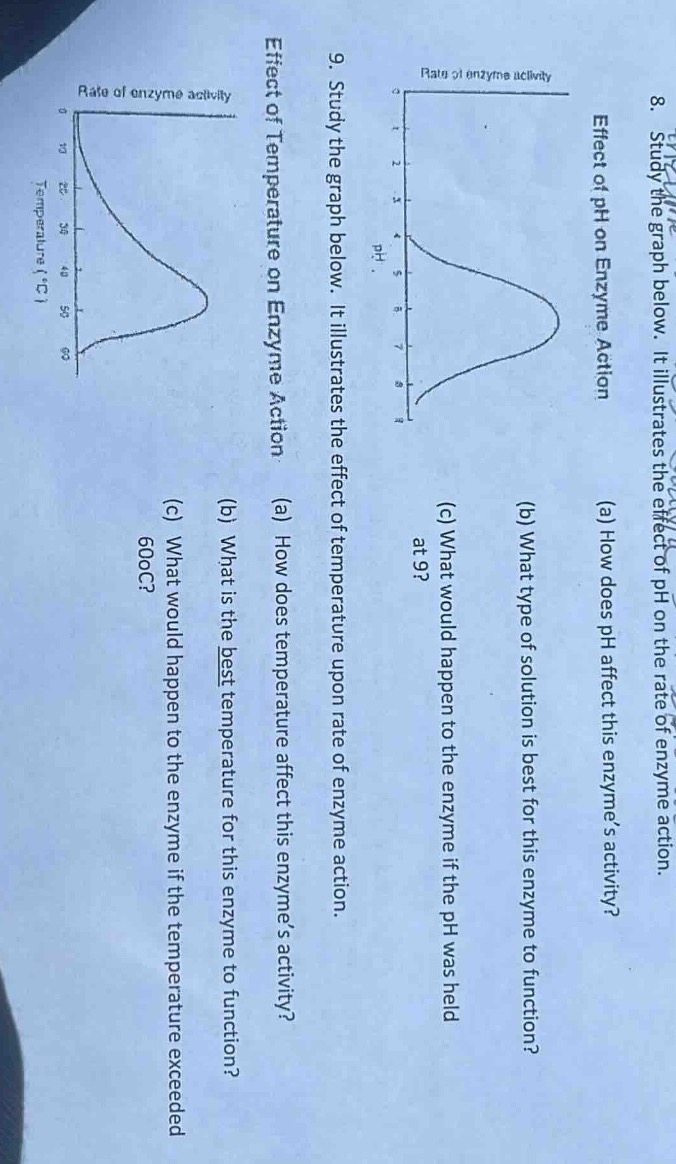
- study the graph below. it illustrates the effect of ph on the rate of enzyme action.
(a) how does ph affect this enzyme’s activity?
(b) what type of solution is best for this enzyme to function?
(c) what would happen to the enzyme if the ph was held at 9?
- study the graph below. it illustrates the effect of temperature upon rate of enzyme action.
effect of temperature on enzyme action
(a) how does temperature affect this enzyme’s activity?
(b) what is the best temperature for this enzyme to function?
(c) what would happen to the enzyme if the temperature exceeded 60°c?
Question 8 (Effect of pH on Enzyme Action)
(a) How does pH affect this enzyme’s activity?
Enzyme activity has an optimal pH range. Outside this range (too acidic or too alkaline), activity decreases. From the graph, the enzyme’s activity increases to an optimal pH, then decreases as pH moves away from that optimal point.
The best solution (in terms of pH) is the one with the pH at which enzyme activity is maximum (optimal pH). From the graph, identify the pH with the highest rate of enzyme activity—this pH’s solution (acidic, neutral, or alkaline) is best. Assuming the peak is around a specific pH (e.g., if the graph peaks at a slightly acidic or neutral/alkaline pH), the solution with that pH is optimal.
pH 9 is likely outside the enzyme’s optimal range (if the graph shows activity dropping at pH 9). Enzymes are sensitive to pH; at non - optimal pH (like 9, if it’s too alkaline), the enzyme’s active site may denature or change shape, reducing its activity or causing it to stop functioning effectively.

Snap & solve any problem in the app
Get step-by-step solutions on Sovi AI
Photo-based solutions with guided steps
Explore more problems and detailed explanations
The enzyme’s activity increases to an optimal pH (where it’s highest) and then decreases as pH deviates (becomes more acidic or alkaline) from that optimal pH.