QUESTION IMAGE
Question
study guide unit 3 test: genetics
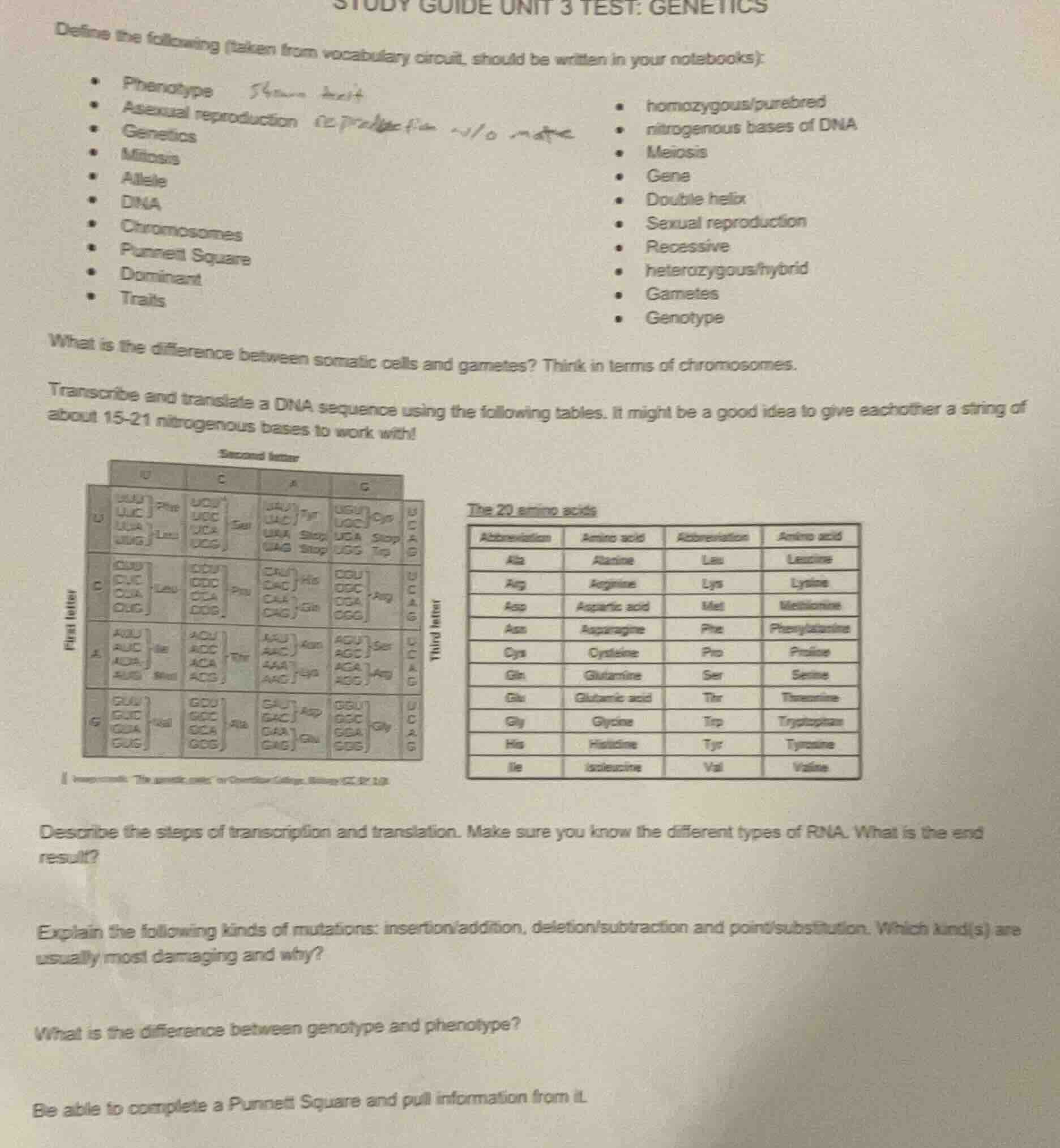
define the following (taken from vocabulary circuit, should be written in your notebooks):
- phenotype
- asexual reproduction
- genetics
- mitosis
- allele
- dna
- chromosomes
- punnett square
- dominant
- traits
- homozygous/purebred
- nitrogenous bases of dna
- meiosis
- gene
- double helix
- sexual reproduction
- recessive
- heterozygous/hybrid
- gametes
- genotype
what is the difference between somatic cells and gametes? think in terms of chromosomes.
transcribe and translate a dna sequence using the following tables. it might be a good idea to give eachother a string of about 15-21 nitrogenous bases to work with!
tables for genetic code and 20 amino acids are included
describe the steps of transcription and translation. make sure you know the different types of rna. what is the end result?
explain the following kinds of mutations: insertion/addition, deletion/subtraction and point/substitution. which kind(s) are usually most damaging and why?
what is the difference between genotype and phenotype?
be able to complete a punnett square and pull information from it.
Vocabulary Definitions
- Phenotype: Observable physical/behavioral traits of an organism, determined by genotype and environment.
- Asexual reproduction: Reproduction with one parent, offspring are genetically identical to parent.
- Genetics: Study of genes, heredity, and genetic variation in organisms.
- Mitosis: Cell division producing 2 identical diploid somatic cells for growth/repair.
- Allele: Alternative form of a gene at a specific chromosome locus.
- DNA: Double-stranded nucleic acid carrying genetic instructions for development/function.
- Chromosomes: Thread-like structures in cells, made of DNA and proteins, carrying genes.
- Punnett Square: Diagram predicting genetic outcomes of a cross between two organisms.
- Dominant: Allele/trait expressed when present (masks recessive alleles).
- Traits: Distinguishing characteristics of an organism, passed or acquired.
- Homozygous/purebred: Having two identical alleles for a given gene.
- Nitrogenous bases of DNA: Adenine (A), Thymine (T), Cytosine (C), Guanine (G); form base pairs.
- Meiosis: Cell division producing 4 non-identical haploid gametes for sexual reproduction.
- Gene: Segment of DNA encoding a specific protein/trait.
- Double helix: Twisted-ladder 3D structure of DNA.
- Sexual reproduction: Reproduction with two parents, offspring have unique genetic mix.
- Recessive: Allele/trait expressed only when homozygous.
- Heterozygous/hybrid: Having two different alleles for a given gene.
- Gametes: Haploid sex cells (sperm/egg) for sexual reproduction.
- Genotype: Genetic makeup of an organism, set of alleles for traits.
Somatic Cells vs Gametes (Chromosomes)
Somatic cells are body cells with a full diploid (2n) set of paired chromosomes. Gametes are sex cells with a haploid (n) set of unpaired chromosomes, half the number of somatic cells.
Transcription & Translation (Example with DNA sequence: TACGGTATCGAATTC)
Transcription:
- DNA template strand: $3'$-TACGGTATCGAATTC-$5'$
- mRNA synthesized (A-U, T-A, C-G, G-C): $5'$-AUGCCAUCGCUUAAG-$3'$
Translation:
- Split mRNA into codons: AUG, CCA, UCG, CUU, AAG
- Use codon table to find amino acids:
- AUG = Methionine (Met)
- CCA = Proline (Pro)
- UCG = Serine (Ser)
- CUU = Leucine (Leu)
- AAG = Lysine (Lys)
- Resulting polypeptide: Met-Pro-Ser-Leu-Lys
Steps of Transcription & Translation
Transcription:
- Initiation: RNA polymerase binds to DNA promoter region, unwinds DNA.
- Elongation: RNA polymerase synthesizes mRNA using complementary base pairing (U replaces T).
- Termination: RNA polymerase reaches stop sequence, mRNA is released.
Types of RNA: mRNA (carries genetic code), tRNA (transfers amino acids), rRNA (makes ribosome structure).
End result: Single-stranded mRNA carrying genetic instructions from DNA.
Translation:
- Initiation: mRNA binds to ribosome, tRNA with start codon (AUG) attaches.
- Elongation: tRNAs bring matching amino acids, ribosome links them into a polypeptide.
- Termination: Ribosome reaches stop codon, polypeptide is released.
End result: Functional polypeptide/protein.
Mutations
- Insertion/addition: Extra nucleotide(s) inserted into DNA, causes a frameshift (shifts all downstream codons).
- Deletion/subtraction: Nucleotide(s) removed from DNA, causes a frameshift (shifts all downstream codons).
- Point/substitution: Single nucleotide replaced with another; may change one amino acid, or have no effect (silent mut…

Snap & solve any problem in the app
Get step-by-step solutions on Sovi AI
Photo-based solutions with guided steps
Explore more problems and detailed explanations
Vocabulary Definitions
- Phenotype: Observable physical/behavioral organism traits
- Asexual reproduction: Single-parent, genetically identical offspring
- Genetics: Study of genes, heredity, and genetic variation
- Mitosis: Diploid somatic cell division for growth/repair
- Allele: Alternative form of a specific gene
- DNA: Double-stranded genetic instruction molecule
- Chromosomes: DNA-protein structures carrying genes
- Punnett Square: Genetic cross outcome prediction diagram
- Dominant: Expressed allele/trait (masks recessive)
- Traits: Distinguishing organism characteristics
- Homozygous/purebred: Two identical alleles for a gene
- Nitrogenous bases of DNA: A, T, C, G (form base pairs)
- Meiosis: Haploid gamete production for sexual reproduction
- Gene: DNA segment encoding a protein/trait
- Double helix: Twisted-ladder 3D DNA structure
- Sexual reproduction: Two-parent, genetically unique offspring
- Recessive: Expressed only when homozygous
- Heterozygous/hybrid: Two different alleles for a gene
- Gametes: Haploid sex cells (sperm/egg)
- Genotype: Organism's genetic allele set
Somatic vs Gamete Chromosomes
Somatic cells: Diploid (2n, paired chromosomes); Gametes: Haploid (n, unpaired chromosomes, half the count)
Transcription & Translation Example
DNA: TACGGTATCGAATTC → mRNA: AUGCCAUCGCUUAAG → Polypeptide: Met-Pro-Ser-Leu-Lys
Transcription & Translation Steps
Transcription: 1. Initiation (RNA polymerase binds DNA) 2. Elongation (mRNA synthesis) 3. Termination (mRNA release); RNA types: mRNA, tRNA, rRNA; End result: mRNA
Translation: 1. Initiation (mRNA-ribosome binding) 2. Elongation (polypeptide building) 3. Termination (polypeptide release); End result: Functional protein
Mutations
Insertion: Extra nucleotides, frameshift; Deletion: Lost nucleotides, frameshift; Point: Single nucleotide swap, may alter one amino acid. Insertion/deletion are most damaging: frameshifts disrupt nearly all downstream amino acids, producing non-functional proteins.
Genotype vs Phenotype
Genotype: Genetic allele makeup (e.g., $Bb$); Phenotype: Observable trait from genotype/environment (e.g., brown eyes)
Punnett Square Example (Bb x Bb)
Genotypic ratio: 1 BB : 2 Bb : 1 bb; Phenotypic ratio: 3 brown eyes : 1 blue eyes