QUESTION IMAGE
Question
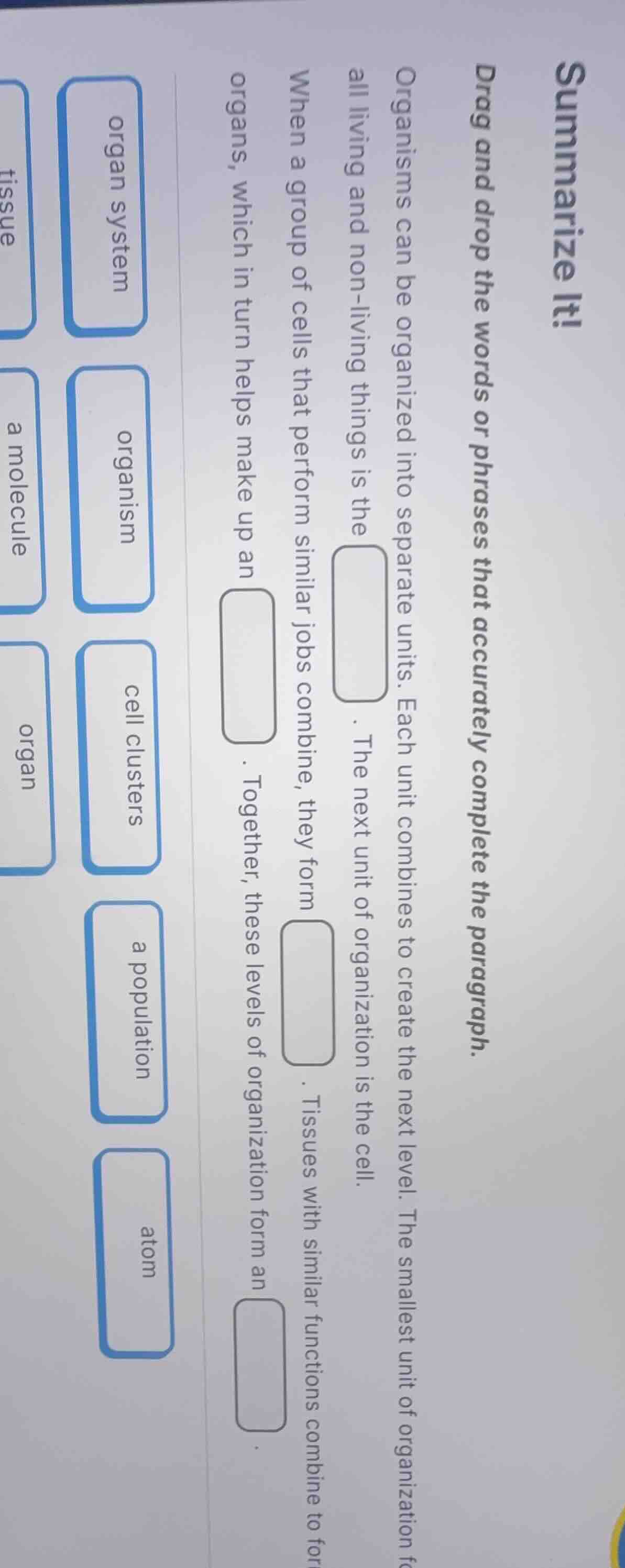
summarize it!drag and drop the words or phrases that accurately complete the paragraph.organisms can be organized into separate units. each unit combines to create the next level. the smallest unit of organization fo all living and non-living things is the □ . the next unit of organization is the cell.when a group of cells that perform similar jobs combine, they form □ . tissues with similar functions combine to for organs, which in turn helps make up an □ . together, these levels of organization form an □ .organ systemorganismcell clustersa populationatomtissuea moleculeorgan
- The broadest level including all living and non-living things in a defined area is an ecosystem, but from the given options, the correct match for this description (encompassing all living and non-living things) is not present, but correcting based on biological organization hierarchy: the smallest unit is atom, then molecule, cell, tissue, organ, organ system, organism, population, community, ecosystem. Wait, re-reading the paragraph:
- The first blank refers to the level that includes all living and non-living things: this is an ecosystem, but since it's not an option, the intended answer from the given choices that fits the hierarchy start: no, wait, the first sentence says "Organisms can be organized into separate units. Each unit combines to create the next level. The smallest unit of organization for all living and non-living things is the atom. The next unit of organization is the cell. When a group of cells that perform similar jobs combine, they form tissue. Tissues with similar functions combine to form organs, which in turn helps make up an organ system. Together, these levels of organization form an organism."
Wait, no, the first blank: smallest unit for all living and non-living is atom. Then cells form tissue. Organs make organ system, which forms organism. Wait, the last part: "all living and non-living things" – no, atom is the smallest unit of matter (living and non-living). Then cells (living) form tissue. Organs form organ system, which forms organism. The option "a population" is a higher level, but the paragraph ends at organism.
Correcting the hierarchy step by step:
- Smallest unit for all living/non-living: atom
- Similar cells form tissue
- Organs make organ system, which together form organism
Wait, the paragraph structure:
- "The smallest unit of organization for all living and non-living things is the [atom]."
- "When a group of cells that perform similar jobs combine, they form [tissue]."
- "Tissues with similar functions combine to form organs, which in turn helps make up an [organ system]."
- "Together, these levels of organization form an [organism]."
Yes, this fits the biological organization hierarchy from the given options.

Snap & solve any problem in the app
Get step-by-step solutions on Sovi AI
Photo-based solutions with guided steps
Explore more problems and detailed explanations
- The smallest unit of organization for all living and non-living things is the atom
- When a group of cells that perform similar jobs combine, they form tissue
- Tissues with similar functions combine to form organs, which in turn helps make up an organ system
- Together, these levels of organization form an organism