QUESTION IMAGE
Question
synthesis & viral hijacking practice
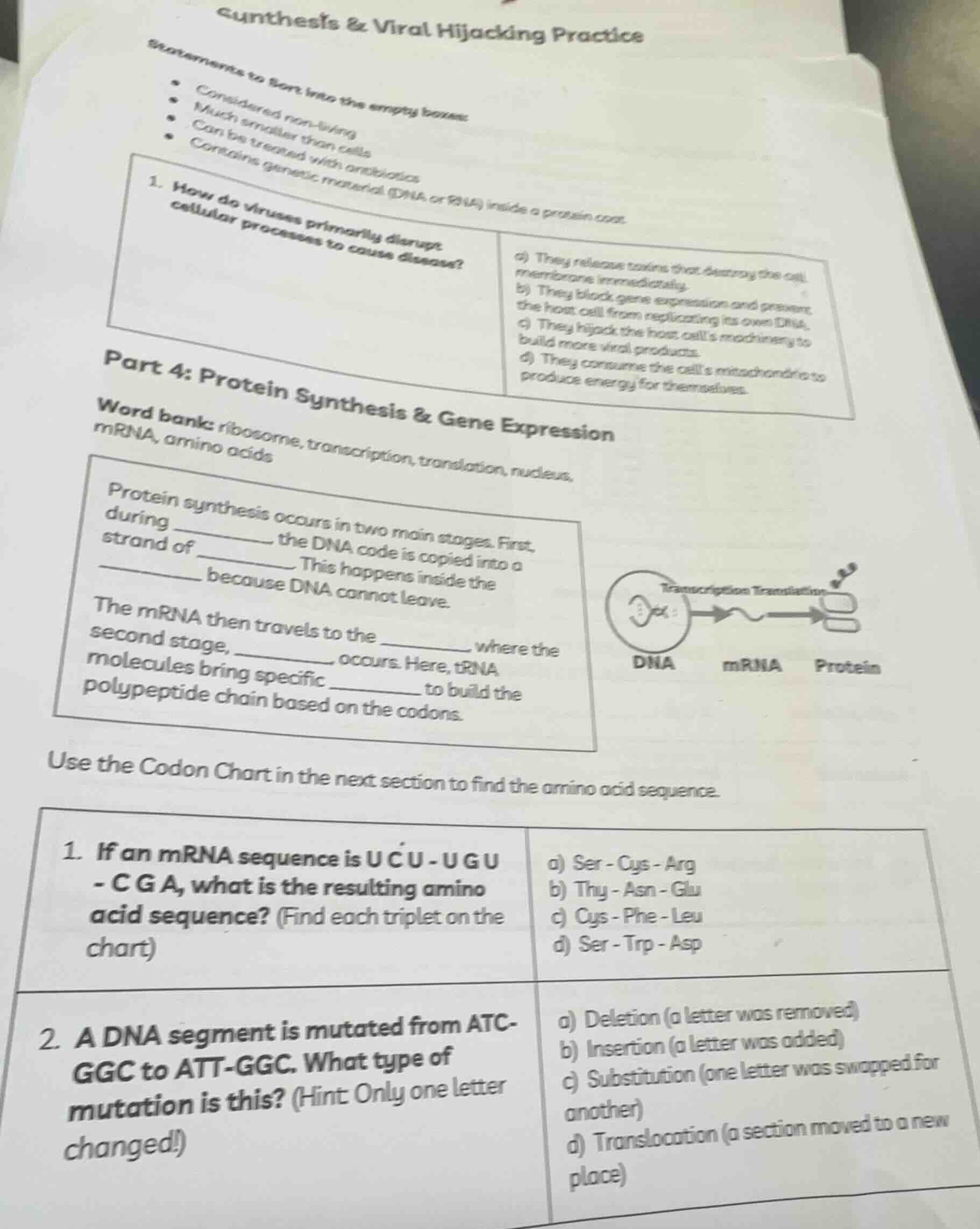
statements to sort into the empty boxes:
- considered non-living
- much smaller than cells
- can be treated with antibiotics
- contains genetic material (dna or rna) inside a protein coat.
- how do viruses primarily disrupt cellular processes to cause disease?
a) they release toxins that destroy the cell membrane immediately.
b) they block gene expression and prevent the host cell from replicating its own dna.
c) they hijack the host cells machinery to build more viral products.
d) they consume the cells mitochondria to produce energy for themselves.
part 4: protein synthesis & gene expression
word bank: ribosome, transcription, translation, nucleus, mrna, amino acids
protein synthesis occurs in two main stages. first, during ________ the dna code is copied into a strand of ______. this happens inside the ________ because dna cannot leave.
the mrna then travels to the ________ where the second stage, ______ occurs. here, trna molecules bring specific ________ to build the polypeptide chain based on the codons.
use the codon chart in the next section to find the amino acid sequence.
- if an mrna sequence is ucu-ugu - cga, what is the resulting amino acid sequence? (find each triplet on the chart)
a) ser - cys - arg
b) thy - asn - glu
c) cys - phe - leu
d) ser - trp - asp
- a dna segment is mutated from atc-ggc to att-ggc. what type of mutation is this? (hint: only one letter changed!)
a) deletion (a letter was removed)
b) insertion (a letter was added)
c) substitution (one letter was swapped for another)
d) translocation (a section moved to a new place)
Step1: Solve virus disruption question
Viruses take over host cell machinery to replicate.
Step2: Fill protein synthesis blanks
Match terms to protein synthesis stages:
- First stage: transcription (DNA to mRNA)
- Copied into mRNA
- Occurs in nucleus (DNA cannot leave)
- mRNA goes to ribosome
- Second stage: translation
- tRNA brings amino acids
Step3: Solve mRNA to amino acids
Use codon chart:
- UCU = Ser, UGU = Cys, CGA = Arg
Step4: Identify DNA mutation type
Single nucleotide (C→T) swapped; this is substitution.

Snap & solve any problem in the app
Get step-by-step solutions on Sovi AI
Photo-based solutions with guided steps
Explore more problems and detailed explanations
Virus Disruption Question:
c) They hijack the host cell's machinery to build more viral products.
Protein Synthesis Fill-in-the-Blanks:
Protein synthesis occurs in two main stages. First, during transcription, the DNA code is copied into a strand of mRNA. This happens inside the nucleus because DNA cannot leave.
The mRNA then travels to the ribosome, where the second stage, translation, occurs. Here, tRNA molecules bring specific amino acids to build the polypeptide chain based on the codons.
Amino Acid Sequence Question:
a) Ser - Cys - Arg
Mutation Type Question:
c) Substitution (one letter was swapped for another)